Drilling a reliable water well is a complex engineering feat that requires balancing mechanical force with unpredictable geological variables. Even with the most advanced equipment, subsurface conditions can change in an instant, leading to costly delays or borehole failure.
Field engineers and rig operators must anticipate these hurdles before they occur. Understanding the physics of the borehole and the limitations of the drilling string is essential for maintaining project timelines and ensuring water quality.
This guide analyzes the most frequent water well drilling problems and provides technical solutions based on industry best practices and hydraulic engineering principles.
The Dynamics of Lost Circulation
Lost circulation occurs when drilling fluid flows into the formation instead of returning up the annulus. This is one of the most common water well drilling problems encountered in fractured rock or highly permeable gravel layers.
When the hydrostatic pressure of the mud column exceeds the formation pressure, the fluid escapes. This leads to a loss of bit cooling and poor cuttings removal. Without the upward flow of fluid, drill cuttings settle around the bit, significantly increasing the risk of a stuck pipe.
To solve this, operators often introduce Lost Circulation Materials (LCM) such as bentonite chips, walnut shells, or specialized polymers. These materials bridge the fractures and create a filter cake on the borehole wall. In extreme cases, switching from rotary mud drilling to Air Hammer (DTH) drilling can bypass the need for fluid circulation entirely.
Managing Borehole Instability and Caving
Unconsolidated formations, such as loose sand or swelling clays, often lead to borehole collapse. This instability is usually caused by insufficient fluid pressure or improper mud chemistry.
Caving occurs when the mechanical strength of the surrounding soil is lower than the stress exerted by the drilling process. If the drilling fluid density is too low, the hole “sloughs” or caves in. Conversely, swelling clays react chemically with water-based fluids, expanding into the borehole and seizing the drill string.
Technical Solutions for Stability:
- Weighted Drilling Fluids: Increase mud density using barite to provide outward pressure against the borehole walls.
- Polymer Additives: Use PHPA (Partially Hydrolyzed Polyacrylamide) to encapsulate clay particles and prevent hydration.
- Temporary Casing: In high-risk zones, advancing a temporary steel casing while drilling provides a physical barrier against collapse.
Troubleshooting Stuck Pipe Scenarios
A stuck pipe is a critical failure that can result in the loss of the drill string and the borehole itself. This problem generally falls into two categories: differential sticking and mechanical sticking.
Differential sticking happens when the drill string comes into contact with a thick filter cake in a permeable zone. The pressure difference between the wellbore and the formation “pins” the pipe against the wall. Mechanical sticking occurs due to the accumulation of cuttings (poor hole cleaning) or hole collapse.
Recovery Procedures:
- Spotting Fluids: Injecting lubricants or acid around the stuck zone to reduce friction.
- Working the Pipe: Applying controlled tension and torque, often using a “jar” tool to deliver high-impact mechanical shocks to break the bond.
- Back-off Operations: If the pipe remains stuck, operators may use a “washover” pipe to drill out the debris surrounding the stuck section.
Equipment Fatigue and Bit Wear
The efficiency of a drilling project is directly tied to the condition of the drilling tools. Hard rock formations, such as granite or basalt, cause rapid abrasive wear on drill bits and stabilizers.
Excessive vibration (bit bounce) and high heat are the primary causes of premature tool failure. When a bit loses its gauge, the resulting hole is undersized, making it difficult to install well casing or lower a new bit into the hole.
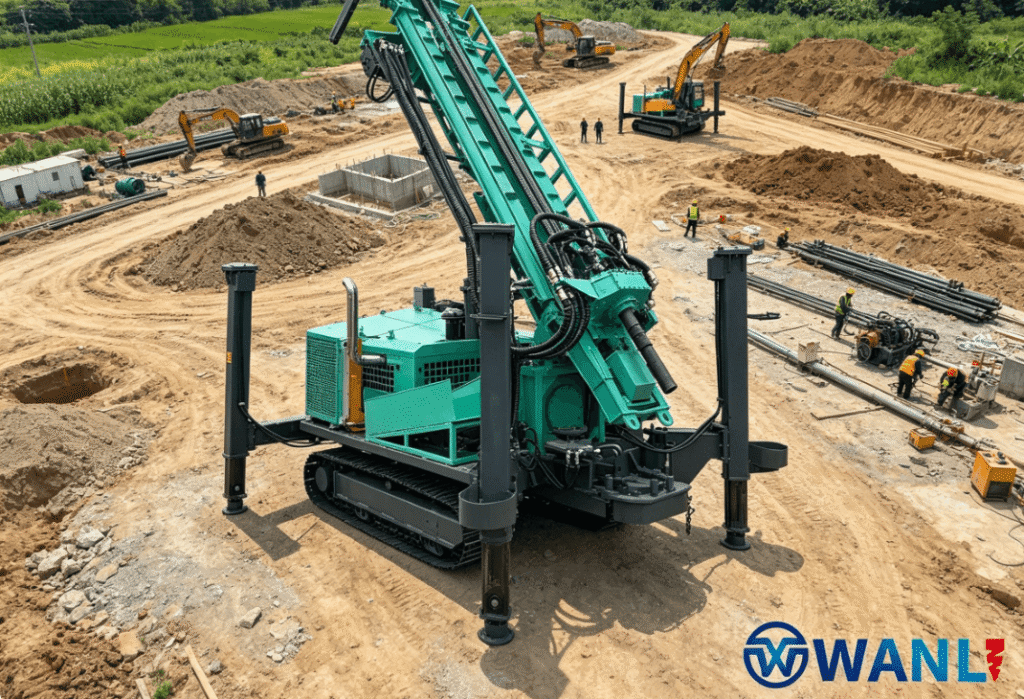
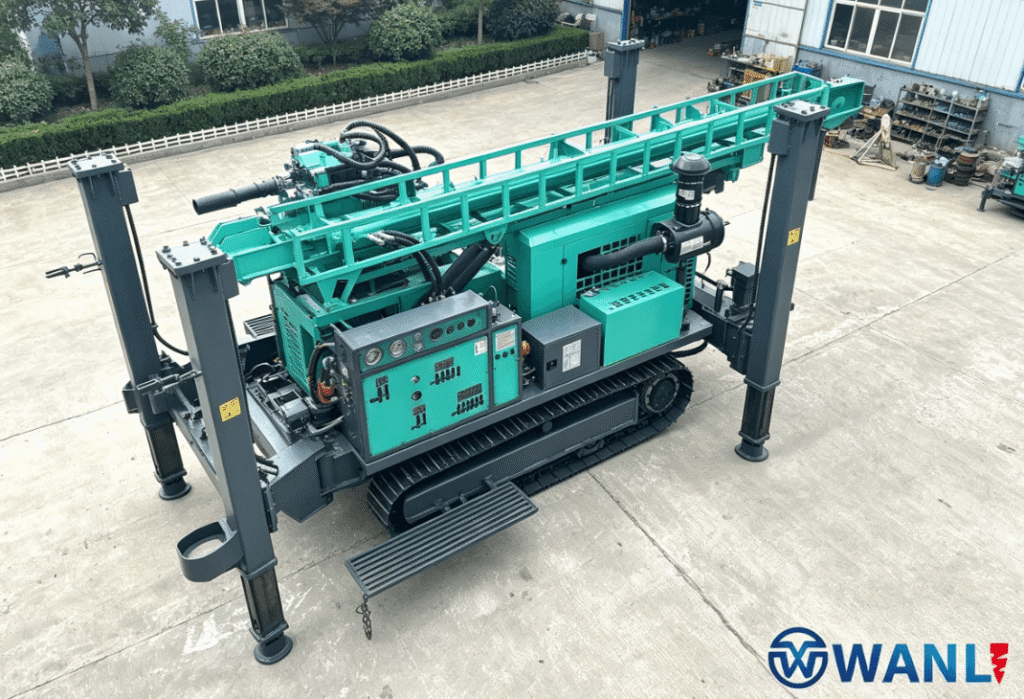
Modern drilling rigs, such as the high-torque crawler units designed for deep-hole applications, mitigate this by providing stable, consistent rotational speed. Maintaining the correct Weight on Bit (WOB) and Revolutions Per Minute (RPM) is critical. Operators should monitor the “rate of penetration” (ROP); a sudden drop usually indicates a dulled bit or a change in formation hardness.
Quick Reference: Drilling Problems and Solutions
| Problem | Primary Cause | Immediate Technical Solution |
| Lost Circulation | Fractured or porous strata | Add LCM (Lost Circulation Materials) or switch to air drilling. |
| Stuck Pipe | Cuttings buildup or differential pressure | Circulate at high velocity; apply “jarring” force; use lubricants. |
| Borehole Caving | Unconsolidated sand/gravel | Increase mud viscosity; use temporary casing or stabilizers. |
| Crooked Hole | High WOB or dipping formations | Reduce Weight on Bit (WOB); use stabilizers and stiff drill collars. |
| Slow Penetration | Bit wear or improper bit type | Replace bit; match bit geometry (Tricone vs. DTH) to rock hardness. |
Preventing Hole Deviation
A “crooked hole” or hole deviation occurs when the drill bit wanders from its vertical path. This is often caused by the bit following the path of least resistance in dipping rock layers or by applying too much downward pressure on a flexible drill string.
Deviation creates high-torque environments and makes casing installation nearly impossible. To maintain verticality, engineers use “stiff” bottom-hole assemblies (BHA) including heavy drill collars and stabilizers. These components use gravity and mechanical rigidity to keep the bit pointing downward. Periodic “inclination surveys” are essential for deep wells to ensure the project remains within tolerance.
The Role of Rig Selection in Problem Mitigation
The ability to solve onsite problems is often limited by the technical specifications of the drilling rig. A rig with insufficient “pull-back” capacity cannot recover a stuck pipe, and a rig with a low-torque motor cannot penetrate hard lithologies efficiently.
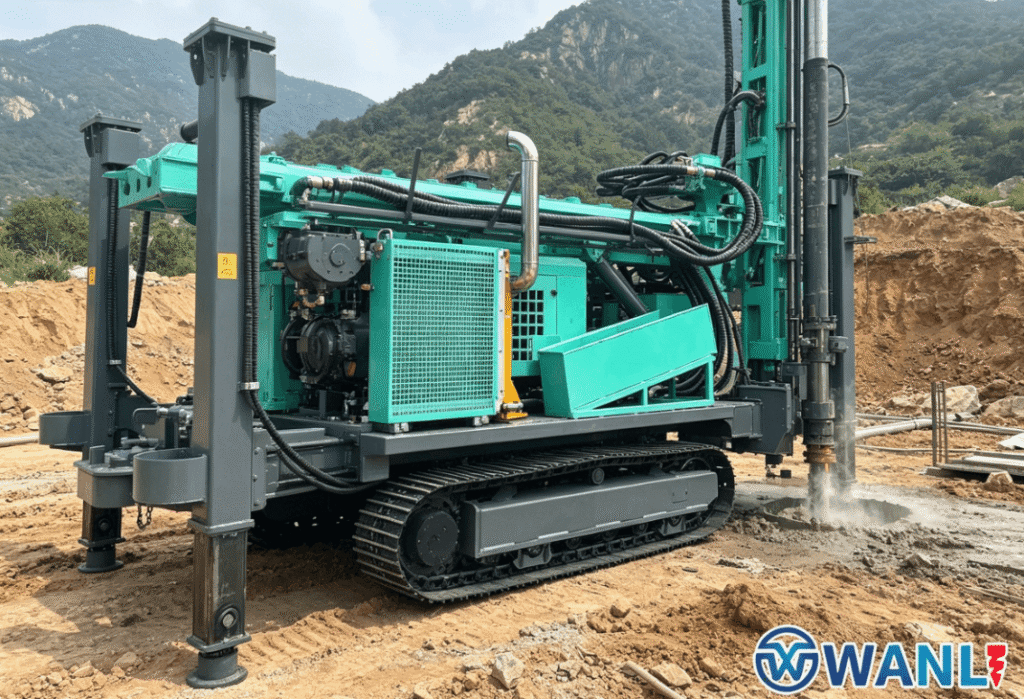
For diverse geological environments, versatile rigs—ranging from portable mountain-access units to heavy-duty truck-mounted systems—allow for the switching of drilling methods (e.g., from mud rotary to DTH hammer) as conditions dictate. Choosing equipment with robust hydraulic systems and automated cooling ensures that the machine can handle the high-duty cycles required to push through difficult zones.Conclusion: Proactive Borehole Management
Successful water well drilling is defined by the ability to anticipate subsurface behavior. By monitoring fluid returns, observing ROP changes, and maintaining strict mud chemistry, most common water well drilling problems can be mitigated before they escalate into catastrophic failures.
Technical proficiency combined with the right mechanical assets ensures that every well reaches its target depth with structural integrity and maximum water yield.
FAQ
1. What is the most common cause of a dry well?
A dry well is often caused by poor site selection or failing to drill deep enough to reach a productive aquifer. However, technical issues like “skin damage” (where drilling mud clogs the formation pores) can also prevent water from entering a well that was otherwise correctly positioned.
2. How do I know if my drill bit is worn out without pulling the string?
Operators monitor the Rate of Penetration (ROP). If the ROP drops significantly while the RPM and WOB remain constant, the bit teeth or buttons are likely dulled. Unusual vibrations in the drill string can also indicate irregular wear or lost cones on a tricone bit.
3. Why is drilling mud so important in water well projects?
Drilling mud serves three vital functions: it cools the drill bit, carries cuttings to the surface, and provides hydrostatic pressure to prevent the borehole walls from collapsing.
4. Can air drilling be used in all soil types?
No. Air drilling (using a DTH hammer) is exceptionally efficient in hard rock but is generally unsuitable for loose, water-saturated sands or thick clays, as the hole will collapse without the support of drilling fluid or casing.
5. What is “surging” a well?
Surging is a development technique used after drilling is complete. It involves moving a plunger or using compressed air to force water in and out of the formation. This clears out fine sediments and “drilling skin,” significantly increasing the well’s flow rate.
Reference Sources
- National Ground Water Association (NGWA): Standards for water well construction and troubleshooting protocols.
- ASTM D5092: Standard Practice for Design and Installation of Groundwater Monitoring Wells.
- American Petroleum Institute (API): Specifications for drilling fluid materials and drill pipe tolerances.
- International Society of Soil Mechanics and Geotechnical Engineering (ISSMGE): Guidelines on borehole stability in unconsolidated strata.