Raising boring is only as dependable as the rig behind it and the standard it is built to. For mining houses and underground engineering contractors planning ventilation shafts, filling shafts, chute shafts, ore-pass shafts, exploratory shafts, or blind shafts, the procurement question in 2026 is no longer simply about which raise boring machine carries the biggest torque number in its brochure. It is whether the rig conforms to GB/T 12761-2025, the national standard for raise-boring machines that came into effect on December 1, 2025, and whether the supplier treats raise-boring as an engineered system rather than a single piece of hardware. Shandong Wanli Construction Machinery Co., Ltd. answers this need with its Hydraulic Raise Borer, offered through Wanli’s direct factory channel and configured to project-specific shaft requirements.
Why GB/T 12761-2025 Redefines the Raise Boring Conversation
The national standard GB/T 12761-2025 was released on May 30, 2025, and came into effect on December 1, 2025, completely replacing the 2010 edition. Issued by the State Administration for Market Regulation and the Standardization Administration of the People’s Republic of China and administered by the National Technical Committee for Standardization of Mining Machinery (SAC/TC 88), the standard applies to raise-boring machines used in the construction of ventilation shafts, filling shafts, chute shafts, ore-pass shafts, exploratory shafts, and blind shafts in underground mines and other engineering projects.
The 2025 revision introduces substantial changes that every procurement team must absorb before issuing an RFQ:
- Expanded product scope: New models, including remote-controlled drilling rigs, crawler drilling rigs, and tire self-propelled drilling rigs, are now explicitly covered
- Strengthened safety requirements: The number of safety control clauses increased from 12 to 17
- New mandatory provisions: Fire extinguisher configuration, warning signs, and diesel engine exhaust emissions
- Emission limits: For diesel-engine-driven rigs, NO ≤ 900×10⁻⁶ and CO ≤ 1500×10⁻⁶
- Updated noise requirements and nine newly added test methods: track average ground pressure, climbing ability, braking performance, lighting, cab inspection, noise, and diesel engine exhaust emissions
- Changed technical parameters: Type and basic parameters, environmental adaptability, and maximum thrust/pull test methods were all revised
For B2B buyers, the implication is direct: any raise boring rig quoted for a project in or after December 2025 must demonstrate conformity to GB/T 12761-2025. A supplier offering equipment built to the superseded 2010 paradigm introduces compliance and residual risk into the project.
The Raise Boring Process: Engineering Discipline Over Marketing Claims
Raising boring is a well-established method for creating shafts in the mining, hydropower, and tunnel industries. The process executes in two passes:
- Pilot hole drilling: A small-diameter pilot hole is drilled from the upper level down to the lower level
- Upward reaming: After breakthrough, a large reaming head is attached at the bottom and pulled upward as it cuts the rock
Epiroc—whose Robbins rigs have set the industry benchmark for more than fifty years—explains that this method creates smooth-walled raises typically used for ventilation, ore passes, service shafts, and escape ways. The effectiveness of the process rests on the combination of torque and thrust, the two engineering variables that define any credible raise boring machine.
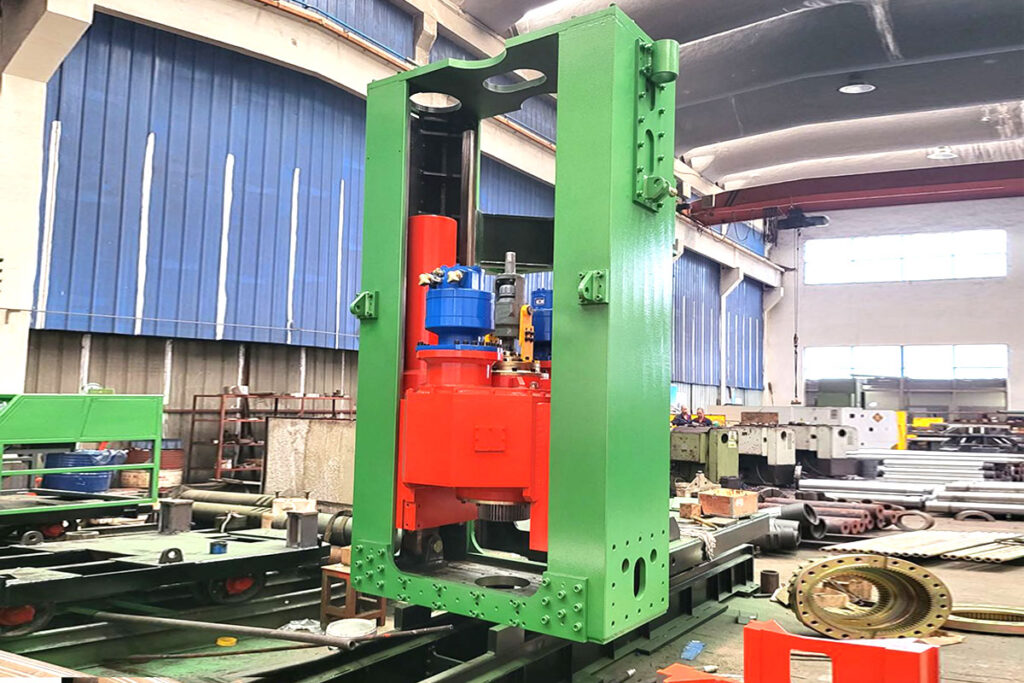
Wanli’s Hydraulic Raise Borer is purpose-positioned for exactly this two-pass process. As a full-hydraulic raise boring machine configured to project-specific parameters, it is offered to mining and tunnel construction clients who require GB/T 12761-2025-aligned equipment sourced through a responsive, factory-direct channel.
How the Market’s Raised Boring Rigs Compare
For procurement managers, hard-parameter comparison reveals the market landscape. The following tables contrast publicly documented competitor rigs with the considerations that frame a Wanli Hydraulic Raise Borer procurement.
Capability Positioning Across Documented Rigs
| Dimension | Epiroc Robbins 92R | Epiroc Robbins 123RH (2018) | TRB Rhino 2000 (2016) | Wanli Hydraulic Raise Borer |
|---|---|---|---|---|
| Raise diameter. | 2.4 – 6.0 m | Ø0.35 – 6.5 m | Ø0.35 – 5.5 m | Configured to project |
| Raise length | Up to 1,100 m | Up to 1,100 m | Up to 800 m | Configured to project |
| Reaming torque | Driven by a 500 kW hydraulic motor | 540 kNm | 460 kNm | Configured to project |
| Drive power | 500 kW hydraulic | 706 kVA, 400V, 50 Hz | 600 kVA, 400V, 50 Hz | Configured to site |
| Modular transport | Yes, the gearbox is in a removable barrel. | Crawler, 32,000 kg | Crawler, 24,100 kg | Optimized for transport |
| Standard compliance | Pre-2025 OEM framework | Pre-2025 | Pre-2025 | GB/T 12761-2025 (effective Dec 1, 2025) |
The Wanli Hydraulic Raise Borer does not chase the absolute maximum envelope of an Epiroc Robbins 92R or 123RH. Instead, it is positioned as a project-matched solution sourced through a factory-direct manufacturer. For mining operations that require GB/T 12761-2025 conformity, responsive manufacturer communication, and a rig configured to their specific shaft diameter and depth, Wanli’s offering occupies a strategically rational position.
Standards Compliance Framework
| Requirement | GB/T 12761-2025 (effective Dec 1, 2025) | Procurement implication |
|---|---|---|
| Applicable models | Remote-controlled, crawler, and self-propelled tire rigs | The rig must fit one of these categories. |
| Safety clauses | 17 items (increased from 12) | The supplier must document conformity. |
| Fire extinguisher | Mandatory | Must be present on rig |
| Warning signs | Mandatory | Must be present on rig |
| Diesel exhaust NO | ≤ 900×10⁻⁶ | Must be tested and verified |
| Diesel exhaust CO | ≤ 1500×10⁻⁶ | Must be tested and verified |
| Noise | Updated thresholds with test method | Must be tested per Clause 7.9 |
| Test methods | 9 new items added (ground pressure, climbing, braking, lighting, cab, noise, emissions) | Type inspection per Chapter 8 |
This table defines the procurement filter for any raise boring rig purchased in or after December 2025. Wanli’s Hydraulic Raise Borer is offered within this framework, meaning the procurement conversation centers on how rig configuration, safety interlocks, and emission profile align with the 2025 regulatory present.
Application Scenario Mapping
| Shaft type (per GB/T 12761-2025 scope) | Wanli Hydraulic Raise Borer Fit |
|---|---|
| Ventilation shafts | Configured per project |
| Filling shafts | Configured per project |
| Chute / ore-pass shafts | Configured per project |
| Exploratory shafts | Configured per project |
| Blind shafts | Configured per project |
| Drill angle | 45° – 90° from horizontal (typical) |
GB/T 12761-2025 explicitly applies to ventilation shafts, filling shafts, chute shafts, ore-pass shafts, exploratory shafts, and blind shafts in underground mines and other engineering projects. The Wanli Hydraulic Raise Borer is specified against this full range of applications, with the manufacturer configuring the rig to the project’s borehole design, rock conditions, and site power availability.
The Wanli Advantage: A Multi-Category Drilling Rig Manufacturer
What sets Wanli apart in the rising boring market is not a single maximum specification—it is the company’s position as a comprehensive drilling rig manufacturer. Wanli’s product portfolio spans:
- RC Reverse Circulation Drilling Rigs
- Vehicle-Mounted Drilling Rigs
- Down-the-Hole Drilling Rigs
- Coring Drilling Rigs
- Water Well Drilling Rigs
- Hydraulic Raise Borer (including the Anti Well series)
This cross-category engineering depth means that when a client procures a hydraulic raise borer from Wanli, they are working with a manufacturer that understands drilling hydraulics, mast structures, power units, and crawler mobility across multiple rig types. For mining operations that run several drilling rig categories simultaneously, this creates a single-point engineering relationship rather than fragmented supplier management.
Wanli’s direct contact channel—phone +86 13792392792, email [email protected], and physical address at New Materials Industrial Park, Yunhe Economic Development Zone, Rencheng District, Jining City, Shandong Province—means international buyers communicate directly with the factory, not through layered distributors.
The Specification Conversation: What Your Manufacturer Should Discuss
A credible, boring supplier begins every project with engineering questions:
- Shaft type and final diameter—ventilation, filling, chute, ore-pass, exploratory, or blind shaft per GB/T 12761-2025 scope
- Raise length and drill angle—vertical to inclined configurations (typically 45°-90° from horizontal)
- Lithology—rock hardness and abrasiveness determine torque and thrust requirements
- Mobility architecture—crawler, tire self-propelled, or remote-controlled per the 2025 standard’s expanded scope
- Power availability—site power capacity (kVA, voltage, frequency)
- Standard conformity—explicit alignment with GB/T 12761-2025; type inspection per Chapter 8
- Diesel engine emission compliance—NO ≤ 900×10⁻⁶ and CO ≤ 1500×10⁻⁶ for diesel-driven rigs
- Safety system completeness—17 safety control clauses, fire extinguisher, warning signs
- Test documentation—no-load test, ground pressure, climbing ability, braking, lighting, cab inspection, sealing, noise, exhaust emissions
- After-sales and spare parts—overseas service capability for international projects
Wanli’s engineering team addresses each of these dimensions, configuring the hydraulic raise borer to the project rather than offering a take-it-or-leave-it stock unit.
Why the Manufacturer’s Total Capability Matters
When procurement teams select a raise boring rig, several commercial risks must be mitigated:
- Standards compliance risk—does the rig conform to GB/T 12761-2025, effective December 1, 2025? Wanli’s Hydraulic Raise Borer is offered within this framework
- Configuration risk—can the manufacturer configure the rig to project-specific shaft diameter, depth, and lithology? Wanli’s project-matched approach answers this directly
- Capacity risk—can the manufacturer deliver the rig on schedule? Wanli operates as a comprehensive drilling rig manufacturer with extensive product lines
- Communication risk—can the buyer reach the factory directly? Wanli provides direct phone, email, and address
- Lifecycle risk—does the procurement align with the 17 safety requirements, updated noise thresholds, and emission limits of the 2025 standard?
GB/T 12761-2025 reminds the industry that the technological evolution of raise-boring machines now explicitly encompasses remote-controlled drilling rigs, crawler drilling rigs, and tire self-propelled drilling rigs—the 2010 edition did not. A supplier that designs to this expanded paradigm and validates performance through the standard’s specified test methods becomes a true engineering partner for the next decade of shaft construction.
Frequently Asked Questions
Q: What does GB/T 12761-2025 require for a modern raise boring machine?
A: Released May 30, 2025, and effective December 1, 2025, GB/T 12761-2025 is the national standard for raise-boring machines in China. It replaces the 2010 edition and expands the applicable models to include remote-controlled, crawler, and self-propelled tire drilling rigs. Safety requirements increased from 12 to 17 items, with new provisions for fire extinguisher configuration, warning signs, and diesel engine exhaust emissions (NO ≤ 900×10⁻⁶, CO ≤ 1500×10⁻⁶). The standard explicitly applies to ventilation shafts, filling shafts, chute shafts, ore-pass shafts, exploratory shafts, and blind shafts in underground mines and other engineering projects.
Q: How does the raise boring process work?
A: Raising boring is a drilling technique used to create shafts in the mining, hydropower, and tunnel industries. First, a small-diameter pilot hole is drilled from the upper level down to the lower level. Then, after breakthrough, a large reaming head is attached at the bottom and pulled upward as it cuts the rock. The broken material falls to the lower level for removal. This method creates smooth-walled raises typically used for ventilation, ore passes, service shafts, and escape ways. The effectiveness rests on the combination of torque and thrust—the two engineering variables that define any credible raise boring machine.
Q: How does Wanli’s Hydraulic Raise Borer compare to an Epiroc Robbins 92R?
A: The Epiroc Robbins 92R is the market’s most powerful class, delivering 500 kW of hydraulic drive power, rigid-frame construction for holes up to 1,100 m, and 2.4–6.0 m diameter raises. The Wanli Hydraulic Raise Borer is configured to project-specific parameters and sourced through a factory-direct manufacturer, rather than built to a single maximum envelope. For mining operations that require GB/T 12761-2025 alignment, responsive manufacturer communication, and a rig configured to their specific shaft design, the Wanli rig offers a strategically sound alternative.
Q: What application scenarios can a Wanli Hydraulic Raise Borer serve?
A: Per the scope of GB/T 12761-2025, Wanli’s Hydraulic Raise Borer can be configured for ventilation shafts, filling shafts, chute shafts, ore-pass shafts, exploratory shafts, and blind shafts in underground mines and other engineering projects. Each project is specified individually based on shaft diameter, raise length, lithology, and site power availability.
Making the Right Raise Boring Decision
Selecting a boring rig is a decision with 10-20 year implications. The wrong choice surfaces as non-compliance with the updated GB/T 12761-2025 standard, shaft delivery delays, and unreliable communication with the manufacturer in remote mining locations. The right choice becomes invisible: the shaft is delivered on spec, the rig operates within the 2025 safety framework, and the manufacturing partner responds when called.
Shandong Wanli Construction Machinery Co., Ltd. delivers its Hydraulic Raise Borer as a raise boring machine engineered for the standards landscape of 2026 and beyond. As a comprehensive drilling rig manufacturer with product lines spanning reverse circulation, down-the-hole, coring, vehicle-mounted, and water well drilling rigs, Wanli brings cross-category engineering depth to the raise boring domain. For B2B procurement teams specifying raising boring equipment for underground mines and civil engineering projects, the partnership conversation should begin at the engineering level and extend through the full equipment lifecycle.
To discuss your shaft project requirements, request a customized configuration tailored to your borehole design, or obtain a quotation for your raise boring project, visit sdwanli.com/product/hydraulic-raise-borer/hydraulic-raise-borer/ and contact the engineering team directly at +86 13792392792 or [email protected]. A properly specified raise boring rig, procured within the framework of GB/T 12761-2025, is the foundation of every successful shaft construction program—and the specification process should begin today.
References
Epiroc, Robbins 92R technical specification. https://www.epiroc.com/content/dam/epiroc/underground-mining-and-tunneling/rb/raiseboring-technial-specifications/9869_0150_01_Robbins_92R_technical_specification_english.pdf
Standardization Administration of China, GB/T 12761-2025, raises boring machines. China National Standardization Administration. https://std.samr.gov.cn/gb/search/gbDetailed?id=36DE96AA3F78CD71E06397BE0A0A23D9
Orefields, Raise Boring rig specifications (Epiroc Robbins 123RH, 73; TRB Rhino 2000, 400). https://orefields.com/en/services/raise-boring-eng
Why GB/T 12761-2025 Redefines the Raise Boring Conversation
The national standard GB/T 12761-2025 was released on May 30, 2025, and became effective on December 1, 2025, completely replacing the 2010 edition. Issued by the State Administration for Market Regulation and the Standardization Administration of the People’s Republic of China and administered by the National Technical Committee for Standardization of Mining Machinery (SAC/TC 88), the standard applies to raise-boring machines used in the construction of ventilation shafts, filling shafts, chute shafts, ore-pass shafts, exploratory shafts, and blind shafts in underground mines and other engineering projects.
The 2025 revision introduces substantial changes that every procurement team must absorb before issuing an RFQ:
- Expanded product scope: New models, including remote-controlled drilling rigs, crawler drilling rigs, and tire self-propelled drilling rigs, are now explicitly covered
- Strengthened safety requirements: The number of safety control clauses increased from 12 to 17
- New mandatory provisions: Fire extinguisher configuration, warning signs, and diesel engine exhaust emissions
- Emission limits: For diesel-engine-driven rigs, NO ≤ 900×10⁻⁶ and CO ≤ 1500×10⁻⁶
- Updated noise requirements and nine newly added test methods: track average ground pressure, climbing ability, braking performance, lighting, cab inspection, noise, and diesel engine exhaust emissions
- Changed technical parameters: Type and basic parameters, environmental adaptability, and maximum thrust/pull test methods were all revised
For B2B buyers, the implication is direct: any raise boring rig quoted for a project in or after December 2025 must demonstrate conformity to GB/T 12761-2025. A supplier offering equipment built to the superseded 2010 paradigm introduces compliance and residual risk into the project.
The Raise Boring Process: Engineering Discipline Over Marketing Claims
Raising boring is a well-established method for creating shafts in mining, hydropower, and civil engineering. The process executes in two passes:
- Pilot hole drilling: A small-diameter pilot hole is drilled from the upper level down to the lower level
- Upward reaming: After breakthrough, a large reaming head is attached at the bottom and pulled upward as it cuts the rock
years—explains,As Epiroc—whose Robbins rigs have set the industry standard for more than fifty years — explains, this method creates smooth-walled raises typically used for ventilation, ore passes, service shafts, and escape ways. The effectiveness of the process rests on the combination of torque and thrust, the two engineering variables that define any credible raise boring machine.
Wanli’s Hydraulic Raise Borer is purpose-positioned for exactly this two-pass process. As a full-hydraulic raise boring machine configured to project-specific parameters, it is offered to mining and tunnel construction clients who require GB/T 12761-2025-aligned equipment sourced through a responsive, factory-direct channel.
RaisedHow the Market’s Raise Boring Rigs Compare
For procurement managers, hard-parameter comparison reveals the market landscape. The following tables contrast publicly documented competitor rigs with the considerations that frame a Wanli Hydraulic Raise Borer procurement.
Capability Positioning Across Documented Rigs
| Dimension | Epiroc Robbins 123RH (2018) | Epiroc Robbins 73 (2025) | TRB Rhino 2000 (2016) | TRB Rhino 400 (2004) | Wanli Hydraulic Raise Borer |
|---|---|---|---|---|---|
| Raise diameter | Ø0.35 – 6.5 m | Ø1.5 – 3.1 m | Ø0.35 – 5.5 m | Ø0.25 – 1.8 m | Configured to project |
| Raise length | Up to 1,100 m | Up to 700 m | Up to 800 m | Up to 400 m | Configured to project |
| Reaming torque | 540 kNm | 540 kNm | 460 kNm | 85 kNm | Configured to project |
| Reaming thrust | 8,923 kN | 4,159 kN | 6,800 kN | 2,010 kN | Configured to project |
| Power requirement | 706 kVA, 400V, 50 Hz | 300 kVA | 600 kVA, 400V, 50 Hz | 160 kVA, 400V, 50 Hz | Configured to site |
| Weight incl. pipeloader | 32,000 kg | 13,150 kg | 24,100 kg | 9,200 kg (no crawler) | Optimized for transport |
| Crawler | Yes. | Yes. | Yes. | No | Per the GB/T 12761-2025 model |
| Standard compliance | Pre-2025 | Pre-2025 | Pre-2025 | Pre-2025 | GB/T 12761-2025 (effective Dec 1, 2025) |
The Wanli Hydraulic Raise Borer does not chase the absolute maximum envelope of an Epiroc Robbins 123RH. Instead, it is positioned as a project-matched solution sourced through a factory-direct manufacturer. For mining operations that require GB/T 12761-2025 conformity, responsive manufacturer communication, and a rig configured to their specific shaft diameter and depth, Wanli’s offering occupies a strategically rational position.
Standards Compliance Framework
| Requirement | GB/T 12761-2025 (effective Dec 1, 2025) | Procurement implication |
|---|---|---|
| Applicable models | Remote-controlled, crawler, and self-propelled tire rigs | The rig must fit one of these categories. |
| Safety clauses | 17 items (increased from 12) | The supplier must document conformity. |
| Fire extinguisher | Mandatory | Must be present on rig |
| Warning signs | Mandatory | Must be present on rig |
| Diesel exhaust NO | ≤ 900×10⁻⁶ | Must be tested and verified |
| Diesel exhaust CO | ≤ 1500×10⁻⁶ | Must be tested and verified |
| Noise | Updated thresholds with test method | Must be tested per Clause 7.9 |
| Test methods | 9 new items added (ground pressure, climbing, braking, lighting, cab, noise, emissions) | Type inspection per Chapter 8 |
This table defines the procurement filter for any raise boring rig purchased in or after December 2025. Wanli’s Hydraulic Raise Borer is offered within this framework, meaning the procurement conversation centers on how rig configuration, safety interlocks, and emission profile align with the 2025 regulatory present.
Application Scenario Mapping
| Shaft type (per GB/T 12761-2025 scope) | Wanli Hydraulic Raise Borer Fit |
|---|---|
| Ventilation shafts | Configured per project |
| Filling shafts | Configured per project |
| Chute / ore-pass shafts | Configured per project |
| Exploratory shafts | Configured per project |
| Blind shafts | Configured per project |
| Drill angle | 45° – 90° from horizontal (typical) |
GB/T 12761-2025 explicitly applies to ventilation shafts, filling shafts, chute shafts, ore-pass shafts, exploratory shafts, and blind shafts in underground mines and other engineering projects. The Wanli Hydraulic Raise Borer is specified against this full range of applications, with the manufacturer configuring the rig to the project’s borehole design, rock conditions, and site power availability.
The Wanli Advantage: A Multi-Category Drilling Rig Manufacturer
What sets Wanli apart in the rising boring market is not a single maximum specification—it is the company’s position as a comprehensive drilling rig manufacturer. Wanli’s product portfolio spans:
- RC Reverse Circulation Drilling Rigs
- Vehicle-Mounted Drilling Rigs
- Down-the-Hole Drilling Rigs
- Coring Drilling Rigs
- Water Well Drilling Rigs
- Hydraulic Raise Borer (including the Anti Well series)
This cross-category engineering depth means that when a client procures a hydraulic raise borer from Wanli, they are working with a manufacturer that understands drilling hydraulics, mast structures, power units, and crawler mobility across multiple rig types. For mining operations that run several drilling rig categories simultaneously, this creates a single-point engineering relationship rather than fragmented supplier management.
Wanli’s direct contact channel—phone +86 13792392792, email [email protected], and physical address at New Materials Industrial Park, Yunhe Economic Development Zone, Rencheng District, Jining City, Shandong Province—means international buyers communicate directly with the factory, not through layered distributors.
The Specification Conversation: What Your Manufacturer Should Discuss
A credible, boring supplier begins every project with engineering questions:
- Shaft type and final diameter—ventilation, filling, chute, ore-pass, exploratory, or blind shaft per GB/T 12761-2025 scope
- Raise length and drill angle—vertical to inclined configurations (typically 45°-90° from horizontal)
- Lithology—rock hardness and abrasiveness determine torque and thrust requirements
- Mobility architecture—crawler, tire self-propelled, or remote-controlled per the 2025 standard’s expanded scope
- Power availability—site power capacity (kVA, voltage, frequency)
- Standard conformity—explicit alignment with GB/T 12761-2025; type inspection per Chapter 8
- Diesel engine emission compliance—NO ≤ 900×10⁻⁶ and CO ≤ 1500×10⁻⁶ for diesel-driven rigs
- Safety system completeness—17 safety control clauses, fire extinguisher, warning signs
- Test documentation—no-load test, ground pressure, climbing ability, braking, lighting, cab inspection, sealing, noise, exhaust emissions
- After-sales and spare parts—overseas service capability for international projects
Wanli’s engineering team addresses each of these dimensions, configuring the hydraulic raise borer to the project rather than offering a take-it-or-leave-it stock unit.
Why the Manufacturer’s Total Capability Matters
When procurement teams select a raise boring rig, several commercial risks must be mitigated:
- Standards compliance risk—does the rig conform to GB/T 12761-2025, effective December 1, 2025? Wanli’s Hydraulic Raise Borer is offered within this framework
- Configuration risk—can the manufacturer configure the rig to project-specific shaft diameter, depth, and lithology? Wanli’s project-matched approach answers this directly
- Capacity risk—can the manufacturer deliver the rig on schedule? Wanli operates as a comprehensive drilling rig manufacturer with extensive product lines
- Communication risk—can the buyer reach the factory directly? Wanli provides direct phone, email, and address
- Lifecycle risk—does the procurement align with the 17 safety requirements, updated noise thresholds, and emission limits of the 2025 standard?
GB/T 12761-2025 reminds the industry that the technological evolution of raise-boring machines now explicitly encompasses remote-controlled drilling rigs, crawler drilling rigs, and tire self-propelled drilling rigs—the 2010 edition did not. A supplier that designs to this expanded paradigm and validates performance through the standard’s specified test methods becomes a true engineering partner for the next decade of shaft construction.
Frequently Asked Questions
Q: What does GB/T 12761-2025 require for a modern raise boring machine?
A: Released May 30, 2025, and effective December 1, 2025, GB/T 12761-2025 is the national standard for raise-boring machines in China. It replaces the 2010 edition and expands the applicable models to include remote-controlled, crawler, and self-propelled tire drilling rigs. Safety requirements increased from 12 to 17 items, with new provisions for fire extinguisher configuration, warning signs, and diesel engine exhaust emissions (NO ≤ 900×10⁻⁶, CO ≤ 1500×10⁻⁶). The standard explicitly applies to ventilation shafts, filling shafts, chute shafts, ore-pass shafts, exploratory shafts, and blind shafts in underground mines and other engineering projects.
Q: How does the raise boring process work?
A: Raising boring is a drilling technique used to create shafts in the mining, hydropower, and tunnel industries. First, a small-diameter pilot hole is drilled from the upper level down to the lower level. Then, after breakthrough, a large reaming head is attached at the bottom and pulled upward as it cuts the rock. The broken material falls to the lower level for removal. This method creates smooth-walled raises typically used for ventilation, ore passes, service shafts, and escape ways. The effectiveness rests on the combination of torque and thrust—the two engineering variables that define any credible raise boring machine.
Q: How does Wanli’s Hydraulic Raise Borer compare to an Epiroc Robbins 123RH?
A: The Epiroc Robbins 123RH is the market’s most powerful class, delivering 540 kNm reaming torque, 8,923 kN thrust, and up to 1,100 m raise length at 0.35-6.5 m diameter. The Wanli Hydraulic Raise Borer is configured to project-specific parameters and sourced through a factory-direct manufacturer, rather than built to a single maximum envelope. For mining operations that require GB/T 12761-2025 alignment, responsive manufacturer communication, and a rig configured to their specific shaft design, the Wanli rig offers a strategically sound alternative.
Q: What application scenarios can a Wanli Hydraulic Raise Borer serve?
A: Per the scope of GB/T 12761-2025, Wanli’s Hydraulic Raise Borer can be configured for ventilation shafts, filling shafts, chute shafts, ore-pass shafts, exploratory shafts, and blind shafts in underground mines and other engineering projects. Each project is specified individually based on shaft diameter, raise length, lithology, and site power availability.
Making the Right Raise Boring Decision
Selecting a boring rig is a decision with 10-20 year implications. The wrong choice surfaces as non-compliance with the updated GB/T 12761-2025 standard, shaft delivery delays, and unreliable communication with the manufacturer in remote mining locations. The right choice becomes invisible: the shaft is delivered on spec, the rig operates within the 2025 safety framework, and the manufacturing partner responds when called.
Shandong Wanli Construction Machinery Co., Ltd. delivers its Hydraulic Raise Borer as a raise boring machine engineered for the standards landscape of 2026 and beyond. As a comprehensive drilling rig manufacturer with product lines spanning reverse circulation, down-the-hole, coring, vehicle-mounted, and water well drilling rigs, Wanli brings cross-category engineering depth to the raise boring domain. For B2B procurement teams specifying raising boring equipment for underground mines and civil engineering projects, the partnership conversation should begin at the engineering level and extend through the full equipment lifecycle.
To discuss your shaft project requirements, request a customized configuration tailored to your borehole design, or obtain a quotation for your raise boring project, visit sdwanli.com/product/hydraulic-raise-borer/hydraulic-raise-borer/ and contact the engineering team directly at +86 13792392792 or [email protected]. A properly specified raise boring rig, procured within the framework of GB/T 12761-2025, is the foundation of every successful shaft construction program—and the specification process should begin today.
References
- Standardization Administration of China, GB/T 12761-2025, raise-boring machines. China National Standardization Administration. https://std.samr.gov.cn/gb/search/gbDetailed?id=36DE96AA3F78CD71E06397BE0A0A23D9
- Orefields, Raise Boring rig specifications (Epiroc Robbins 123RH, 73; TRB Rhino 2000, 400). https://orefields.com/en/services/raise-boring-eng
- Epiroc, raiseboring equipment—product range and conventional raiseboring methodology. https://www.epiroc.com/en-tz/products/raiseboring