Procuring RC drilling equipment is not a transaction about hydraulics and steel alone—it is a decision about sample purity, penetration velocity across unconsolidated and competent formations, and total cost per meter across a multi-season exploration campaign. For B2B buyers in mineral exploration, geotechnical investigation, and water resource development, the RC drilling equipment you specify determines whether your cuttings arrive at the lab uncontaminated, whether your rig can traverse between drill pads without support trucks, and whether your operation survives the 5,000- to 8,000-hour overhaul window without catastrophic downtime. Shandong Wanli Construction Machinery Co., Ltd. engineers RC reverse circulation drilling rigs with full hydraulic drive, high-efficiency slag discharge by reverse circulation, and crawler chassis for flexible relocation—purpose-built for cobble, gravel, and other complex formations where conventional methods stall.
Why International Standards Govern RC Drilling Equipment
The single most overlooked criterion when evaluating RC drilling equipment is adherence to international standards for drilling machinery safety and dual-wall reverse-circulation methodology. These standards separate exploration-grade equipment from commodity fabrications.
ISO’s catalogue for Equipment for drilling and mine excavation (ICS 73.100.30) lists the full scope of relevant standards: ISO 18758-2:2018 “Mining and earth-moving machinery—Rock drill rigs and rock reinforcement rigs—Part 2: Safety requirements” remains at 90.93 status (confirmed), while ISO/FDIS 18758 is under development to consolidate the series. The catalogue also confirms ISO 3551-1:1992 and ISO 3551-2:1992 (Rotary core diamond drilling equipment, System A), ISO 10097-1:1999 and ISO 10097-2:1999 (Wireline diamond core drilling equipment, System A), and ISO 10207:1991 (Rock drilling equipment—Rope threaded drill steel equipment for percussive drilling). For procurement teams, the practical implication is direct: RC drilling equipment built to these frameworks ensures your drill rods, DTH hammers, and sampling accessories from different suppliers will interface correctly.
Complementing the ISO framework, ASTM International publishes ASTM D5781/D5781M:18—”Standard Guide for Use of Dual-Wall Reverse-Circulation Drilling for Geoenvironmental Exploration and the Installation of Subsurface Water Quality Monitoring Devices.” This standard explicitly governs the dual-wall reverse-circulation drilling method, confirming that the technique’s defining advantage—transporting cuttings inside the inner tube, never touching the borehole wall—is the industry-recognized pathway to contamination-free samples.
When your RFQ reaches an RC drilling equipment supplier, the first qualification question must be, “Which ISO drilling machinery safety standards and ASTM dual-wall RC guides does your rig comply with?” Shandong Wanli’s RC reverse circulation drilling rig is engineered with full hydraulic drive and high-efficiency slag discharge by reverse circulation—designed to operate within the international standards framework that governs the category.
Shandong Wanli’s RC Drilling Equipment Engineering
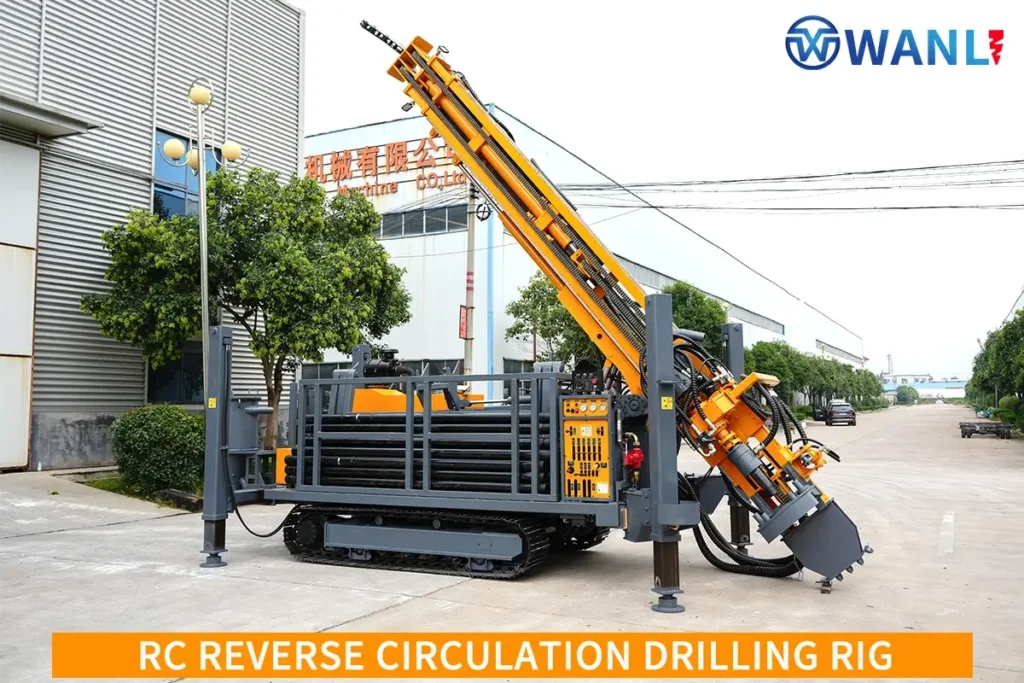
Shandong Wanli’s RC reverse circulation drilling rig delivers full hydraulic drive with high-efficiency slag discharge by reverse circulation and fast hole forming with smooth walls. It is suitable for cobble, gravel, and other complex formations and stable for deep hole drilling. The crawler chassis enables flexible relocation, with easy operation and full protection—customizable, direct factory supply with worry-free after-sales.
Key published specifications from Wanli’s RC reverse circulation rock powder sampling drilling rig:
- Drilling depth: 500-1000 meters
- Drilling diameter: 100-300 mm (model variants: 140 mm, 150 mm, 120 mm, 110 mm, 900 mm, 1000 mm)
- Work pressure: 1.5-3.5 MPa
- Air consumption: 17-42 m³
- Power head pressure: 7 T
- Lift force: 28 T
- Increase speed: 23 m/min
- Rapid advance: 33 m/min
- Drill rod length: 3 m
- Drill pipe diameter: 89/102/114 mm
- Weight: 12,000 KG
- Dimensions: 6.8 × 2.1 × 2.8 m
- Power type: Diesel
- Voltage: 24 V / 220 V
Wanli’s published engineering analysis establishes the commercial exploration benchmark: “Engine power: 132 kW is the benchmark for mid-to-deep RC rigs. Lifting force: 210 kN allows for the safe handling of heavy drill strings. Rotation torque: 10,000 Nm provides the force for hard rock penetration. Drilling diameter: Capabilities up to 300mm ensure versatility. Walking speed: Crawler speeds of 2km/h help the rig move between holes quickly. Drilling depth: 300 meters is a standard professional rating for commercial exploration.”
URL: https://sdwanli.com/news/is-reverse-circulation-drilling-rig-fast/
The engineering significance for B2B buyers:
- Three to four times faster than diamond drilling: Wanli’s analysis confirms RC drilling offers 3-4× the speed of diamond drilling, driven by dual-wall pipe technology and high-power engines. Daily progress exceeds 100 meters.
- Sample purity by design: Cuttings are transported inside the pipe, never touching the borehole wall—eliminating cross-contamination risk and delivering the geochemical accuracy your resource estimation demands.
- Complex formation mastery: The full hydraulic RC platform is purpose-engineered for cobble, gravel, and other complex formations where conventional rotary methods stall or lose circulation.
- Crawler independence: 2 km/h walking speed means the rig moves between drill pads without support trucks, compressing setup time and reducing logistics cost.
- Reliability as the hidden speed factor: A reliability rating above 95% is essential—a rig that breaks down frequently negates its high penetration rate. Wanli uses high-grade steel for the mast and reputable brands for hydraulic pumps.
Commercial Comparison Table 1: RC Drilling Equipment Capability Matrix
| Parameter | Wanli RC Rig | Epiroc Explorac 100 | Epiroc Explorac 235 | YG S-RC-016 (Market Reference) |
|---|---|---|---|---|
| Max drilling depth | 500-1000 m | 250 m | 450 m | 500 m (needs larger compressor) |
| Drilling diameter | 100-300 mm | Not specified | Not specified | Customizable |
| Max torque | 10,000 Nm (benchmark) | 7,475 Nm | 14,000 Nm | Not specified |
| Lift/pull force | 28 T lift | 100 kN pull | 220 kN pull | Not specified |
| Engine power | 132 kW (benchmark class) | Cummins QSB 4.5, 82 kW | Cat C18, 522 kW | Electric 380V |
| Feed type | Full hydraulic, rapid advance 33 m/min | Cylinder with chain | Cylinder with chain | Hydraulic |
| Mobility | Crawler, 2 km/h walking | Radio remote control | Radio remote control | Crawler tracks |
| Formation application | Cobble, gravel, complex | Surface exploration | Surface exploration | Unconsolidated & consolidated |
| Approx. price point | Project-based factory-direct | Premium (reference ~$55,000+) | Premium (reference ~$120,000+) | ~$38,765 + compressor |
| Customization | High, factory-direct | Limited | Limited | High |
| After-sales model | Direct factory, worry-free | Dealer network | Dealer network | Manufacturer basic |
URLs: https://sdwanli.com/product/rc-reverse-circulation-drilling-rig/rc-reverse-circulation-drilling-rig-rock-powder-sampling-drilling-rig/ | https://sdwanli.com/news/is-reverse-circulation-drilling-rig-fast/ | https://www.epiroc.com/en-ml/products/drill-rigs/exploration-drill-rigs/reverse-circulation-drill-rigs | https://realproductsreview.com/best-rc-drilling-rig-equipment/
Where Wanli wins for the right buyer:
- Depth class leadership: 500-1000 m capability in a single platform—exceeding Epiroc Explorac 100 (250 m) and Explorac 235 (450 m), and matching the YG S-RC-016’s 500 m claim with headroom to 1000 m
- Complex formation specialization: Purpose-engineered for cobble, gravel, and other complex formations where premium-brand surface exploration rigs are not optimized
- Crawler mobility at 2 km/h: Independent walking between drill pads without support trucks—a decisive logistics advantage on rough mining terrain
- Rapid advance speed: 33 m/min rapid advance and 23 m/min increase speed—engineered for high-penetration commercial exploration
- Factory-direct customization and after-sales: Direct from factory with worry-free after-sales, eliminating dealer intermediation and accelerating spare parts response
- High torque benchmark: 10,000 Nm rotational torque provides the force for hard rock penetration—positioned between Explorac 100 (7,475 Nm) and Explorac 235 (14,000 Nm) at a project-based price point
- 28 T lift capacity: Safely handles heavy drill strings for deep hole operations
Where competitors retain advantage:
- Epiroc Explorac 235: Higher absolute torque (14,000 Nm), 522 kW Cat C18 engine, established global dealer network, Tier 3 emission compliance
- Epiroc Explorac 100: Compact 250 m class with radio remote control, ideal for shallow, high-precision exploration pads
- YG S-RC-016: Electric 380V power source reduces fuel cost for sites with grid access; genuinely high customization at a lower entry price point (~$38,765), though a larger air compressor is needed for maximum depth
Commercial Comparison Table 2: Application Fit by Exploration Scenario
| Exploration Scenario | Recommended Configuration | Wanli Advantage | Competitive Context |
|---|---|---|---|
| Shallow geotechnical (50-250 m) | Full hydraulic, 100-150 mm diameter | Fast hole forming, smooth walls, crawler mobility | Epiroc Explorac 100 at 250 m depth class |
| Mid-depth mineral exploration (250-500m) | Full hydraulic, 10000 Nm torque, 132 kW | 3-4× faster than diamond drilling, 100-300 mm diameter flexibility | Epiroc Explorac 235 at 450m; YG S-RC-016 at 500m |
| Deep RC exploration (500-1000m) | Full hydraulic, 28 T lift, 500-1000 m depth | Only the platform in this comparison is capable of 1000 m; the 28 T lift safely handles heavy drill strings. | None of the compared alternatives reach 1000 m in a single configuration. |
| Cobble & gravel formations | Reverse circulation, dual-wall pipe | Purpose-engineered for cobble, gravel, and complex formations; full hydraulic high-efficiency slag discharge | Epiroc rigs are optimized for surface exploration; YG rigs are verified in both unconsolidated and consolidated formations but at shallower depths. |
| Remote mining sites | Crawler chassis, 2km/h walking | Moves between drill pads without support trucks; reduces logistics cost | Epiroc uses a radio remote; YG uses a crawler, but at 15,000 lbs weight, it requires heavy-duty transport |
| Water well & large diameter | 100-300 mm diameter, up to 1100 mm variants | Versatility for water wells and large-diameter boreholes; low power consumption, high efficiency | Dedicated water well rigs required for some competitors |
URLs: https://sdwanli.com/product/rc-reverse-circulation-drilling-rig/rc-reverse-circulation-drilling-rig-rock-powder-sampling-drilling-rig/ | https://sdwanli.com/news/is-reverse-circulation-drilling-rig-fast/ | https://www.epiroc.com/en-ml/products/drill-rigs/exploration-drill-rigs/reverse-circulation-drill-rigs | https://realproductsreview.com/best-rc-drilling-rig-equipment/
Wanli’s published guidance is explicit: “Reliability is the hidden factor in drilling speed. If a rig breaks down frequently, its high penetration rate becomes irrelevant. You should look for reverse circulation drilling manufacturers who use high-grade steel for the mast and reputable brands for the hydraulic pumps. A well-built rig can operate for thousands of hours with minimal downtime. A reliability rating of over 95% is essential for maintaining a fast project schedule.” This mirrors the exact methodology B2B buyers should apply when evaluating any RC drilling equipment supplier.
The Five Cost Buckets of RC Drilling Equipment Ownership
When evaluating RC drilling equipment, the acquisition price is only the first of five cost buckets over a 15-year equipment lifespan:
- Hardware acquisition: Varies by depth class—shallow surface exploration rigs at entry-level pricing, deep 1000 m-class full hydraulic crawler rigs at premium. Wanli provides project-based factory-direct quotation
- Air compressor integration: RC drilling requires a high-capacity air compressor (17-42 m³ air consumption for Wanli rigs). Budget for an appropriately sized compressor matched to your target depth
- Consumables: DTH hammers, drill bits, dual-wall drill rods, and wear parts—standardized per ISO 10207:1991 for rope-threaded drill steel equipment, ensuring multi-supplier sourcing
- Major overhauls: Engine and hydraulic pump overhaul at 5,000-8,000 operating hours; budget 2-3 overhauls across a 15-year lifespan
- Cost per meter: While the hourly rate for RC drilling may be higher than diamond drilling, the cost per meter is usually lower due to 3-4× faster penetration—most mining companies find RC provides the best overall ROI for exploration
The true differentiator between suppliers is not the sticker price—it is the structural cost per meter across the campaign. Wanli’s full hydraulic platform, with high-efficiency slag discharge and 33 m/min rapid advance, is engineered to maximize daily meterage and minimize bit replacement frequency.
RFP Framework: Qualifying Your RC Drilling Equipment Supplier
When issuing an RFQ to any RC drilling equipment supplier, mandate responses against the following framework:
- Target depth with 20% safety margin: Define your maximum target depth and add 20%—your rig must reach this without exceeding 80% of rated power. Wanli’s RC platform delivers 500-1000 m in a single configuration
- Formation profile: Cobble, gravel, unconsolidated overburden, or competent rock? Wanli’s full hydraulic RC rig is purpose-engineered for cobble and gravel complex formations
- Torque requirement: 10,000 Nm is the benchmark for mid-to-deep RC rigs penetrating hard rock. Request the torque curve across the full RPM range
- Lift capacity: The 28 T lift (Wanli) safely handles heavy drill strings for deep holes. Verify the supplier’s lift/pull force against your deepest planned hole
- Dual-wall RC compliance: ASTM D5781/D5781M:18 governs dual-wall reverse-circulation drilling—confirm your supplier’s rig transports cuttings inside the inner tube without borehole wall contact
- Mobility model: Crawler walking at 2 km/h (Wanli) vs. truck-mounted (some Epiroc models) vs. trailer. Crawler independence eliminates support truck logistics
- ISO safety compliance: ISO 18758-2:2018 for rock drill rig safety requirements; ISO 10207:1991 for drill steel equipment. Confirm the supplier’s conformance
- Hydraulic pump and mast quality: High-grade steel mast and reputable hydraulic pump brands are non-negotiable for 95%+ reliability
- Customization scope: Drilling diameter (100-300 mm), drill pipe diameter (89/102/114 mm), power configuration, and crawler width—confirm factory-direct customization capability
- After-sales model: Direct factory after-sales (Wanli) vs. dealer network (Epiroc). For remote mining sites, factory-direct responsiveness compresses downtime
Wanli responds to each of these points with documented engineering capability: full hydraulic high-torque power heads, 500-1000 m depth in a single platform, 28 T lift capacity, purpose-engineering for cobble and gravel, crawler walking at 2 km/h, ISO standards alignment, and factory-direct customization with worry-free after-sales.
The EEAT-Aligned Supplier Evaluation
For B2B procurement teams, evaluating RC drilling equipment requires evidence across four dimensions:
- Expertise: Demonstrated fluency in ASTM D5781 dual-wall RC methodology, ISO 18758-2:2018 safety requirements, and ISO 10207:1991 drill steel equipment standards. Wanli’s published benchmark analysis — 132kW engine power, 210kN lifting force, 10,000Nm rotation torque, 2km/h walking speed — reflects category mastery
- Experience: Documented capability across cobble, gravel, and complex formations, with full hydraulic RC rigs engineered for deep hole drilling stability and high-efficiency slag discharge
- Authoritativeness: Full hydraulic RC platform with 500-1000 m depth, 100-300 mm diameter versatility, 28 T lift, and 7 T power head pressure—the engineering envelope that defines the mid-to-deep RC class
- Trustworthiness: Direct factory supply with worry-free after-sales, project-based customization, and a transparent reliability philosophy—a well-built rig operating for thousands of hours with minimal downtime at 95%+ reliability
FAQ
Q1: What international standards should I require from an RC drilling equipment supplier?
A: The foundational standards are ISO 18758-2:2018 (Mining and earth-moving machinery—Rock drill rigs and rock reinforcement rigs—Part 2: Safety requirements), currently at 90.93 confirmed status with ISO/FDIS 18758 under development to consolidate the series. For the drilling method itself, ASTM D5781/D5781M:18 provides the Standard Guide for Use of Dual-Wall Reverse-Circulation Drilling. Additionally, ISO 10207:1991 governs rope-threaded drill steel equipment for percussive drilling (22-38 mm nominal sizes), ensuring your DTH hammers and drill rods interface correctly. A supplier unfamiliar with these standards is not ready for export-grade exploration projects.
Q2: How deep can Wanli’s RC drilling equipment drill?
A: Wanli’s RC reverse circulation rock powder sampling drilling rig delivers 500-1000 m depth capability in a single platform configuration, with drilling diameters from 100 to 300 mm. The 28 T lift force safely handles heavy drill strings for deep hole operations, while the 10,000 Nm rotational torque provides the force for hard rock penetration. Define your target depth and add a 20% safety margin when specifying.
Q3: What is the drilling speed advantage of RC equipment over diamond drilling?
A: Wanli’s engineering analysis confirms RC drilling delivers 3-4× the speed of diamond drilling, driven by dual-wall pipe technology and high-power engines (132kW benchmark). Daily progress exceeds 100 meters. While the hourly rate for RC may be higher than diamond drilling, the cost per meter is usually lower because the rig completes the hole much faster—reducing labor, fuel, and site maintenance costs. Most mining companies find RC provides the best overall ROI for exploration.
Q4: Why is sample purity critical in RC drilling, and how is it achieved?
A: Sample purity directly impacts the accuracy of resource estimation and geochemical analysis. In RC drilling, cuttings are transported inside the inner tube of the dual-wall pipe system, never touching the borehole wall. This eliminates the risk of cross-contamination between sampling intervals. ASTM D5781/D5781M:18 specifically governs this dual-wall reverse-circulation methodology for geoenvironmental exploration, confirming it as the industry-recognized pathway to contamination-free samples.
Q5: How does Wanli’s RC equipment compare to Epiroc Explorac 100 and 235?
A: Wanli’s RC rig delivers 500-1000 m depth in a single platform—exceeding Epiroc Explorac 100 (250 m) and Explorac 235 (450 m). Wanli’s 10,000 Nm torque sits between Explorac 100 (7,475 Nm) and Explorac 235 (14,000 Nm). Where Epiroc wins is absolute torque on the 235 model (14,000 Nm) and global dealer network support. Where Wanli wins is depth class leadership (1000 m capability), purpose-engineering for cobble and gravel complex formations, crawler walking at 2 km/h for independent pad-to-pad relocation, 28 T lift capacity, and factory-direct customization with worry-free after-sales at a project-based price point.
Q6: Can Wanli RC rigs operate in cobble, gravel, and complex formations?
A: Yes. Wanli’s RC reverse circulation drilling rig is purpose-engineered for cobble, gravel, and other complex formations where conventional rotary methods stall or lose circulation. The full hydraulic drive delivers high-efficiency slag discharge by reverse circulation, enabling fast hole forming with smooth walls. This specialization distinguishes Wanli from premium-brand surface exploration rigs not optimized for these demanding geological conditions.
Q7: What mobility advantages does Wanli’s crawler chassis provide?
A: Wanli’s RC rig features a crawler chassis with a 2 km/h walking speed, enabling the rig to move between drill pads without support trucks. This independence compresses setup time between each hole location and reduces logistics costs on rugged mining sites. The crawler design allows operation on steep slopes and rough terrain without requiring crane lifts or separate transport equipment.
Q8: What air compressor specifications are required for RC drilling?
A: RC drilling requires a high-capacity air compressor. Wanli’s RC rig operates at 1.5-3.5 MPa work pressure with 17-42 m³ air consumption. For maximum depth capability (approaching 1000 m), a larger air compressor is required—this is typical for the RC equipment class. When budgeting your total cost of ownership, include the compressor as a separate line item matched to your target depth.
Q9: What is the expected lifespan and overhaul schedule for RC drilling equipment?
A: With a strict maintenance schedule and a high-grade steel mast with reputable hydraulic pump brands, a well-built RC rig can operate for thousands of hours with minimal downtime. Major overhauls of the engine and hydraulic pumps are typically required every 5,000-8,000 operating hours. Wanli’s reliability philosophy targets a 95%+ reliability rating as essential for maintaining fast project schedules.
Q10: How do I initiate a project with Wanli as my RC drilling equipment supplier?
A: Contact Wanli with your target depth (plus 20% margin), formation profile (cobble/gravel/competent rock), required drilling diameter, torque requirement, site accessibility profile, and air compressor capacity. The engineering team will recommend the optimal configuration—a full hydraulic RC rig with your specified drilling diameter (100-300 mm), drill pipe diameter (89/102/114 mm), and power configuration—provide a project-based factory-direct quotation, and define the customization scope. Wanli offers direct factory supply with worry-free after-sales support.
Making the RC Drilling Equipment Decision
When presenting an RC drilling equipment selection to your exploration committee or procurement team, anchor the discussion in five verifiable pillars:
- International standards compliance: ISO 18758-2:2018 for rock drill rig safety, ASTM D5781/D5781M:18 for dual-wall RC methodology, ISO 10207:1991 for drill steel equipment. Without these, your tooling inventory becomes locked to a single supplier
- Depth and torque alignment: Wanli’s 500-1000 m depth in a single platform with 10,000 Nm torque and 28 T lift exceeds the depth class of Epiroc Explorac 100/235 while remaining within a project-based price envelope. Define target depth plus 20% margin
- Sample purity by design: RC drilling transports cuttings inside the inner tube, never touching the borehole wall. This ASTM D5781-governed methodology eliminates cross-contamination, delivering the geochemical accuracy your resource estimation demands
- Complex formation specialization: Wanli’s full hydraulic RC rig is purpose-engineered for cobble, gravel, and other complex formations where conventional methods stall—a decisive advantage over surface exploration-optimized premium rigs
- Mobility and reliability: Crawler walking at 2 km/h for independent pad-to-pad relocation, 95%+ reliability through high-grade steel mast and reputable hydraulic pumps, and factory-direct customization with worry-free after-sales
For B2B buyers evaluating RC drilling equipment, the evidence-based path is clear: mandate ISO 18758-2:2018 and ASTM D5781 compliance, define your depth with 20% margin, prioritize torque for hard rock penetration, verify lift capacity against your heaviest drill string, and select a supplier whose platform is purpose-engineered for your formation profile. Shandong Wanli Construction Machinery delivers on all five dimensions—with full hydraulic RC rigs capable of 500-1000 m depth, 100-300 mm diameter versatility, 10,000 Nm torque, 28 T lift, crawler mobility at 2 km/h, and direct factory supply with worry-free after-sales.
When your next mineral exploration, geotechnical investigation, or water resource development project demands a defensible RC drilling equipment partnership—whether for gold exploration in Western Australia, copper sampling in Central Africa, lithium mapping in the Andes, or groundwater development in Southeast Asia—understanding supplier evaluation criteria is the first step. The next step is matching your target depth, formation profile, drilling diameter, and site accessibility to the right RC rig configuration.
To explore how Shandong Wanli’s RC reverse circulation drilling rig can accelerate your exploration program with 3-4× the speed of diamond drilling and contamination-free samples, visit our website at https://sdwanli.com/. Our engineering team will assess your target depth and formation conditions, map your site accessibility, and provide a project-based factory-direct quotation with customized drilling diameter, drill pipe configuration, and power package. Request a technical consultation today, and let us demonstrate why full hydraulic drive, high-efficiency slag discharge by reverse circulation, and crawler chassis mobility deliver the exploration velocity and sample integrity your geological team demands.
References
- ISO — Equipment for drilling and mine excavation (ICS 73.100.30). Confirms ISO 18758-2:2018 (Rock drill rigs safety requirements, 90.93 status), ISO/FDIS 18758 under development, ISO 3551-1:1992/3551-2:1992, ISO 10097-1:1999/10097-2:1999, and ISO 10207:1991 (rope threaded drill steel equipment for percussive drilling, 22-38 mm). https://www.iso.org/ics/73.100.30.html
- ASTM D5781/D5781M:18 — Standard Guide for Use of Dual-Wall Reverse-Circulation Drilling for Geoenvironmental Exploration and the Installation of Subsurface Water Quality Monitoring Devices. Part of the drilling and mine excavation standards catalogue. https://www.bsbedge.com/ics/equipment-for-drilling-and-mine-excavation-1075
- Shandong Wanli RC Reverse Circulation Drilling Rig — Rock Powder Sampling Drilling Rig. Full hydraulic drive, high-efficiency slag discharge by reverse circulation, 500-1000 m depth, 100-300 mm diameter, 28 T lift, 7 T power head pressure, 10,000 Nm torque class, crawler chassis, 2 km/h walking, customizable, direct factory supply with worry-free after-sales. https://sdwanli.com/product/rc-reverse-circulation-drilling-rig/rc-reverse-circulation-drilling-rig-rock-powder-sampling-drilling-rig/
- Epiroc Explorac Reverse Circulation Drilling Rigs. Explorac 100: 250 m depth, 7,475 Nm torque, 100 kN pull, 82 kW Cummins. Explorac 235: 450 m depth, 14,000 Nm torque, 220 kN pull, 522 kW Cat C18. https://www.epiroc.com/en-ml/products/drill-rigs/exploration-drill-rigs/reverse-circulation-drill-rigs