Mining contractors operate in high-stakes environments where the accuracy of subsurface data determines the viability of multi-million dollar projects. At the center of this data acquisition is geological drilling equipment—a specialized category of machinery designed to penetrate various rock formations to recover physical samples or install monitoring instruments.
Unlike standard construction drilling, geological drilling for mining focuses on structural integrity and sample purity. Whether the objective is “grassroots” exploration or “brownfield” expansion, understanding the mechanics and engineering behind these rigs is fundamental to operational success.
What Defines Modern Geological Drilling Equipment?
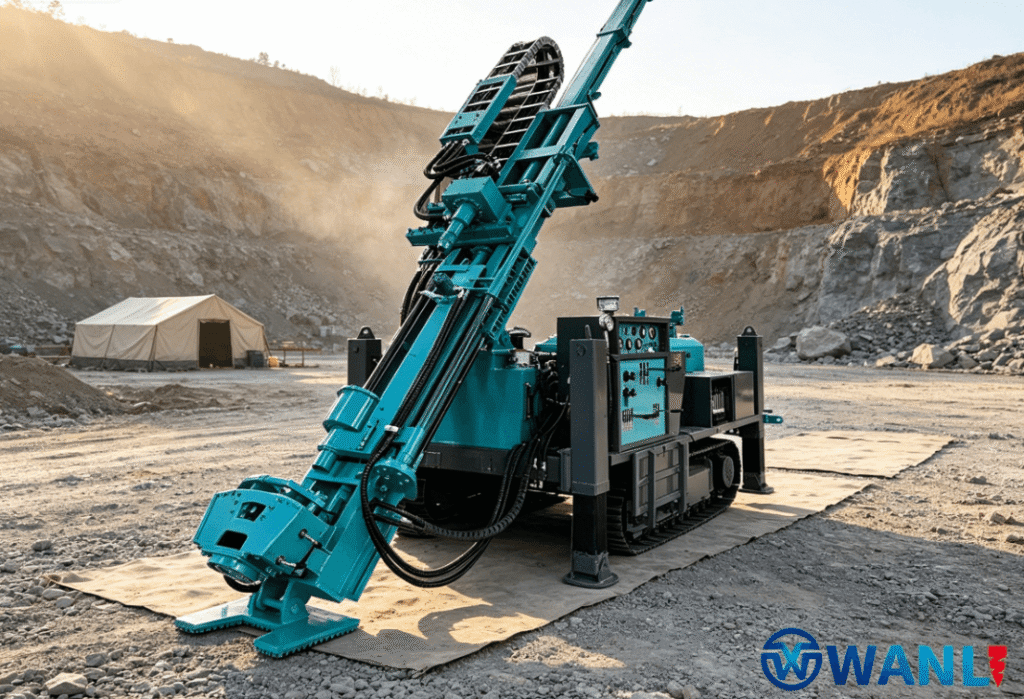
Geological drilling equipment refers to the integrated system of machinery, tools, and consumables used to create boreholes in the earth’s crust for geological analysis. For mining contractors, this equipment is primarily used to extract “cores”—cylindrical sections of rock that provide a chronological and compositional record of the strata.
Modern systems have evolved from simple mechanical winches to sophisticated hydraulic platforms. The primary goal is to maintain a high rate of penetration (ROP) while ensuring the geological sample remains uncontaminated and structurally intact. This requires a delicate balance between rotational speed, “weight on bit” (WOB), and the management of drilling fluids.
Core Recovery vs. Destructive Drilling: The Technical Distinction
Mining contractors categorize drilling into two primary methodologies based on the desired output:
- Coring (Non-Destructive): This involves using a hollow diamond-tipped bit. The equipment cuts an annular ring, leaving a solid cylinder of rock in the center (the core). This is the gold standard for geological mapping as it preserves the orientation and texture of the mineral veins.
- Reverse Circulation/Percussive (Destructive): These rigs use hammers or tri-cone bits to crush the rock into chips, which are then blown to the surface via compressed air. While faster and often cheaper for bulk sampling, it does not provide the structural context that a solid core offers.
For contractors focused on resource estimation, coring drilling rigs are the essential tool. Advanced units, such as those found in Wanli’s core drilling range, utilize wireline technology. This allows the inner tube containing the core to be winched to the surface through the drill string, eliminating the need to “trip” (remove) all the rods, thus significantly increasing efficiency at depth.
Classifying Rigs by Mobility and Power Systems
Geological drilling equipment is categorized by how it moves and how it generates force. Contractors must match the rig to the terrain and the target depth of the mineral deposit.
1. Full Hydraulic Coring Rigs
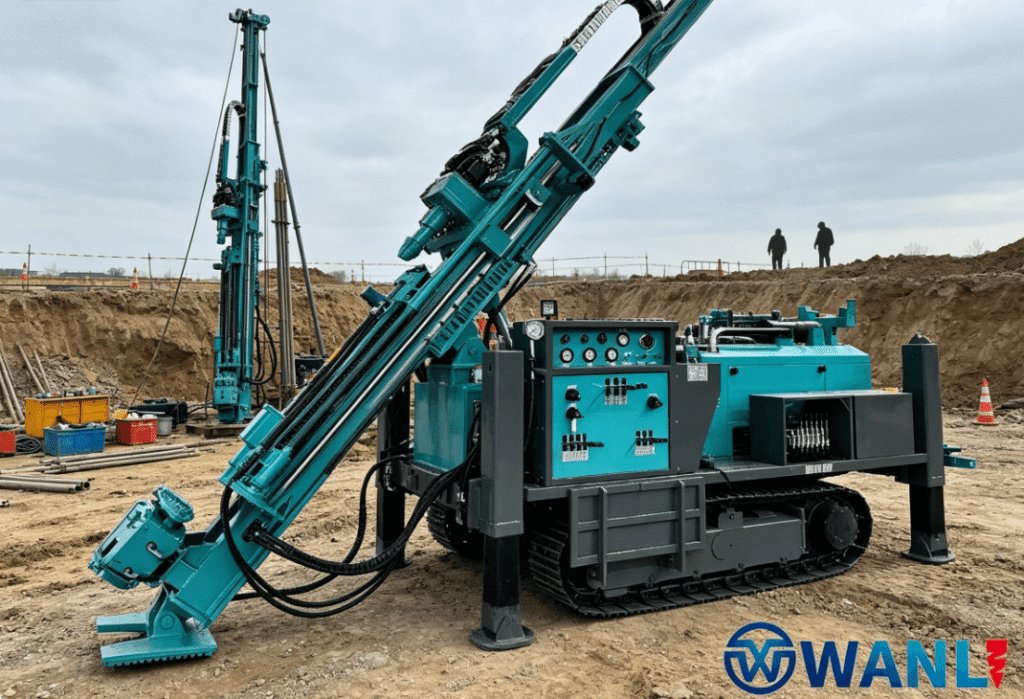
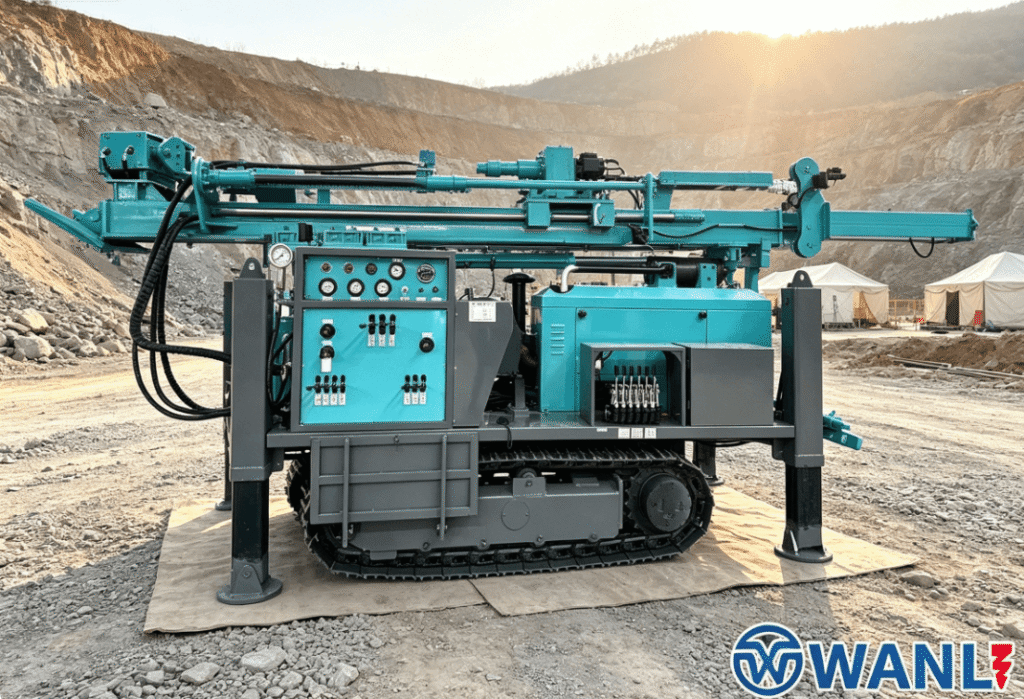
These represent the current industry standard for deep-hole exploration. In a full hydraulic system, the rotation, feed, and hoisting are all controlled by hydraulic motors. This provides infinite variable speed control and smoother operation, which is critical when drilling through fractured or “vuggy” ground where sudden torque changes can snap a drill string.
2. Spindle-Type (Mechanical) Rigs
Historically dominant and still used for shallower or more budget-conscious projects, spindle rigs use a mechanical gearbox. While they lack the finesse of hydraulic systems, they are often easier to repair in extremely remote locations with limited technical support.
3. Mobility Platforms
- Crawler-Mounted: Integrated onto tracks, these rigs are self-propelled and ideal for rugged, off-road mining tenements.
- Skid-Mounted: These rigs sit on a heavy steel frame and must be moved by a crane or truck. They are typically used for long-term, deep-hole projects where the rig stays in one spot for months.
- Portable/Modular: Designed to be broken down into components small enough for man-portable transport or helicopter lifts. These are vital for high-altitude or dense jungle exploration where road access is non-existent.
Essential Components of an Exploration Drill String
A rig is only as capable as the string it rotates. Mining contractors must understand the synergy between the surface equipment and the “downhole” assembly.
- The Rotation Unit (Head): The powerhouse that provides the torque. High-speed heads are required for diamond coring (often exceeding 1,000 RPM), while high-torque, low-speed settings are used for larger-diameter boring.
- Drill Rods: These must be manufactured from high-tensile alloy steel. In geological drilling, “N” and “H” size rods (NQ and HQ) are the industry standards, balanced for weight and internal clearance for wireline tools.
- The Diamond Bit: The cutting interface. Contractors choose between “impregnated” bits (where diamonds are mixed throughout the metal matrix) and “surface-set” bits. The choice depends on the Mohs hardness of the rock—impregnated bits are generally preferred for hard, abrasive formations.
- Mud Pumps: These circulate drilling fluid (mud) down the string. The fluid cools the bit, lubricates the hole, and carries the “cuttings” to the surface. Effective fluid management prevents the drill string from getting stuck—a contractor’s worst nightmare.
Operational Variables Influencing Equipment Performance
Selecting the right geological drilling equipment requires an engineering-first approach. Contractors must evaluate several geological and environmental constraints:
Formation Hardness and Abrasiveness
Hard rock formations like quartzite or basalt require high rotational speeds and specific diamond matrices. Conversely, soft, “swelling” clays require specialized drilling fluids and lower pressure to prevent the hole from collapsing.
Target Depth and Hole Diameter
Every rig has a “depth rating.” As a hole goes deeper, the weight of the drill rods increases, requiring a more powerful hoist (drawworks). A rig rated for 1,000 meters of NQ core may only be capable of 600 meters of the heavier HQ core.
Site Accessibility
In the early stages of a mining project, roads may not exist. Contractors often opt for modular hydraulic rigs that can be disassembled. This minimizes the environmental footprint—a key factor in modern ESG (Environmental, Social, and Governance) compliance for mining companies.
Technical Standards and Safety in Geological Drilling
Safety in geological drilling is governed by both mechanical design and operational protocol. Rig manufacturers now prioritize:
- Hands-Free Rod Handling: Automated systems that move drill rods into place, reducing the risk of crush injuries to the drill crew.
- Safety Cages: Interlocked guards that stop the rotation unit if a worker enters the “spin zone.”
- Emergency Stop Systems: Strategically placed “E-stops” and pull-cords that can kill the engine or hydraulic pressure instantly.
From a compliance perspective, contractors look for equipment that meets ISO standards for hydraulic safety and pressure vessel regulations for the onboard compressors and pumps.
Conclusion: Matching Equipment to the Geological Mission
For the mining contractor, geological drilling equipment is a specialized investment in data precision. The shift toward full hydraulic, crawler-mounted coring rigs reflects the industry’s need for deeper exploration and safer, more efficient operations. By understanding the mechanical limitations of depth, torque, and mobility, contractors can ensure that they provide the high-quality core samples necessary for the next generation of mining developments.
FAQ
Q1: What is the difference between a spindle rig and a full hydraulic rig?
A spindle rig uses a mechanical gearbox and manual levers for shifting gears, similar to a manual transmission car. A full hydraulic rig uses fluid power to control all movements, offering smoother torque transitions, better safety features, and finer control over the drilling process.
Q2: Why is diamond coring preferred over other methods in mining?
Diamond coring provides a continuous, solid physical sample of the rock. This allows geologists to see the exact angle of mineral veins, the presence of fractures, and the specific density of the ore, which is impossible with the crushed chips produced by other methods.
Q3: What does “Wireline Coring” mean?
Wireline coring is a system where the inner tube of the core barrel (which holds the rock sample) is retrieved through the center of the drill rods using a steel cable (wireline) and an overshot tool. This saves hours of labor because the entire drill string does not need to be pulled out of the hole every time the barrel is full.
Q4: How do I determine the depth capacity of a rig?
Depth capacity is determined by the hoist’s lifting capacity and the torque of the rotation head. Manufacturers provide ratings based on standard rod sizes (e.g., 1000m for NQ, 700m for HQ). Always ensure the rig has a 20% safety margin above your target depth.
Q5: Can geological drilling rigs be used for water well drilling?
Technically, yes, many core rigs can drill for water. However, water well drilling usually requires larger hole diameters and different flushing systems (like air or heavy mud), whereas geological rigs are optimized for high-speed, small-diameter core recovery.
Reference Sources
- ASTM D2113: Standard Practice for Rock Core Drilling and Sampling of Rock for Site Investigation.
- International Society for Rock Mechanics (ISRM): Suggested Methods for Determining the Strength of Rock Materials.
- Australian Drilling Industry Association (ADIA): Drilling Manual and Technical Guides.
- ISO 28916: Geological hazard risk assessment — Core drilling and sampling for landslide investigation.