Selecting a water well drilling rig requires more than matching a depth rating to a hole requirement. In industrial and municipal groundwater projects, the relationship between depth, borehole diameter, and geological formations dictates the mechanical limits of the machine.
A rig rated for 300 meters operates under significantly different structural stresses than a 100-meter utility rig. Choosing incorrectly often leads to premature component fatigue or insufficient hoisting power during pipe extraction.
Technical Constraints: Why Rig Capacity Scales with Borehole Depth
Drilling depth is a function of the rig’s hoisting capacity and rotary torque. As the borehole deepens, the total weight of the drill string increases exponentially.
For instance, a 200-meter drill string assembly, including stabilizers and the bit, can weigh several tons. The rig must not only rotate this mass but also possess the “pull-back” force to recover the string in high-friction soil conditions.
When evaluating equipment, engineers prioritize the power-to-depth ratio. A machine operating at its maximum depth limit continuously will see a 40% faster degradation of hydraulic seals and motor brushes.
100m Drilling Rigs: Portability and Small-Scale Irrigation
Rigs designed for the 100m range are typically optimized for “shallow” aquifers. These are common in residential water supply and small-scale agricultural irrigation.
Technical Characteristics:
- Chassis: Often mounted on light trailers or compact rubber crawlers to access confined rural spaces.
- Power Source: Usually powered by 22-30kW diesel engines.
- Application: Ideal for 4-to-6-inch diameter boreholes in soft to medium-hard rock.
For 100m projects, the focus is on setup speed and fuel efficiency. These rigs utilize smaller mud pumps because the hydrostatic pressure at 100m is relatively low, requiring less force to flush cuttings to the surface.
200m Drilling Rigs: The Industrial “Sweet Spot”
The 200m depth category represents the most versatile segment for commercial contractors. These machines bridge the gap between domestic utility and heavy industrial exploration.
Performance Requirements:
- Lifting Force: Typically requires a hoisting capacity of 15-20 tons to handle the drill string and casing loads.
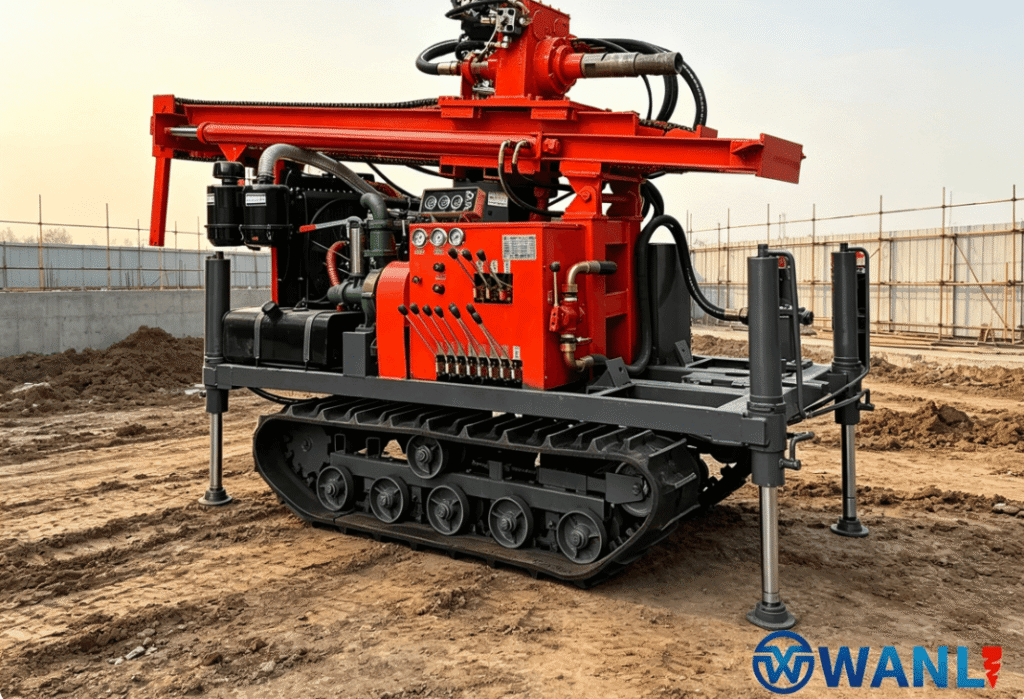
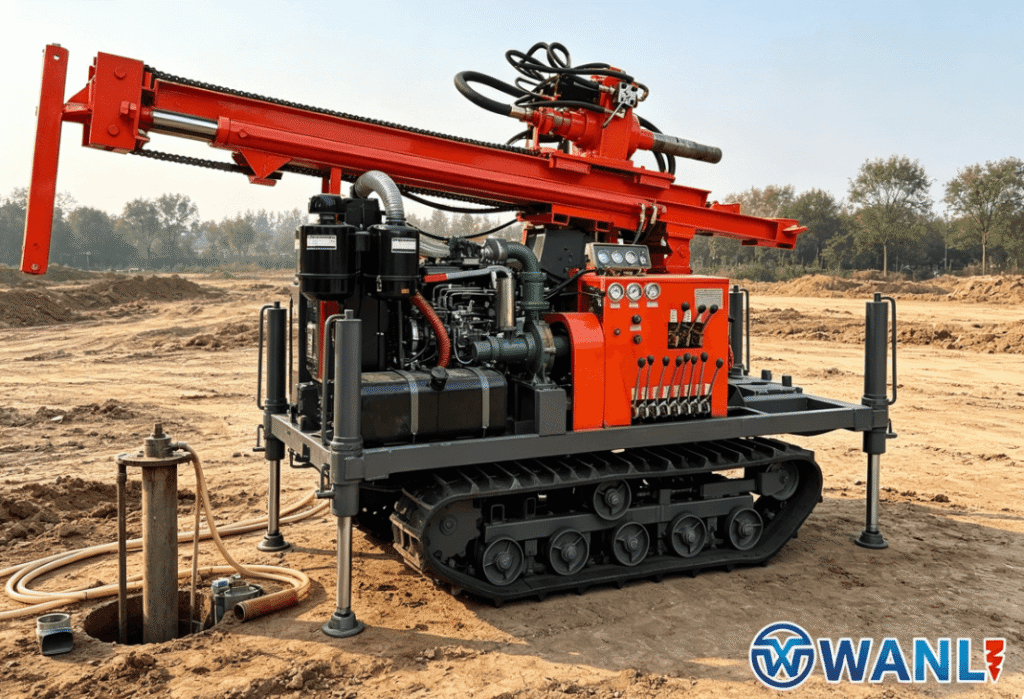
- Dual Systems: Most 200m rigs, such as the Wanli Crawler Series, integrate both mud pump and air compressor capabilities.
- Geology: Capable of handling “overburden” (loose soil) and transitioning into hard basalt or granite using DTH (Down-The-Hole) hammers.
At 200 meters, pipe friction becomes a major factor. Operators should look for rigs with high-torque rotary heads (above 4000 Nm) to prevent the bit from “stalling” in clay-heavy layers.
300m+ Drilling Rigs: Deep Aquifer and Geothermal Applications
Drilling to 300 meters or deeper requires a heavy-duty hydraulic architecture. These rigs are used for municipal water works, large industrial cooling wells, and geothermal heat pump installations.
Engineering Specifications:
- Structural Integrity: Heavy steel masts and high-strength hydraulic cylinders are mandatory to prevent mast “flexing” under tension.
- Feed Stroke: Longer stroke lengths (3.4m to 6.6m) are preferred to reduce the frequency of pipe changes, which saves hours of labor on deep holes.
- Advanced Hydraulics: Variable displacement pumps are essential to manage the power distribution between the winch, rotation, and cooling systems.
For 300m depths, the rig’s stability is paramount. Large hydraulic outriggers are necessary to level the machine on uneven terrain, ensuring the borehole remains perfectly vertical—a critical factor for pump installation later.
Comparison Table: Rig Specifications by Target Depth
| Specification | 100m Utility Rig | 200m Versatile Rig | 300m Heavy-Duty Rig |
| Drilling Diameter | 100 – 200 mm | 140 – 325 mm | 140 – 400 mm |
| Lifting Force | 5 – 8 Tons | 12 – 18 Tons | 20 – 30+ Tons |
| Rotary Torque | 2,000 – 3,000 Nm | 4,000 – 6,000 Nm | 6,500 – 9,500 Nm |
| Walk Speed | 2.0 km/h | 2.5 km/h | 3.0 km/h (Truck option) |
| Best For | Residential Wells | Farm & Commercial | Municipal & Geothermal |
Operational Factors: Beyond the Depth Rating
When sourcing a rig, depth is the starting point, but “Lithology” (rock type) determines the final configuration.
- Air vs. Mud: If the region has high water tables and loose sand, a mud pump is required to stabilize the hole walls. In hard rock, an air compressor (DTH drilling) is 3x faster.
- Compressor Requirements: A 300m rig requires a high-pressure compressor (at least 25 bar) to effectively clear cuttings from the bottom of the hole.
- Maintenance Access: For OEM buyers, ensure the hydraulic valves and filters are accessible. Downtime on a 300m project can cost thousands of dollars per day in labor and fuel.
Strategic Procurement for B2B Buyers
If you are a project manager or a wholesale distributor, standardizing your fleet around depth tiers improves spare parts management.
For contractors working across diverse terrains, a 200m-rated crawler rig offers the best ROI. It is light enough for transport yet powerful enough for the majority of commercial groundwater contracts.
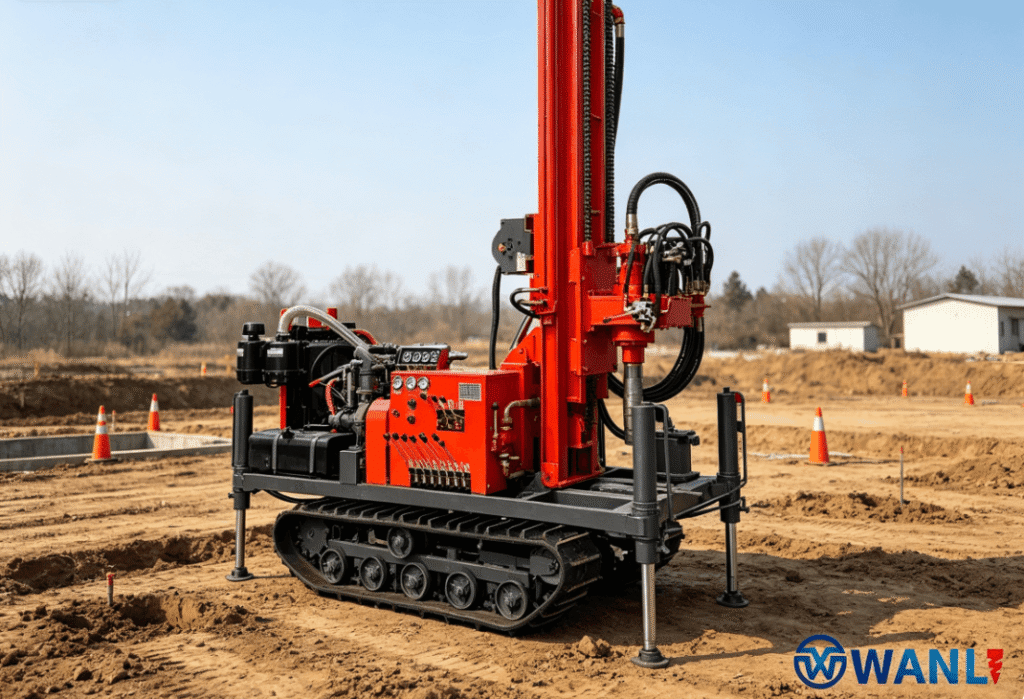
Customization is also key. Manufacturers like Wanli allow for specific engine upgrades (e.g., Cummins or Quanchai) and chassis modifications to meet regional environmental regulations or specific terrain challenges.
FAQ
Q: Can a 200m rig be used for 100m projects?
A: Yes. It is often safer and more efficient to “under-work” a larger rig. However, the initial capital expenditure and fuel consumption will be higher than a dedicated 100m unit.
Q: Does drilling diameter affect the depth rating?
A: Absolutely. A rig rated for 300m at a 6-inch diameter may only be capable of 150m if the borehole diameter is increased to 12 inches due to the weight of the casing and the volume of cuttings.
Q: What is the typical lead time for a custom 300m truck-mounted rig?
A: For OEM/ODM configurations, lead times usually range from 30 to 45 days, depending on engine availability and hydraulic component sourcing.
Q: Is a crawler or truck mount better for 300m depths?
A: Truck mounts are better for long-distance travel between sites. Crawlers are superior for off-road, rugged terrain where stability and maneuverability on-site are the priority.
Reference Sources
- International Ground Water Association (IGWA): Standards for borehole construction and rig safety.
- ISO 18674-4: Measurement of pore water pressure and drilling rig mechanical safety.
- American Society of Civil Engineers (ASCE): Guidelines for deep aquifer exploration and equipment loads.
- SGS Technical Reports: Performance testing benchmarks for hydraulic drilling systems.