The transition from mechanical drive systems to fully integrated hydraulic drilling systems has redefined the efficiency of modern borehole construction. For project managers and lead engineers, selecting the right hydraulic borehole drilling equipment is no longer just about engine horsepower; it is about the precision of fluid power, torque management, and the adaptability of the rig to varying geological strata.
In industrial drilling, hydraulic systems leverage Pascal’s law to multiply force, allowing relatively compact machines to exert massive downward pressure (pull-down) and rotational torque. This technical evolution is critical for operations ranging from deep-water well drilling to complex geological exploration.
The Core Mechanics of Hydraulic Borehole Drilling Equipment
Modern hydraulic drilling systems operate on a closed-loop or open-center hydraulic circuit that powers three primary functions: rotation, feeding (hoisting/crowding), and auxiliary operations (leveling jacks and winch systems).
Unlike older mechanical rigs that rely on complex gearboxes and belts, a hydraulic rig uses a variable displacement pump to drive a hydraulic motor mounted on the power head. This allows for infinitely variable speed control. An operator can fine-tune the RPM to match the bit type—whether using a Tricone bit for sedimentary layers or a DTH (Down-The-Hole) hammer for hard granite—without stopping the drilling process to shift gears.
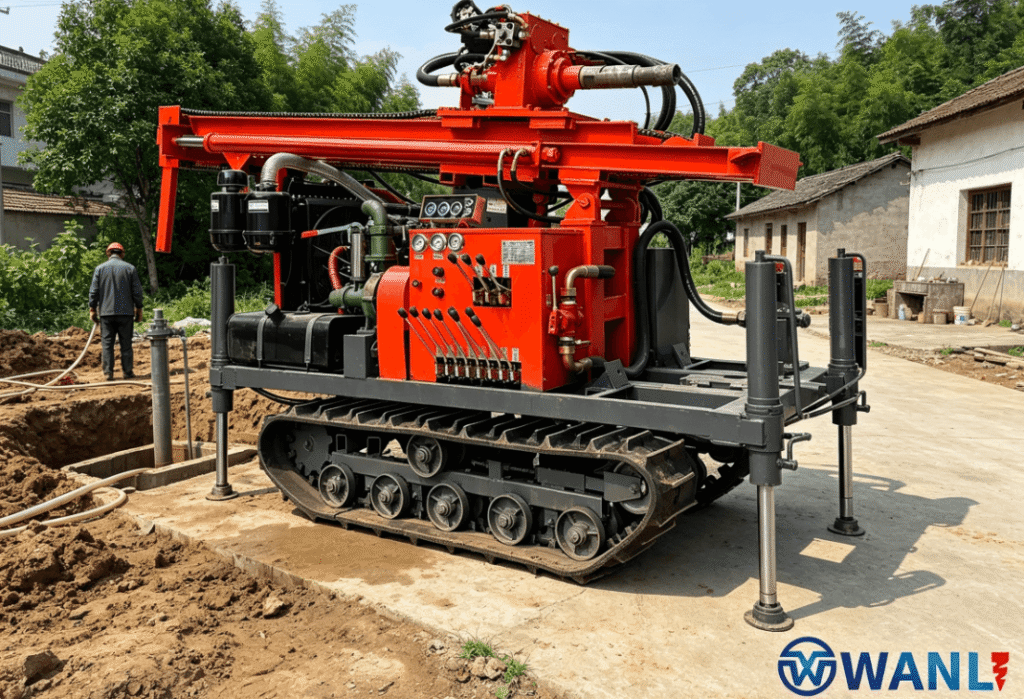
The efficiency of these systems is measured by their “power density.” High-quality hydraulic borehole drilling equipment, such as the crawler-mounted series found in professional manufacturing fleets, integrates high-pressure oil circuits that minimize thermal energy loss, ensuring that the maximum percentage of engine output reaches the drill bit.
Key Technical Specifications for Equipment Evaluation
When moving through the commercial evaluation phase, technical buyers must prioritize four critical metrics that determine the machine’s ROI and field capability.
1. Rotary Torque vs. Spindle Speed
Torque is the rotational force required to overcome the friction of the borehole wall and the resistance of the formation. For deep boreholes (300m+), high torque is non-negotiable. However, for smaller-diameter geothermal holes, spindle speed (RPM) is often the priority. Professional-grade hydraulic rigs often feature multi-speed power heads to balance these two needs.
2. Lifting and Pull-back Capacity
As the drill string grows longer, the weight becomes immense. Hydraulic borehole drilling equipment must have a pull-back capacity that exceeds the total weight of the drill rods, stabilizers, and the bit by at least 25% to account for “stuck pipe” scenarios.
3. Hydraulic System Pressure and Flow Rate
The “blood” of the system is the hydraulic oil. A rig operating at 25–30 MPa (Mega Pascals) generally offers better response times and power than lower-pressure systems. Look for equipment utilizing components from recognized brands like Kawasaki or Rexroth, which are common in high-end Chinese manufacturing exports for their reliability in high-heat environments.
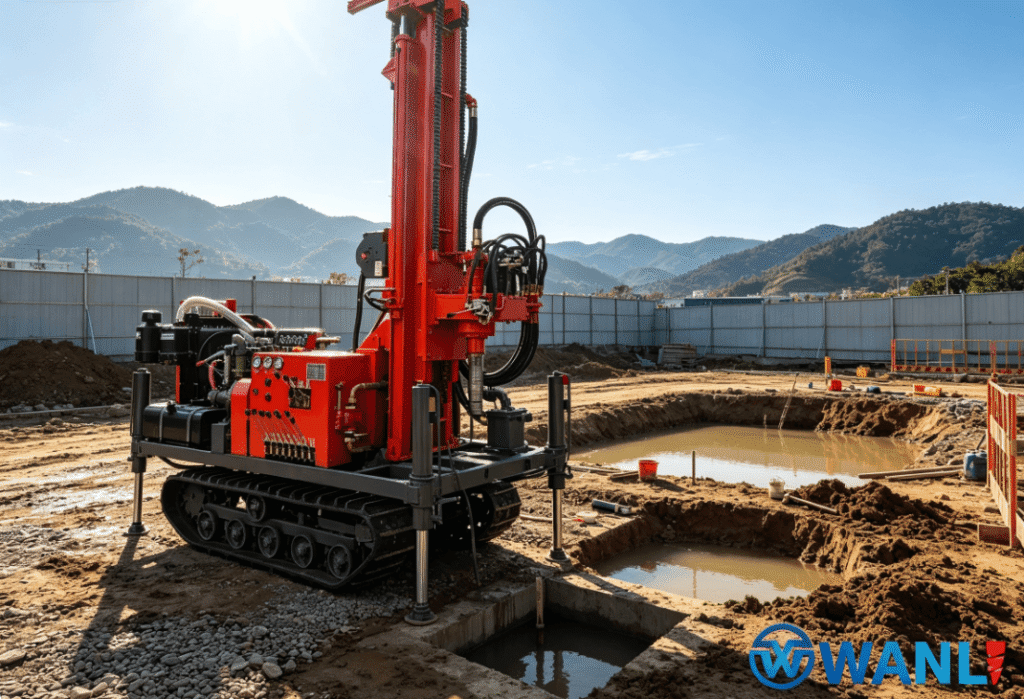
4. Chassis Stability and Mobility
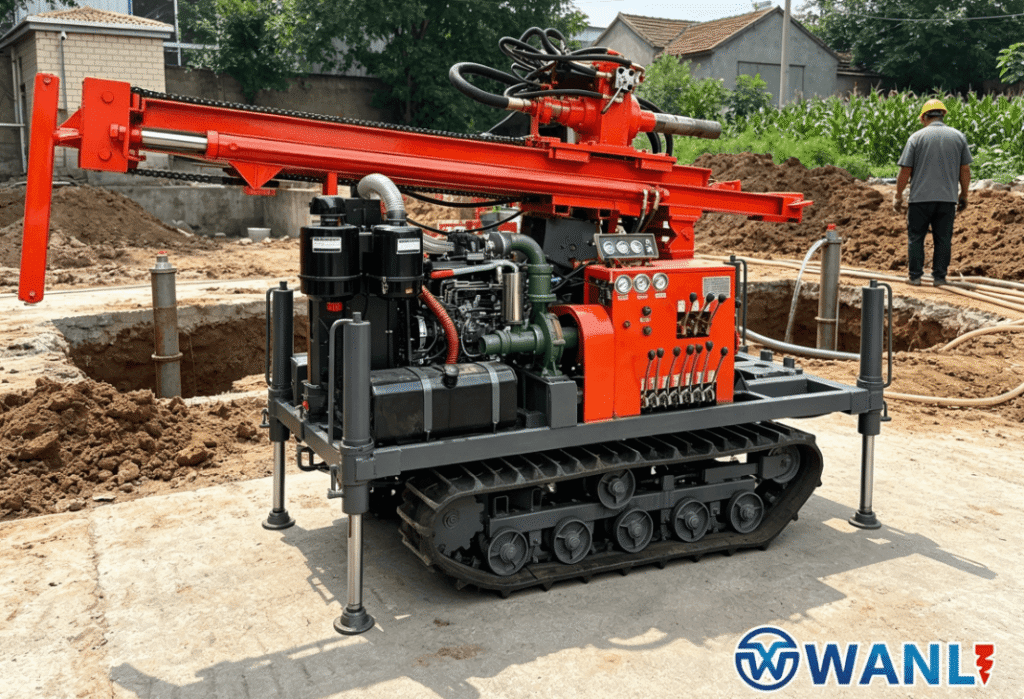
For rugged terrains, crawler-mounted hydraulic systems are the industry standard. The steel tracks provide a lower center of gravity and better weight distribution, which is essential when the rig is exerting maximum pull-down force.
| Feature | Water Well Application | Geotechnical Exploration | Mining/Blasting |
| Drilling Depth | 200m – 600m | 50m – 150m | 20m – 50m |
| Typical Diameter | 140mm – 400m | 75mm – 110mm | 90mm – 165mm |
| Primary Bit Type | DTH Hammer / Mud Rotary | Core Bit (Diamond/Tungsten) | DTH Hammer |
| Mobility Requirement | High (Crawler/Truck) | Very High (Portable/Crawler) | Fixed/Crawler |
Application Suitability: Matching Rigs to Geology
The versatility of hydraulic borehole drilling equipment is best demonstrated in its ability to switch between different drilling methodologies.
- DTH (Down-The-Hole) Drilling: In hard rock formations, the hydraulic system provides the rotation while a high-pressure air compressor drives a pneumatic hammer at the bottom of the hole. This is the fastest method for hard rock.
- Mud Rotary Drilling: In loose or sandy formations, the hydraulic system drives a mud pump. The drilling fluid (bentonite slurry) stabilizes the hole wall and carries cuttings to the surface.
- Auger Drilling: For shallow, dry holes in soil, the high torque of the hydraulic head allows for large-diameter flights to be screwed into the ground.
Industrial-grade manufacturers, such as those producing the SDWanli Water Well Drilling Rigs, design their machines to be “multi-functional.” This means the hydraulic manifold is pre-configured to accept either high-pressure air inputs for DTH or high-volume fluid inputs for mud rotary, providing the contractor with maximum utility on a single capital investment.
Operational Longevity and Maintenance
In a B2B context, the “Expertise” and “Trustworthiness” of a drilling system are proven in its maintenance cycle. Hydraulic systems are sensitive to contamination.
- Filtration Systems: High-end rigs utilize multi-stage suction and return line filters. If a pump begins to wear, the filters catch metallic debris before it can damage the expensive rotary motors or control valves.
- Cooling Capacity: Continuous drilling generates significant heat. Effective rigs feature oversized hydraulic oil coolers (air or water-cooled) to maintain viscosity. If the oil overheats, “O-rings” fail, leading to internal leakage and a “spongy” feel in the controls.
- Hose Routing: In the field, a blown hose is the most common cause of downtime. Professional engineering emphasizes “neat” hose routing with protective sleeves to prevent abrasion against the mast during operation.
Commercial Guidance: Procurement Considerations
For procurement managers looking at hydraulic borehole drilling equipment, the total cost of ownership (TCO) outweighs the initial purchase price. When evaluating suppliers:
- Engine Compliance: Ensure the power unit (e.g., Yuchai, Quanchai, or Cummins) meets local emission standards (Tier 3/Tier 4/Euro V).
- Component Commonality: Opt for rigs that use internationally recognized hydraulic fittings and valves. This ensures that if a component fails in a remote location, a replacement can be sourced locally rather than waiting for an international shipment.
- Customization Capability: Does the manufacturer offer mast extensions? Can the winch capacity be upgraded? A manufacturer’s ability to modify the hydraulic circuit for specific auxiliary tools is a sign of true engineering depth.
Conclusion
Hydraulic drilling systems represent the pinnacle of current borehole technology, offering a balance of power, control, and reliability. By focusing on the technical synergy between the hydraulic pump output and the rotary head torque, and by choosing platforms that support multi-method drilling, enterprises can ensure long-term operational success in even the most challenging geological environments.
FAQ
1. What is the main advantage of hydraulic rigs over pneumatic ones?
While many rigs use air for the “hammering” action (DTH), a hydraulic rig refers to the power source for the machine’s movement and rotation. Hydraulic systems offer much higher torque and more precise control than purely pneumatic systems, making them essential for deeper and larger-diameter holes.
2. Can hydraulic borehole drilling equipment work in extreme temperatures?
Yes, but it requires specific hydraulic oil grades. In arctic conditions, low-viscosity (VG32) oil is used, often with a pre-heater. In tropical or desert conditions, high-viscosity (VG68) oil and enhanced cooling systems are required to prevent system bypass.
3. How do I determine the right drill pipe diameter for my hydraulic rig?
This depends on the hole diameter and the hydraulic system’s lifting capacity. Larger pipes allow for better air/mud flow (lower pressure drop) but add significant weight. Always consult the rig’s load chart provided by the manufacturer.
4. What is the typical lifespan of a hydraulic pump on these rigs?
With proper maintenance and oil changes every 500–1,000 hours, a high-quality hydraulic pump can last 5,000 to 10,000 hours. Keeping the oil free of water and particulate matter is the single most important factor for longevity.
5. Are crawler-mounted rigs better than truck-mounted ones?
Crawler rigs offer superior “off-road” capability and stability on uneven drilling sites. Truck-mounted rigs are better for projects that require frequent long-distance travel on public highways.
Reference Sources
- ISO 12100:2010: Safety of machinery — General principles for design.
- ASTM D1586: Standard Test Method for Penetration Test (SPT) and Split-Barrel Sampling of Soils (Context for geotechnical rig use).
- International Association of Drilling Contractors (IADC): Technical publications on drilling fluid mechanics and hydraulic horsepower.
- Manufacturer Technical Documentation: Structural load and hydraulic circuit diagrams for HQ-series drilling rigs.