Selecting a water well drilling rig is a high-stakes capital investment where technical compatibility dictates project profitability. A mismatch between the machine and the local geology leads to catastrophic downtime, broken tooling, and abandoned boreholes. Professional drillers and project managers do not choose a rig based on price alone. They evaluate the “Total Drilling System,” which includes the rig’s torque capacity, hoisting power, and adaptability to specific strata. Whether you are expanding a fleet or starting a new municipal project, the selection process must be rooted in geological reality and mechanical specifications.
How to Define Your Primary Geological Environment
The first step to select a water well drilling rig is identifying the ground conditions. Geology dictates the drilling method, which in turn dictates the machine type. In hard rock formations such as granite, basalt, or limestone, Down-The-Hole (DTH) hammers are the industry standard. These systems rely on high-pressure air compressors to break the rock into fragments. If your work primarily involves these terrains, your rig must have a robust hydraulic system capable of managing high-frequency vibrations and a high-capacity air manifold.
Conversely, soft soil and sedimentary layers like sand, clay, or silt are best suited for Mud Rotary drilling. In this process, the rig must support a powerful mud pump to circulate drilling fluid. This fluid serves two purposes: it stabilizes the borehole walls to prevent collapse and lifts cuttings to the surface. If your region features mixed strata, “Multi-function” or “Hybrid” rigs are the most cost-effective choice. Manufacturers like Wanli Machinery offer units that allow operators to switch between DTH and Mud Rotary configurations, ensuring the machine remains productive regardless of the layer encountered.
How to Match Technical Specifications to Project Goals
Once you understand the ground, you must match the rig’s mechanical limits to your borehole requirements. Overloading a rig leads to premature hydraulic failure and structural fatigue.
1. Maximum Drilling Depth and Diameter
Every rig has a physical limit for “Pull-back” force, which is the amount of weight the hydraulic mast can lift. If you plan to drill a 300-meter well, do not buy a rig rated exactly for 300 meters. As the drill string gets longer, the cumulative weight of the pipes and the friction against the borehole walls increase significantly. Always factor in a 20% safety margin. A rig with a 20-ton pull-back capacity is safer and more efficient for a 15-ton load than a machine running at its absolute limit.
2. Torque and Rotation Speed
Torque is the rotational force required to turn the drill bit against resistance. High torque is essential for large-diameter wells or when drilling through sticky clay that can “seize” the drill string. Rotation speed, measured in RPM, is more critical for DTH drilling in hard rock where the hammer needs rapid rotation to index the bit face against the rock. Look for rigs with variable speed gearboxes that allow operators to fine-tune torque and RPM independently.
3. Power Source: Diesel vs. Electric
For remote construction sites or agricultural applications, diesel engines remain the industry standard due to their autonomy. However, if the project is in an urban environment with strict noise and emission regulations, consider a dual-power or electric-start hydraulic system. Industrial-grade diesel engines should be sourced from brands with global service networks, such as Cummins or Deutz, to ensure that maintenance parts are available regardless of the job site location.
Mobility Comparison: Crawler vs. Truck-Mounted
The choice of chassis impacts both project accessibility and transport costs. Crawler rigs are superior for off-road environments, while truck-mounted rigs excel in regional mobility.
| Rig Type | Best Use Case | Key Advantage |
| Crawler-Mounted | Rough terrain, mountains, soft mud. | Superior off-road stability and maneuverability on-site. |
| Truck-Mounted | Widespread municipal projects, highways. | Fast transit between distant sites without a trailer. |
| Portable/Trailer | Shallow wells, residential gardens. | Low transport cost and easy to operate in tight spaces. |
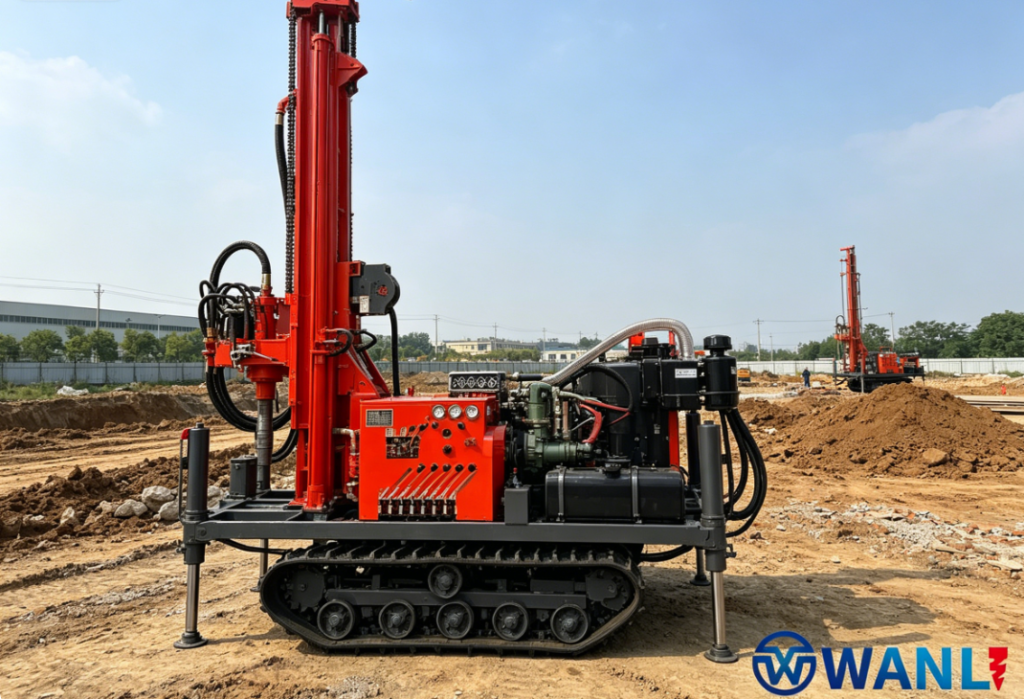
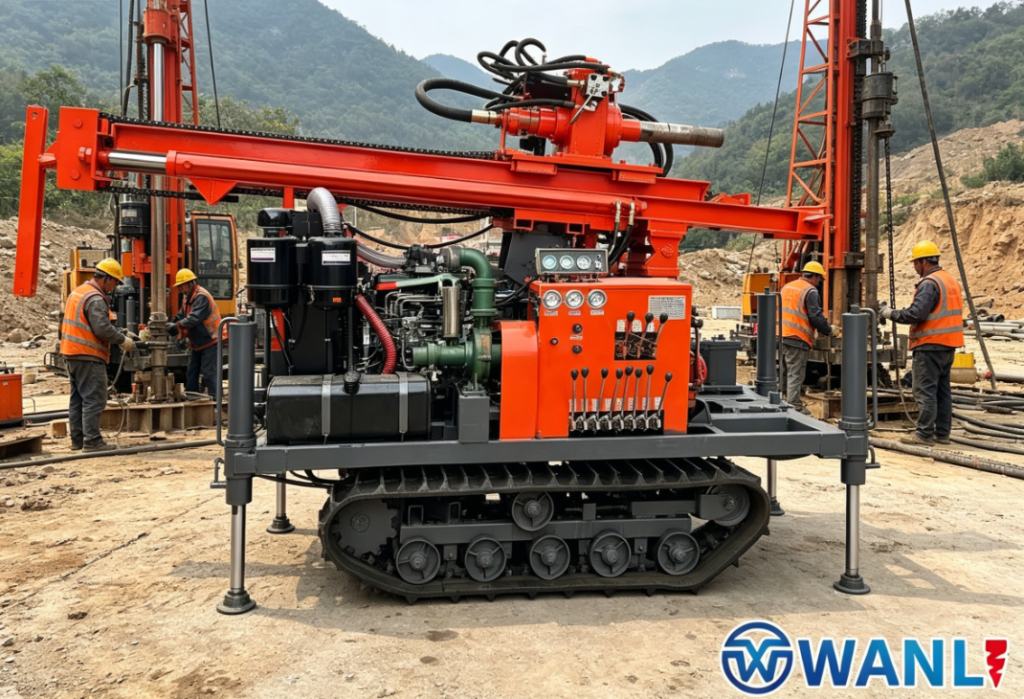
For most industrial contractors, the crawler-mounted rig is preferred for its “All-Terrain” capability. Wanli’s Crawler series, for instance, utilizes heavy-duty steel tracks that allow for stable leveling even on uneven slopes. This stability is critical for maintaining borehole verticality, which prevents casing installation failures.
Which Critical Components Ensure Rig Performance
To ensure long-term reliability and minimize maintenance delays, professional buyers must look beyond the exterior paint and examine the core hydraulic and structural components.
- Hydraulic Systems: The hydraulic pump is the “heart” of the machine. High-performance rigs utilize load-sensing hydraulic systems that only provide power when needed, reducing heat buildup and extending component life.
- The Mast (Derrick): The mast must be constructed from high-strength structural steel. It is subject to intense tension and compression forces. Ensure the welding quality meets international standards to prevent structural cracking under high-load pull-back operations.
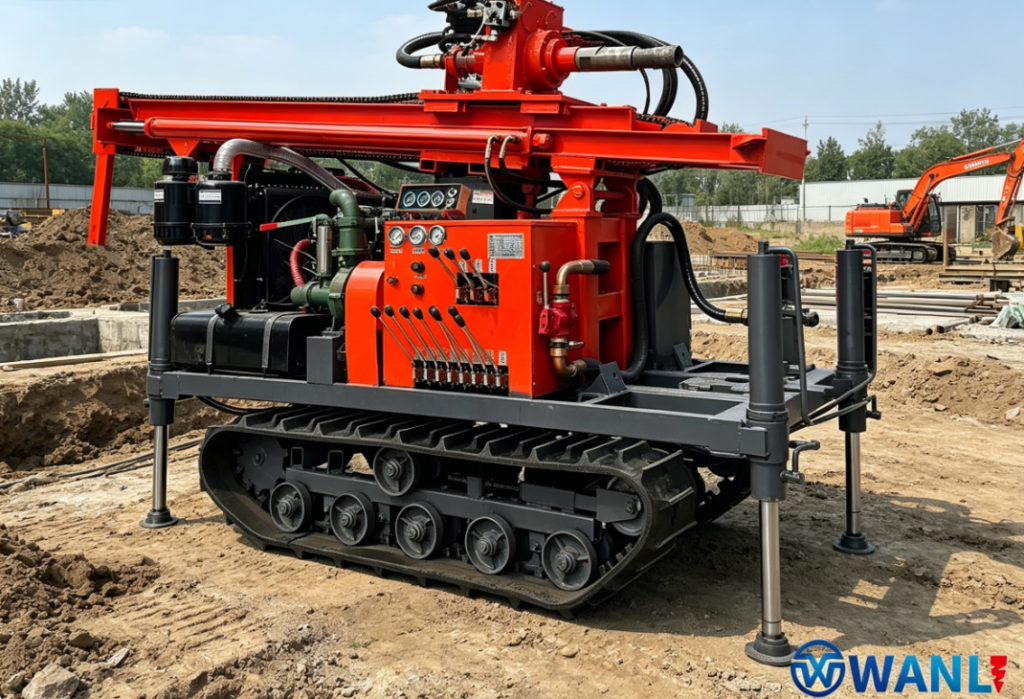
- Control Panel Layout: An ergonomic control system allows the operator to monitor pressure gauges, rotation speeds, and feed rates from a single vantage point. This visibility is vital for “feeling” the drill bit’s progress and reacting to sudden changes in formation.
- Winch Systems: Most water well rigs include a main winch and a tool winch. The main winch must be strong enough to handle casing pipes, which are often heavier than the drill pipes themselves.
How to Evaluate Commercial Value and Supplier Capability
A drilling rig is a 10-to-15-year asset. The commercial relationship with the OEM (Original Equipment Manufacturer) often determines whether the machine remains an asset or becomes a liability.
First, verify spare parts availability. Drilling is a destructive process that consumes bits, hammers, and seals. A supplier that cannot provide overnight shipping for wear parts can cause a project to stall, resulting in thousands of dollars in lost revenue per day. Second, consider customization (OEM/ODM) capabilities. In certain markets, you may require specific safety cages, specialized lighting for night operations, or custom engine calibrations to meet local Tier 4 or Stage V emission standards.
Finally, prioritize manufacturers that offer comprehensive technical support. Modern hydraulic rigs are complex; having access to factory-trained engineers for remote troubleshooting or on-site commissioning is a significant competitive advantage.
Summary
To select a water well drilling rig that delivers a high return on investment, you must balance geological requirements with mechanical specifications. Avoid the trap of “under-specifying” to save on initial costs, as this lead to mechanical failure. Focus on the strata you will drill most often, the maximum depth required plus a safety margin, and the reliability of the hydraulic components. A high-quality rig from a reputable manufacturer like Wanli Machinery ensures that your operation remains productive, safe, and profitable for years to come.
FAQ
1. What is the most common mistake in rig selection?
The most common error is underestimating the “Pull-back” force. Many buyers focus only on the depth rating but forget that the weight of the water, mud, and the drill string requires significant hydraulic power to extract the pipes safely without snapping the lines.
2. How does the air compressor impact DTH drilling?
The compressor is as vital as the rig itself in hard rock. You must ensure the rig’s air manifold and internal piping are sized correctly to handle the CFM (Cubic Feet per Minute) and PSI required to drive the DTH hammer and clear the cuttings from the hole efficiently.
3. Can one rig handle both water and geothermal wells?
Yes, most modern industrial water well rigs are highly effective for geothermal heat pump installations. The primary difference is the volume of holes; geothermal projects often require higher drilling speeds and faster setup times, which crawler-mounted rigs provide.
4. What certifications are required for industrial rigs?
For international procurement, look for ISO 9001 for quality management and CE certification for safety compliance. These certifications ensure the manufacturer follows standardized production processes and that the machine meets basic safety requirements for operator protection.
3.5 What is the typical lead time for custom rigs?
Depending on the complexity and chassis type, lead times usually range from 30 to 60 days. Truck-mounted units may take longer if the vehicle chassis requires specific modifications to meet local road legality and weight distribution standards.
Reference Sources
NGWA standards for water well equipment and site safety.
ISO international quality standards for drilling machinery.
ASCE research on geotechnical drilling and borehole stability.
Wanli Machinery technical specs for industrial drilling rigs.