The maximum depth a water well drilling rig can reach is not a static number; it is a variable determined by the intersection of mechanical engineering, geological resistance, and drilling technology. In residential applications, you might see depths of 100 to 300 feet, whereas industrial or agricultural projects often require deep-borehole rigs capable of reaching 1,000 to 3,000 feet (approx. 300 to 900 meters).
For engineers and project managers, determining the “depth capacity” involves more than reading a spec sheet. It requires an understanding of how hoisting capacity, torque, and fluid dynamics interact with the Earth’s crust.
What Determines a Water Well Drilling Rig’s Maximum Depth?
A rig’s depth rating is essentially a measurement of its ability to manage the weight and friction of the drill string. As the borehole deepens, the total weight of the drill pipes increases, and the resistance from the surrounding formation intensifies.
Several core technical factors dictate these limits:
- Hoisting Capacity (Lifting Force): This is perhaps the most critical constraint. The rig must be able to lift the entire weight of the drill string plus the bit. For deep wells reaching 600 meters or more, the rig requires a massive pullback force—often measured in kilonewtons (kN)—to prevent the string from becoming stuck.
- Rotary Torque: As the bit grinds deeper, friction against the borehole walls increases. The power-head must provide sufficient torque to maintain rotation. If the torque is insufficient, the rig will “stall” before reaching the target aquifer.
- Compressor and Mud Pump Pressure: In DTH (Down-the-Hole) drilling, air pressure must be high enough to eject cuttings from the bottom of a deep hole. In mud rotary drilling, the pump must move viscous fluid down hundreds of meters and back up the annulus against gravity.
Categorizing Depth by Rig Type
Water well rigs are generally categorized by their mobility and power source. Based on industry standards and Wanli’s engineering configurations, depth capabilities typically fall into the following brackets:
| Rig Category | Typical Depth Range (Meters) | Primary Application |
| Portable/Trailer-Mounted | 50 – 150m | Residential wells, soil sampling, light irrigation |
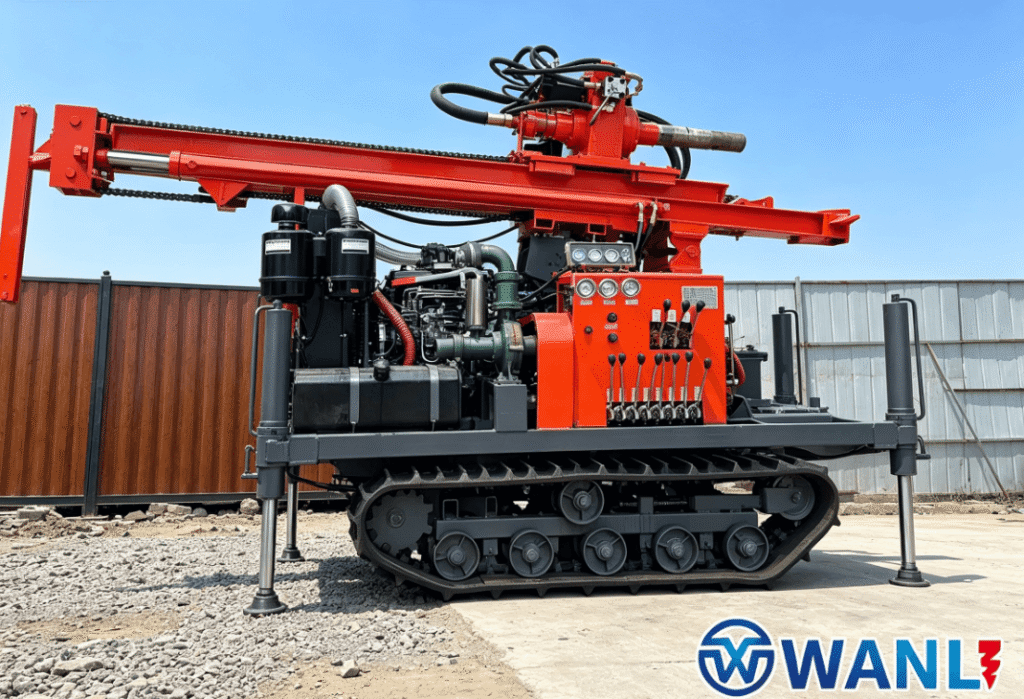
| Pneumatic Crawler Rigs (DTH) | 200 – 600m | Hard rock drilling, mountainous terrain, village water |
| Truck-Mounted Heavy Duty | 600 – 1,000m+ | Large-scale agricultural irrigation, industrial use |
1. Portable and Lightweight Rigs
These units prioritize mobility over raw power. They are often used in regions where the water table is shallow. While they are cost-effective, they lack the “pullback” force required to handle heavy steel casings used in deeper wells.
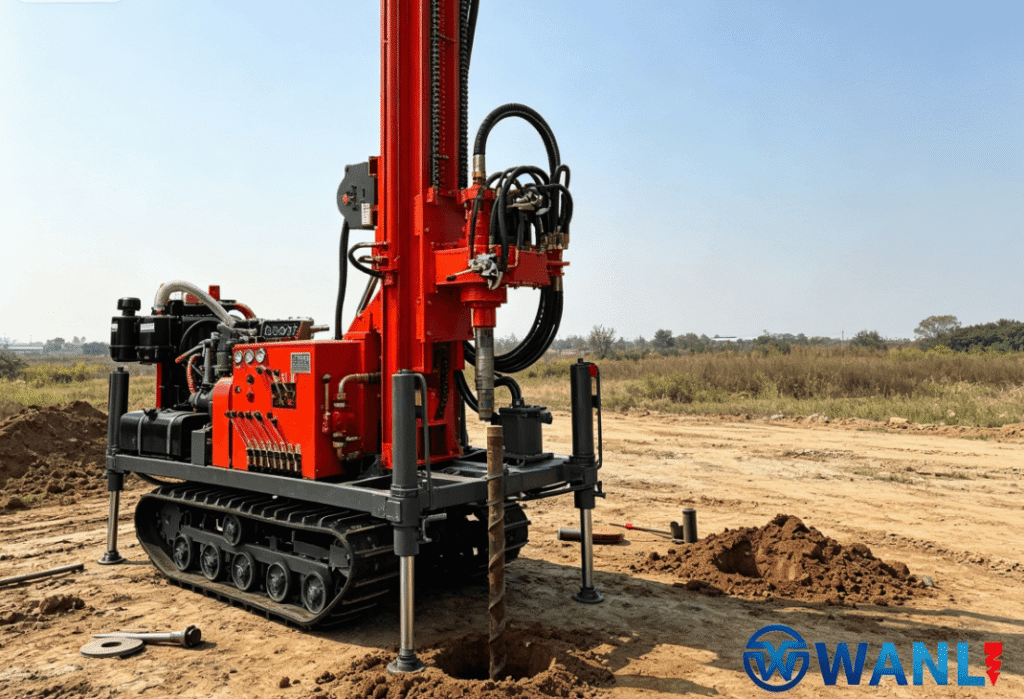
2. Crawler-Type Pneumatic Rigs
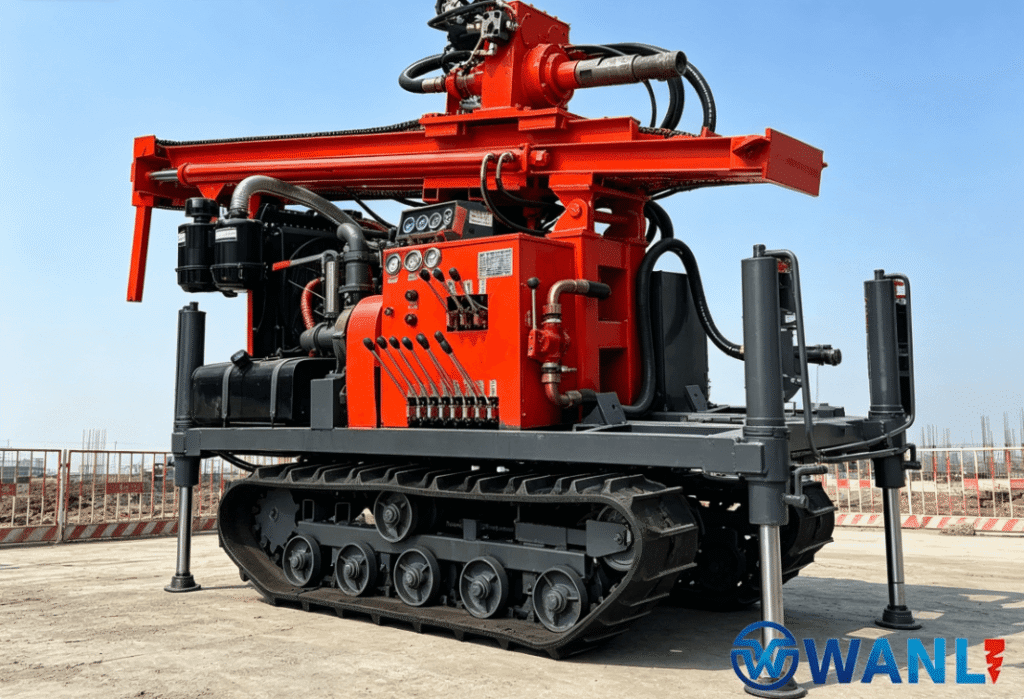
Widely used in professional contracting, these rigs utilize DTH hammers. They are the “workhorses” of the industry. A standard crawler rig, such as those found in the Wanli series, can comfortably reach 300 to 400 meters in hard rock formations by utilizing high-pressure air compressors to clear debris efficiently.
3. Heavy-Duty Truck-Mounted Rigs
When the mission involves tapping into deep confined aquifers, truck-mounted rigs provide the necessary stability. These machines feature reinforced masts and high-displacement hydraulic systems, allowing them to manage the immense weight of 1,000 meters of drill pipe.
The Geological Barrier: How Ground Composition Changes Depth
Geology is the “invisible hand” that limits drilling depth. A rig rated for 500 meters in soft sedimentary soil may struggle to reach 200 meters in high-density basalt or granite.
- Unconsolidated Formations (Sand/Gravel): Here, the depth is limited by the stability of the hole. Without proper mud circulation to “cake” the walls, the hole may collapse long before the rig’s mechanical limit is reached.
- Hard Rock (Granite/Quartzite): Depth is limited by bit wear and the rig’s ability to maintain downward pressure (weight-on-bit). This is where DTH technology excels, as it uses percussive force rather than just rotational grinding.
Technical Trade-offs: Diameter vs. Depth
A common misconception is that a rig has a single depth rating. In reality, depth is inversely proportional to the diameter of the hole.
If a rig is rated for 400 meters with a 6-inch (152mm) borehole, it may only be able to reach 200 meters if the operator increases the diameter to 12 inches (300mm). The larger the hole, the heavier the casing and the more volume of cuttings the machine must evacuate. For industrial projects, engineers must balance the required flow rate (which dictates diameter) with the geological depth of the aquifer.
Engineering Considerations for Deep Boreholes
When planning deep-reach projects, manufacturing and design choices become paramount. Professional rigs incorporate specific features to maximize their effective depth:
- Multi-Speed Power Heads: High torque for starting the hole and high speed for clearing debris.
- Telescopic Masts: Allow for longer drill pipes, reducing the time spent on connections and increasing the “effective” drilling time.
- Hydraulic Leveling: Essential for deep wells; even a 1-degree tilt at the surface can lead to a significant deviation 500 meters down, potentially causing the drill string to bind.
For organizations evaluating equipment, aligning the machine’s hydraulic displacement and hoisting power with the local geological profile is the most critical step in the procurement process. Over-speccing a rig leads to unnecessary fuel and capital costs, while under-speccing leads to abandoned boreholes and mechanical failure.
FAQ
Q: Can a water well rig drill through solid rock?
A: Yes, provided it is equipped for DTH (Down-the-Hole) drilling. Pneumatic rigs use a hammer-like action to pulverize rock, making them highly effective for deep rock-layer wells.
Q: What is the average depth of a residential water well?
A: Most residential wells are between 100 and 500 feet (30 to 150 meters). However, in arid regions, they may go much deeper to find a reliable yield.
Q: Does drilling deeper always mean more water?
A: Not necessarily. While deeper wells often tap into more stable aquifers, the water quality can change. Deep water may have higher mineral content (salinity or hardness), requiring additional treatment.
Q: How do I know if a rig can handle my specific terrain?
A: You must look at the “Climbability” (gradeability) for transport and the “Torque/Pullback” specs for the drilling itself. Crawler-based rigs are generally preferred for uneven or soft terrain.
Reference Sources:
- National Ground Water Association (NGWA): Well Construction Standard
- International Society of Trenchless Technology: Drilling Fluid Dynamics and Borehole Stability
- American Society of Civil Engineers (ASCE): Geotechnical Engineering in Deep Boreholes