For geotechnical engineers, site investigators, and mining project managers, the terminology surrounding subsurface exploration can often overlap. While the terms “coring drilling rig” and “geological drilling machine” are frequently used interchangeably in casual conversation, they represent distinct engineering priorities, mechanical configurations, and end-result objectives.
Selecting the wrong equipment for a site investigation doesn’t just lead to mechanical inefficiency; it can result in compromised data, failed structural assessments, and significant budget overruns. This guide breaks down the technical nuances between these two categories to help you determine which system aligns with your project’s geophysical requirements.
Defining the Core Objectives: Recovery vs. Penetration
To understand the difference, one must first look at the “end product” of the drilling process.
A Coring Drilling Rig is a precision instrument designed specifically to retrieve a continuous, undisturbed cylindrical sample of the subsurface—known as a core. The primary goal is the preservation of the geological structure, allowing experts to examine stratigraphy, fractures, and mineral content in their natural state.
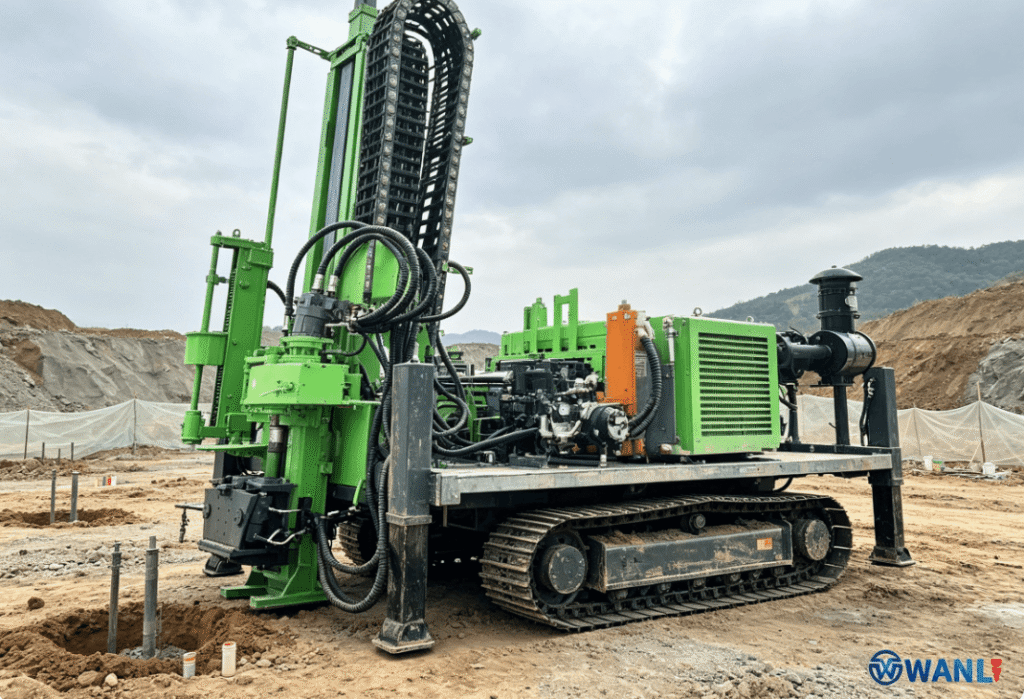
A Geological Drilling Machine is a broader classification. While many geological drills have coring capabilities, the category encompasses machines used for general exploration, borehole logging, mineral prospecting, and even water well drilling. These machines are often judged by their penetration rate and depth capacity rather than their ability to preserve a pristine physical sample.
Technical Specification Comparison
The mechanical divergence between these two systems is most evident in their torque, RPM (rotations per minute), and the types of drill bits employed.
| Feature | Coring Drilling Rig | Geological Drilling Machine |
| Primary Output | Undisturbed cylindrical core samples | Cuttings (chips), borehole data, or cores |
| Rotation Speed | High RPM (often 500–1200+ RPM) | Variable (Low to High depending on method) |
| Torque Profile | Moderate, consistent torque | High torque for deeper or wider bores |
| Bit Type | Annular bits (Diamond or Tungsten Carbide) | Full-face bits (Tricone, PDC, or Auger) |
| Sample Integrity | Superior; prioritizes “Core Recovery Ratio” | Moderate to Low (often destroys soil structure) |
| Typical Depth | Shallow to deep (Wireline systems for depth) | Shallow to ultra-deep (up to several km) |
Engineering Logic: When to Prioritize a Coring Rig
In specialized geotechnical engineering, the Coring Drilling Rig is the gold standard for site characterization. These rigs utilize an annular bit—a hollow cylinder that cuts only the outer edge of the sample.
- Structural Analysis for Construction: If you are surveying a site for a high-rise foundation or a bridge pier, you need to know the RQD (Rock Quality Designation). Only a dedicated coring rig can provide the intact samples required to measure the frequency and nature of rock fractures.
- Mineral Exploration: In gold or copper exploration, “assaying” requires the physical rock. A geological drill using “Reverse Circulation” (RC) might provide crushed chips, but a coring rig provides the spatial context of the ore vein.
- Diamond Bit Efficiency: High-speed rotation is essential when using industrial diamond bits. Manufacturers like SDWanli engineer their rigs with spindle speeds optimized for diamond cutting, ensuring smooth penetration through hard granite or basalt without shattering the core.
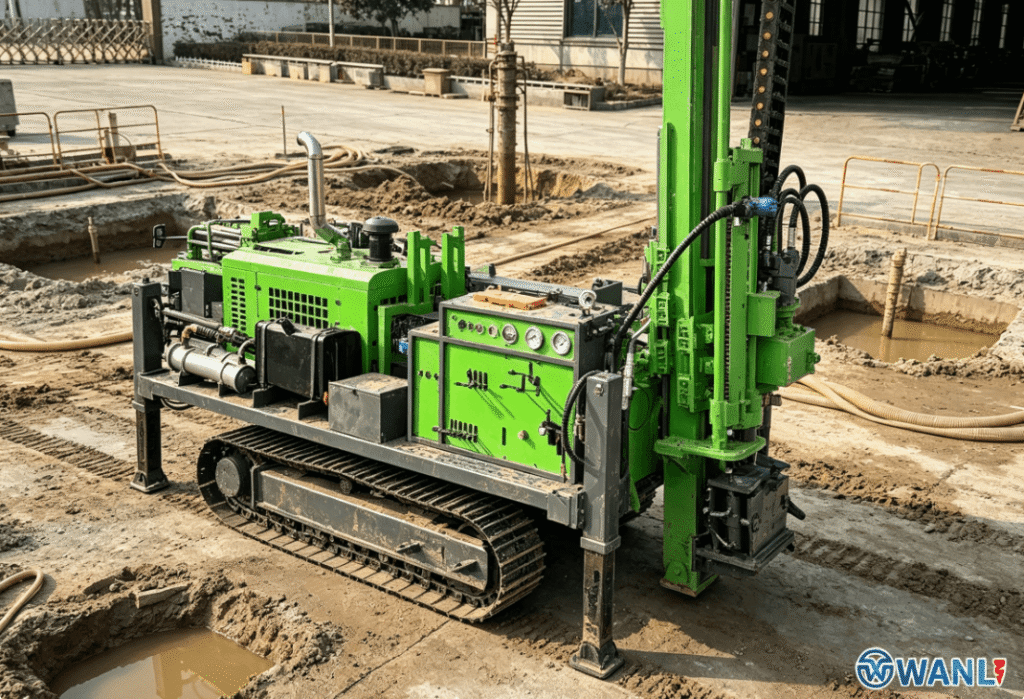
The Versatility of the Geological Drilling Machine
The term “Geological Drilling Machine” often refers to multi-purpose platforms. These are the workhorses of the exploration industry.
- Mapping and Stratigraphy: When the goal is simply to identify the depth of the water table or the contact point between soil and bedrock, a geological machine using rotary-percussion methods is faster and more cost-effective.
- Borehole Logging: In many cases, an engineer doesn’t need a physical sample; they need a clean hole to lower geophysical probes (gamma-ray or resistivity sensors). A geological drill is designed to clear “cuttings” efficiently to keep the hole open and stable.
- Adaptability: These machines are often designed to switch between auger drilling (for soft soil), tricone drilling (for speed), and occasional coring.
Mechanical Configurations: Spindle vs. Top-Head Drive
A subtle but vital difference often lies in the drive system. Many traditional coring rigs utilize a spindle-type design. This allows for high-precision control over the “feed” or downward pressure on the bit—critical when drilling through delicate, alternating layers of hard and soft strata.
Conversely, many modern geological drilling machines utilize top-head drive systems. These provide massive torque and are superior for deep-hole exploration where the weight of the drill string becomes a factor. While top-head drives can core, they often lack the “tactile feedback” that a spindle-driven coring rig provides to an experienced driller.
Environmental and Logistical Considerations
In field operations, the footprint and portability of the rig influence the choice.
Coring operations often require more “support” equipment, such as mud pumps and settling tanks, to maintain a constant flow of drilling fluid. This fluid is essential to cool the diamond bit and lubricate the core as it enters the inner barrel.
Geological drills, particularly those used in arid environments, may be configured for air-flush drilling, which eliminates the need for water but makes high-quality core recovery nearly impossible.
Decision Matrix: Which Machine Does Your Project Require?
To select the correct equipment, ask three technical questions:
- Is lab testing of the physical sample required? If yes, a Coring Drilling Rig is mandatory.
- Is the formation “unconsolidated” (sand/gravel) or “competent” (solid rock)? High-speed coring is best for competent rock; geological drills with augers are better for unconsolidated topsoil.
- What is the required “Core Recovery Ratio” (CRR)? If the project specs demand >90% CRR, you must use a specialized coring rig with a double or triple-tube core barrel.
The Role of Manufacturer Expertise
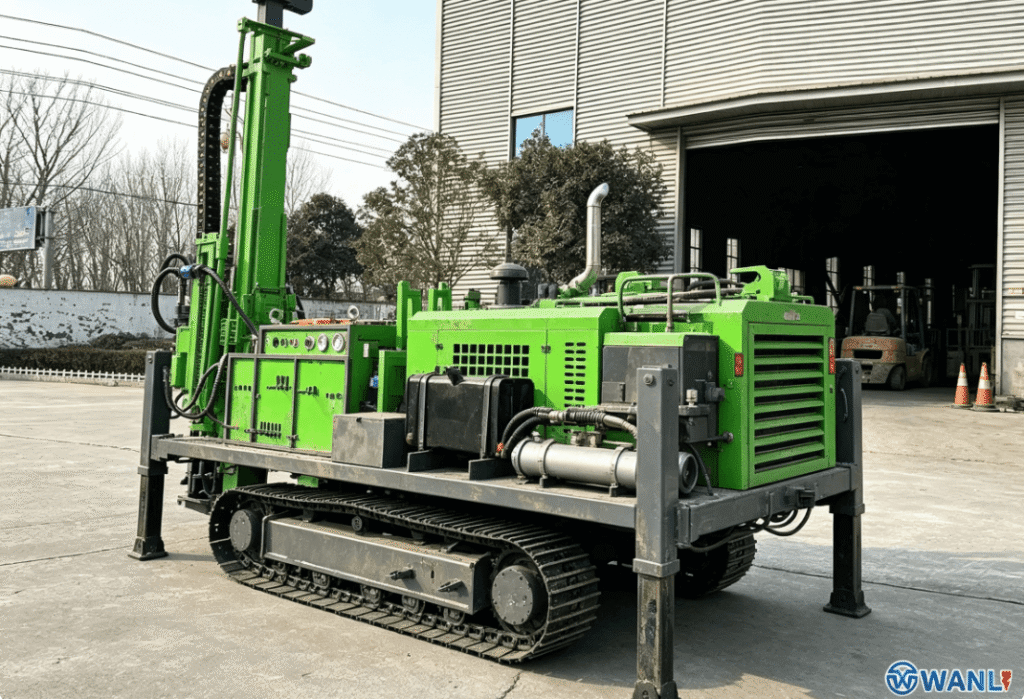
Professional manufacturers in the drilling sector, such as those featured at SDWanli, have shifted toward modular designs. Their current lineup of coring rigs often incorporates hydraulic systems that bridge the gap, offering the high RPM needed for diamond coring while maintaining the rugged durability of a traditional geological explorer. This hybrid approach allows for greater ROI on equipment, though the fundamental engineering still favors the specific needs of core extraction for high-precision geotechnical tasks.
FAQ
Q: Can a geological drilling machine produce a core sample?
A: Yes, many geological machines can be fitted with a core barrel. However, they may lack the high RPM and sensitive feed control necessary for high-quality recovery in fractured or very hard rock.
Q: Why is coring usually more expensive than general geological drilling?
A: Coring is slower and requires specialized “consumables” like diamond bits and core barrels. Additionally, the need for constant fluid management and the time-consuming process of “tripping” the drill string to retrieve the core increases operational costs.
Q: What is “Wireline Coring” in the context of these machines?
A: Wireline coring is a technique used primarily with high-end coring rigs where the inner barrel (containing the sample) is pulled to the surface through the center of the drill rods using a winch. This is much faster than traditional geological drilling where the entire rod string must be pulled out.
Q: Which machine is better for environmental site assessments?
A: Usually a coring rig or a direct-push geological machine. Environmental assessments require precise samples of soil at specific depths to check for contamination migration, which demands high sample integrity.
Reference Sources
- ASTM D2113: Standard Practice for Rock Core Drilling and Sampling of Rock for Site Investigation.
- ISO 22475-1: Geotechnical investigation and testing — Sampling methods and groundwater measurements.
- British Geological Survey (BGS): Guidelines for the use of drilling and sampling equipment in site investigations.
- International Society for Rock Mechanics (ISRM): Suggested methods for rock characterization and testing.