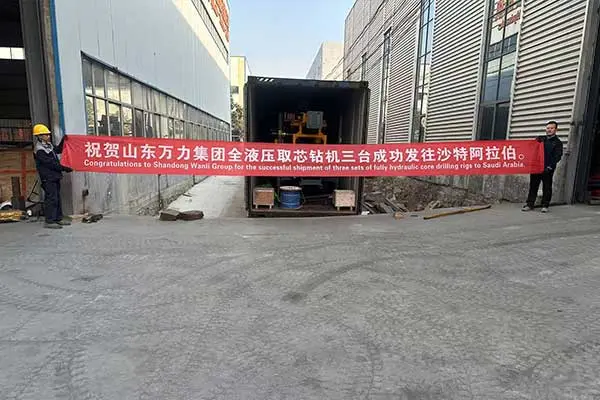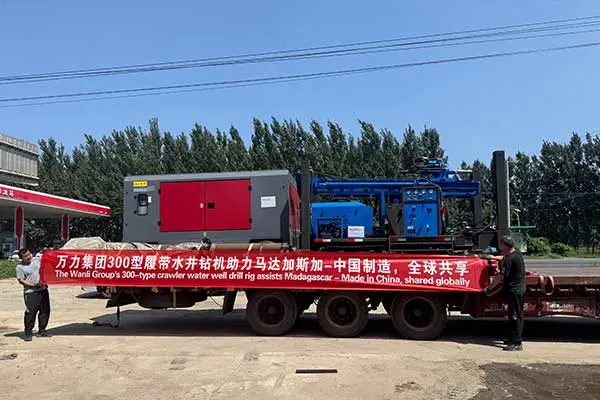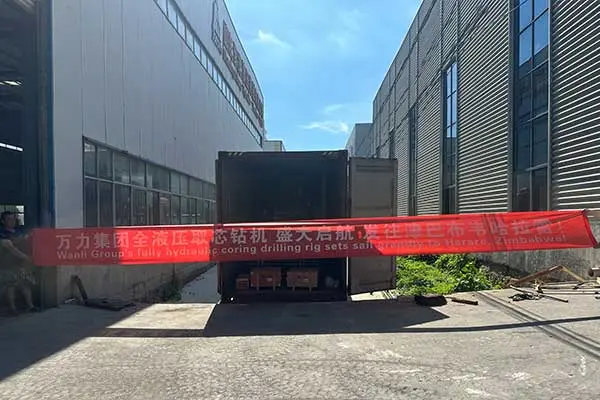
Procuring heavy machinery from overseas involves more than just selecting a high-performance machine. When you decide to export drilling rigs from China—whether they are crawler-mounted water well rigs or truck-mounted industrial units—the complexity lies in the intersection of international maritime law, regional safety certifications, and specialized protective packaging.
For procurement managers and site engineers, the success of a project often hinges on how well the equipment survives the 30-to-45-day transit across high-humidity ocean environments. This guide breaks down the technical and logistical framework required to ensure your drilling assets arrive on-site, compliant, and ready for immediate deployment.
1. Technical Compliance: Mandatory Certifications for Global Markets
To export drilling rigs from China successfully, the equipment must meet the legal standards of the destination country. Customs authorities prioritize safety and environmental impact. Without the correct paperwork, machinery can be impounded or denied entry.
- ISO 9001:2015: This is the baseline. It ensures the manufacturer, such as those producing the Shandong Wanli water well rigs, follows a standardized Quality Management System (QMS).
- CE Marking: Mandatory for the European Economic Area (EEA). It covers the Machinery Directive (2006/42/EC) and ensures the rig meets rigorous safety and health requirements.
- EPA/Euro Stage V Emissions: For rigs powered by diesel engines (common in crawler-mounted models), the engine must meet regional emissions standards. This is particularly strict in North America and the EU.
- EAC Certification: Essential for exports to the Eurasian Customs Union (Russia, Belarus, Kazakhstan).
Before finalizing a Purchase Order, verify that the manufacturer’s technical file includes the “Declaration of Conformity.”
2. Strategic Packaging: Protecting Assets from Saltwater Corrosion
Drilling rigs are composed of precision hydraulics, exposed pistons, and heavy steel structures. During sea freight, “sea air” is the primary enemy. If not packaged correctly, a rig can arrive with seized hydraulic valves or surface oxidation that compromises structural integrity.
Professional Packaging Workflow
- Anti-Corrosion Coating: All exposed chrome parts (such as hydraulic cylinder rods) should be coated with a specialized anti-rust grease or Tectyl-based wax.
- VCI (Volatile Corrosion Inhibitor) Film: Instead of standard plastic wrap, high-end exports use VCI film. This releases a vapor that forms a molecular protective layer on metal surfaces.
- SKD (Semi-Knocked Down) Preparation: For larger rigs, the mast and drill pipes are often disassembled. This reduces the physical footprint, lowering shipping costs and preventing the mast from acting as a lever that could shift the center of gravity during rough seas.
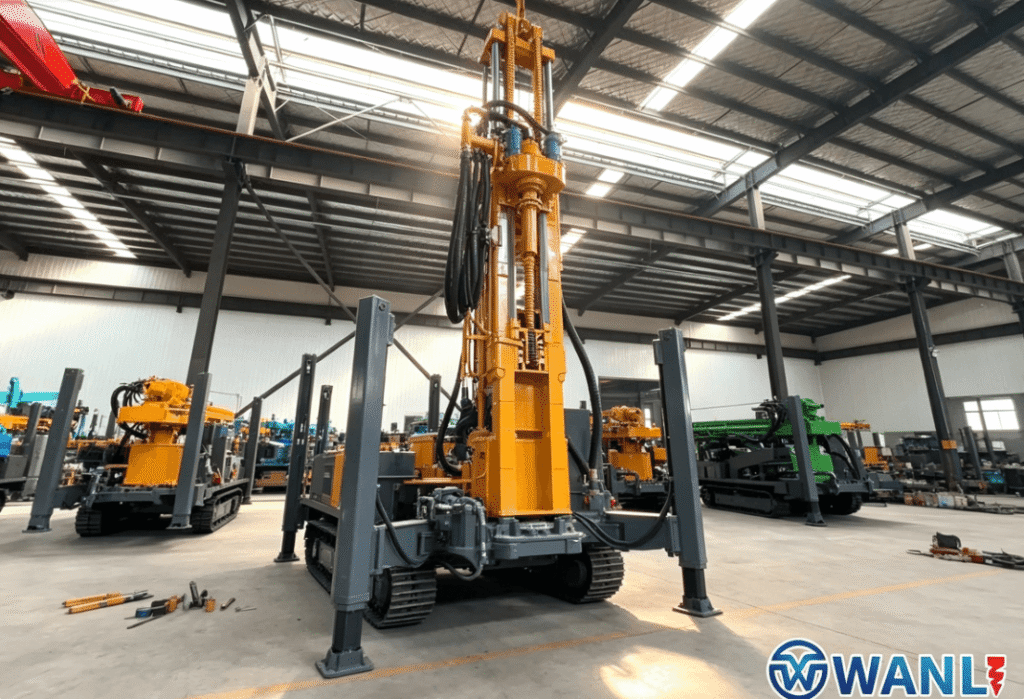
- Base Fixation: For crawler-mounted rigs, the tracks must be secured to the container floor or flat rack using heavy-duty steel wire ropes and turnbuckles to prevent lateral movement.
3. Shipping Methods: Choosing Between RO-RO, Flat Rack, and Containers
The physical dimensions of the rig dictate the logistics strategy. Unlike standard palletized cargo, drilling rigs require a tailored approach to maritime transport.
| Shipping Method | Suitability | Pros | Cons |
| 40HC Container | Small/Medium Water Well Rigs | Lowest cost; best protection from elements. | Requires significant disassembly (SKD). |
| Flat Rack (FR) | Large Crawler Rigs | Accommodates over-width/over-height machinery. | Higher cost; exposed to sea air (requires VCI). |
| RO-RO (Roll-on/Roll-off) | Truck-Mounted Rigs | No crane lifting required; safest handling. | Limited routes; only for self-propelled units. |
| Bulk Cargo | Extreme Industrial Units | Handles any weight/size. | Slowest transit; highest risk of handling damage. |
When you export drilling rigs from China, ask your freight forwarder to calculate the “Total Landed Cost” for each method. For example, a tractor-mounted rig might fit into a standard 40-foot High Cube container, significantly reducing the budget compared to a Flat Rack.
4. Matching Rig Specifications to Regional Geological Requirements
Exporting a rig that isn’t fit for the local terrain is a common procurement error. Manufacturers like Shandong Wanli offer various configurations that impact the shipping weight and final utility:
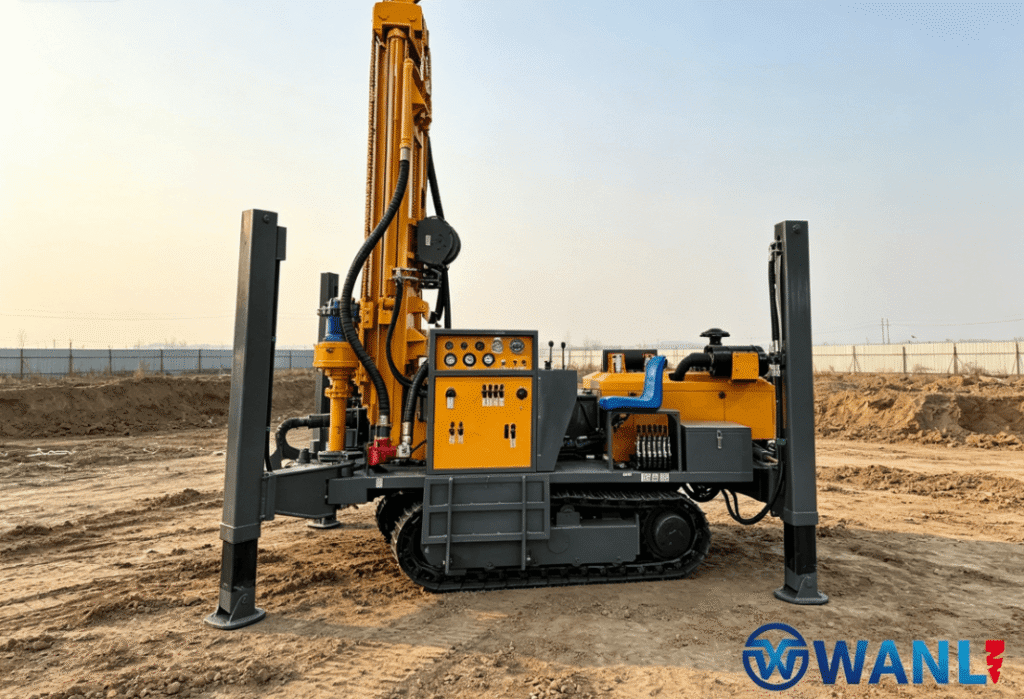
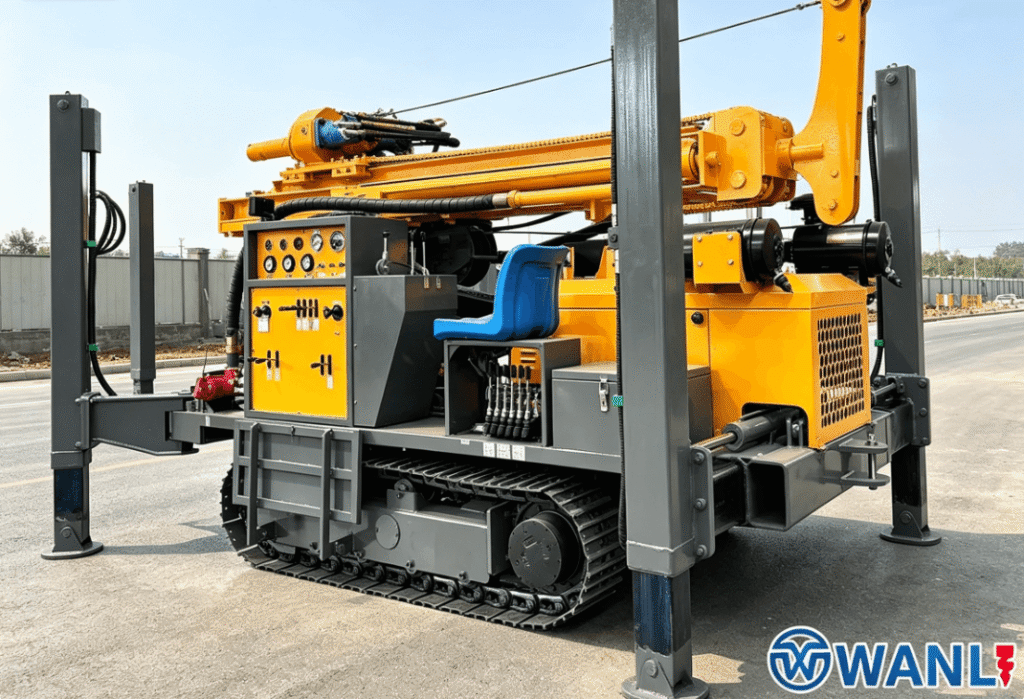
- Crawler-Mounted Rigs: Ideal for soft soil or mountainous terrain where mobility is difficult. These are denser and often require Flat Rack shipping.
- Truck-Mounted Rigs: Best for long-distance travel between boreholes on developed roads. These are typically shipped via RO-RO.
- Pneumatic vs. Hydraulic Systems: Ensure the rig’s power system is compatible with the local climate. High-ambient-temperature regions (e.g., the Middle East) require upgraded oil cooling systems for the hydraulics.
5. Customs Documentation and HS Code Accuracy
The Harmonized System (HS) Code determines the duty rate you will pay upon arrival. For drilling machinery, the most common code is 8430.41 (Self-propelled boring or sinking machinery) or 8430.49 (Other).
The Mandatory Export Document Checklist:
- Bill of Lading (B/L): The title of the goods.
- Commercial Invoice: Must match the LC (Letter of Credit) exactly.
- Packing List: Detailed breakdown of every component, including drill bits, pipes, and toolkits.
- Certificate of Origin (CO): Often used to claim preferential tariff rates under Free Trade Agreements (e.g., China-ASEAN FTA).
- Fumigation Certificate: If wooden crates are used for spare parts, they must be heat-treated and stamped according to ISPM 15 standards.
Summary: The B2B Procurement Workflow
To successfully export drilling rigs from China, the process should follow a disciplined sequence:
- Technical Validation: Confirm the rig’s depth and diameter capabilities match your project (e.g., 200m–600m for standard water wells).
- Certification Audit: Verify CE/ISO/EPA compliance.
- Loading Supervision: Request photos of the anti-rust treatment and the lashing/securing process inside the container.
- Logistics Coordination: Balance the trade-off between the speed of RO-RO and the cost-efficiency of 40HC containers.
By addressing these technical and logistical pillars, you minimize the risk of equipment downtime and unexpected customs expenses, ensuring your drilling operation starts on schedule.
FAQ
Q: Can I fit a 300m water well drilling rig into a standard container?
A: Yes. Most 300m-class rigs, especially crawler or tractor-mounted models, are designed to fit into a 40HQ container by removing the mast and certain hydraulic attachments.
Q: How do I prevent my drilling rig from rusting during the 40-day sea voyage?
A: Ensure the manufacturer applies a professional “sea-worthy packaging” protocol. This includes coating all bright metal parts with anti-rust oil, using VCI (Volatile Corrosion Inhibitor) plastic bags, and placing desiccant silica gel packs inside the control panels.
Q: What is the typical lead time when exporting drilling rigs from China?
A: Production usually takes 15–30 days depending on customization (e.g., specific engine brands or color schemes). Shipping adds another 20–45 days depending on the destination port.
Q: Are Chinese drilling rigs compatible with international drill pipe standards?
A: Most reputable manufacturers use standard API (American Petroleum Institute) thread connections. Always confirm the thread type (e.g., REG or IF) before the rig is shipped to ensure compatibility with your existing drill string.
Reference Sources:
- International Organization for Standardization (ISO) – Machinery Safety
- General Administration of Customs of the People’s Republic of China (GACC)
- European Commission – Machinery Directive 2006/42/EC
- International Maritime Organization (IMO) – Cargo Securing Manuals