Investing in a coring drilling rig is a significant capital expenditure that dictates the technical capability and operational overhead of geotechnical, mining, or construction projects for years. Whether you are upgrading a fleet or transitioning from rental to ownership, the “best” rig is rarely the one with the highest specs; it is the one that best balances geological versatility with long-term maintenance costs.
In the current market, procurement managers often struggle to reconcile manufacturer datasheets with real-world site conditions. This coring drilling rig buying guide addresses the critical technical and commercial questions that buyers must ask to ensure equipment longevity and project profitability.
Which Drive System Fits Your Geological Profile?
The choice between a spindle-type rig and a full hydraulic top-drive rig is the most fundamental technical decision a buyer makes.
- Spindle-Type Rigs: These are the industry workhorses for traditional exploration. Rigs like the HZ-200 series utilize a mechanical spindle to transmit torque. They are favored for their simplicity, ease of repair in remote locations, and lower initial acquisition cost. If your projects involve consistent soil sampling or medium-hard rock at depths up to 200 meters, a spindle rig offers the highest ROI.
- Hydraulic Feed Systems: Modern rigs often incorporate hydraulic feed cylinders (found in many SDWanli models). This allows the operator to control the “weight on bit” (WOB) more precisely. Precision in feed pressure is essential when transitioning through varying strata—such as moving from soft clay to weathered granite—to prevent core blockage or premature bit wear.
Does the Rated Depth Match Your “Real-World” Depth?
One of the most common pitfalls in procurement is purchasing a rig based solely on its maximum rated depth. A rig rated for 200 meters (like the HZ-200) is designed to hit that depth under optimal conditions with specific rod diameters (usually NQ or BQ).
Technical Consideration: As the hole gets deeper, friction between the drill string and the borehole wall increases. If your projects consistently require 180-meter holes, you should look for a rig with a safety margin, perhaps one rated for 250 meters. Factors that reduce your effective depth include:
- Drilling Fluid Density: Thicker mud requires more pump power.
- Borehole Deviation: Higher friction in “crooked” holes.
- Rod Weight: Heavier steel rods consume more of the rig’s hoisting capacity.
Mobility vs. Stability: Which Chassis is Optimal?
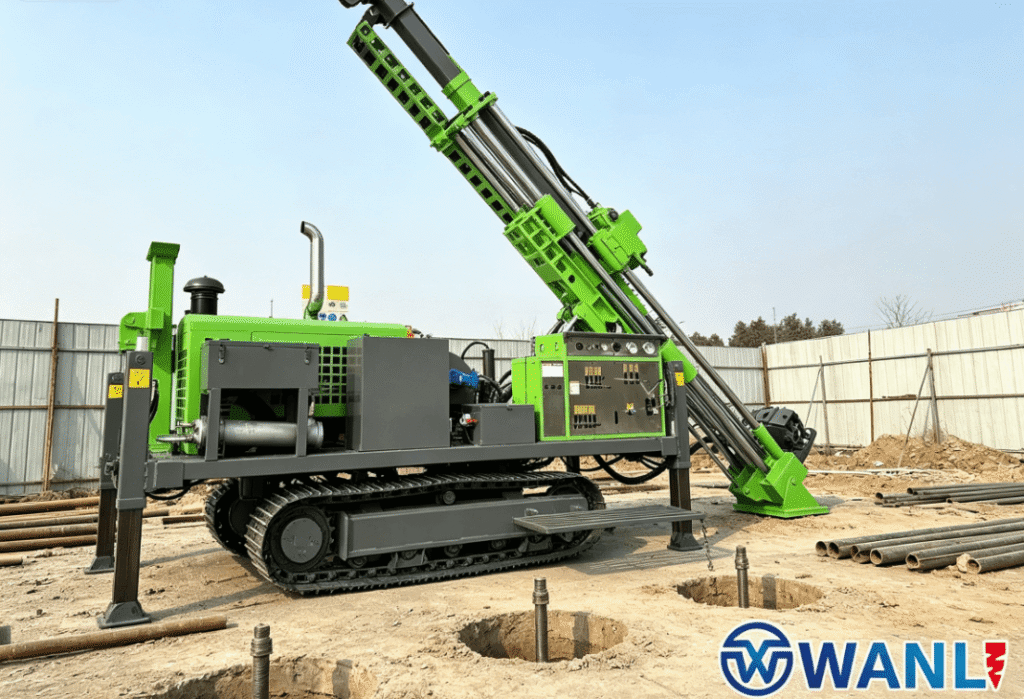
How you move the rig is as important as how it drills. Site accessibility determines whether you need a portable, trailer-mounted, or crawler-mounted solution.
| Chassis Type | Best For… | Key Advantage |
| Skid-Mounted | Long-term stationary projects | Lowest cost; maximum stability. |
| Trailer-Mounted | Urban geotechnical surveys | Rapid transport between sites via standard truck. |
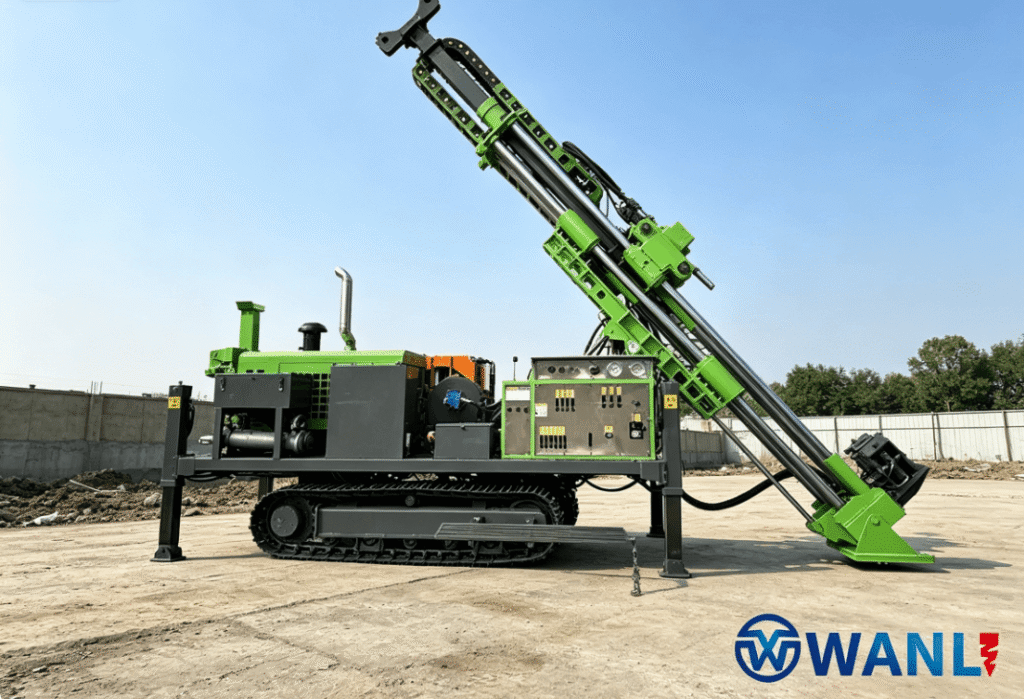
| Crawler-Mounted | Remote, rugged terrain | Self-propelled; no need for a support crane to position the rig. |
For many commercial contractors, the wheeled trailer-mounted rig represents the best middle ground, allowing for quick deployment across multiple municipal sites without specialized heavy-haul permits.
Spindle Hole Diameter and Tooling Compatibility
A rig is only as versatile as the tooling it can accommodate. Before purchasing, verify the spindle hole diameter. This determines the maximum size of the drill rod you can pass through the machine.
For example, a spindle diameter of 53mm or 65mm is standard for many medium-duty rigs. If your project requires large-diameter sampling for structural foundations (e.g., 150mm or 300mm holes), the rig must have a gearbox and torque profile capable of handling the increased resistance of larger core barrels.
What are the Power Source Requirements?
Environmental regulations and site locations dictate your power choice:
- Diesel Engines: Essential for remote mineral exploration where electrical infrastructure is non-existent. Ensure the engine meets local emissions standards (e.g., Tier 4 or Stage V) if operating in North America or Europe.
- Electric Motors: Ideal for indoor foundation work, tunneling, or sites with strict noise ordinances. Electric rigs offer lower maintenance costs but require a stable power supply or a heavy-duty generator.
Evaluating Manufacturer Support and OEM Customization
When reviewing a coring drilling rig category, look beyond the machine. In the B2B manufacturing sector, the ability to customize components—such as the mud pump capacity or the winch hoisting speed—is a marker of a high-quality OEM.
Critical Procurement Checklist:
- Component Origin: Are the hydraulic valves and pumps from reputable brands (e.g., Rexroth, Vickers) or proprietary designs?
- Wear Parts Availability: Can you source replacement seals, bearings, and clutch plates locally, or is there a 4-week lead time?
- Modular Design: Can the mast be detached for transport in small elevators or by helicopter for mountain work?
Commercial Decision: Total Cost of Ownership (TCO)
A “cheap” rig often becomes the most expensive asset due to downtime. When analyzing quotes, request a “recommended spare parts kit” for the first 1,000 hours of operation. This gives you a realistic view of the maintenance overhead. For commercial buyers, a rig like the HZ-130 or HZ-180 often provides the best balance of fuel efficiency and mechanical reliability for standard geotechnical applications.
FAQ: Buying a Coring Drilling Rig
Q: Can I use a coring rig for water well drilling?
A: While possible, coring rigs are designed for high-RPM sampling, not high-volume water production. For shallow wells, a coring rig is sufficient, but for deep water wells, a dedicated water well rig with a larger mud pump and higher torque is more efficient.
Q: What is the difference between “Wireline” and “Conventional” coring?
A: Wireline coring allows you to retrieve the core sample via a cable through the center of the drill rods, which is much faster for deep holes. Conventional coring requires you to pull the entire string of rods out of the hole to get the sample. Ensure your rig’s winch is “wireline ready” if you plan to use this method.
Q: What safety certifications should I look for?
A: Look for ISO 9001 for manufacturing quality and CE certification if you are importing into the European Union. Ensure the rig has emergency stop buttons and safety guards around rotating parts.
Q: How do I determine the appropriate MOQ for drill rods and bits?
A: Most manufacturers require a minimum order for consumables to make shipping cost-effective. Typically, ordering 50–100 meters of rod and a variety of 5–10 diamond bits for different rock hardnesses is standard for a new rig purchase.
Q: What is the lead time for a custom-configured rig?
A: Standard models (like the HZ-200) often have a lead time of 15–30 days. Custom chassis or specialized hydraulic configurations may take 45–60 days depending on the factory’s production cycle.
Reference Sources
- ASTM D2113: Standard Practice for Rock Core Drilling and Sampling for Site Investigation.
- ISO 22475-1: Geotechnical investigation and testing — Sampling methods and groundwater measurements.
- International Society for Rock Mechanics (ISRM): Suggested methods for determining water content, porosity, and density of rock material.
- Technical Specifications: SDWanli Coring Rig Series Documentation.