Coring drilling is a precision-driven process where success is measured not just by the depth reached, but by the quality of the core sample recovered and the cost-per-meter achieved. In geotechnical exploration, mining, and civil engineering, “efficiency” is a multi-dimensional metric. It encompasses the Rate of Penetration (ROP), the longevity of the diamond bit, and the minimization of non-productive time (NPT).
Understanding the factors affecting coring drilling efficiency is essential for site engineers and project managers who need to balance speed with geological accuracy. Whether operating a spindle-type rig or a full hydraulic crawler unit, the interaction between mechanical parameters and subterranean variables determines the ultimate ROI of the drilling program.
Geological Formation and Rock Mechanics
The primary determinant of drilling performance is the ground itself. Rock characteristics dictate the limits of what a drilling rig can achieve.
Hardness and Abrasiveness: Rocks with high Mohs scale ratings require higher bit pressure and specific diamond matrix formulations. Highly abrasive formations, such as sandstone or certain granites, can strip the matrix of a bit prematurely if the RPM is not perfectly calibrated.
Fracture Zones and Competency: In broken or “vuggy” ground, fluid loss and vibration become significant hurdles. Efficiency drops when the energy of the drill string is dissipated into fractures rather than cutting the face of the rock.
Rock Stress: At greater depths, the in-situ stress of the formation can cause borehole instability, requiring more complex mud programs which, while necessary, can slow down the ROP.
Mechanical Specifications of the Drilling Rig
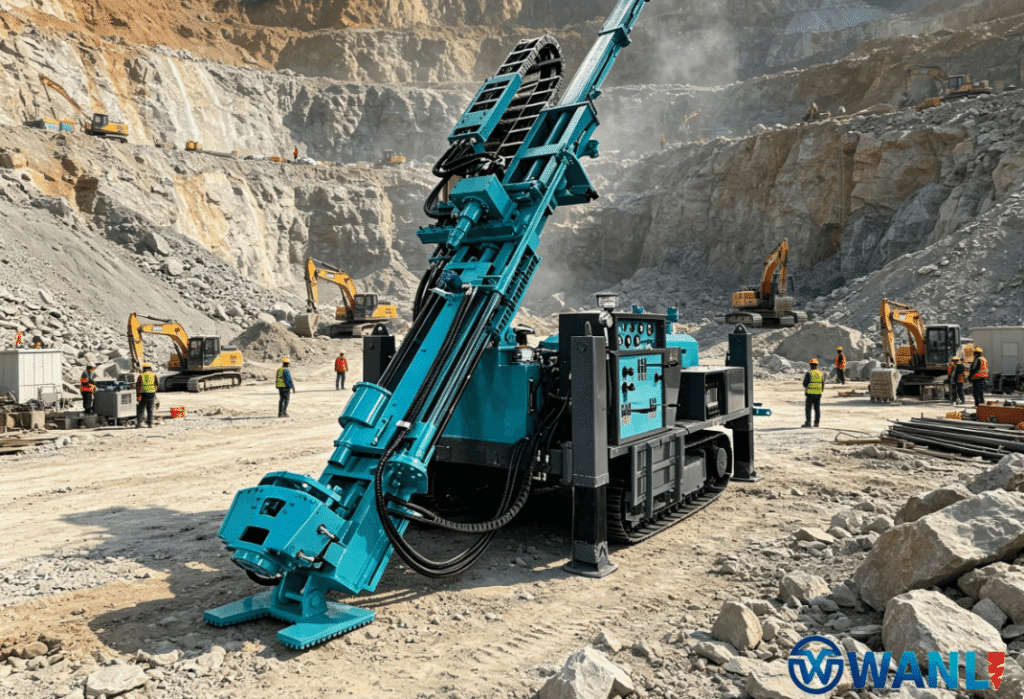
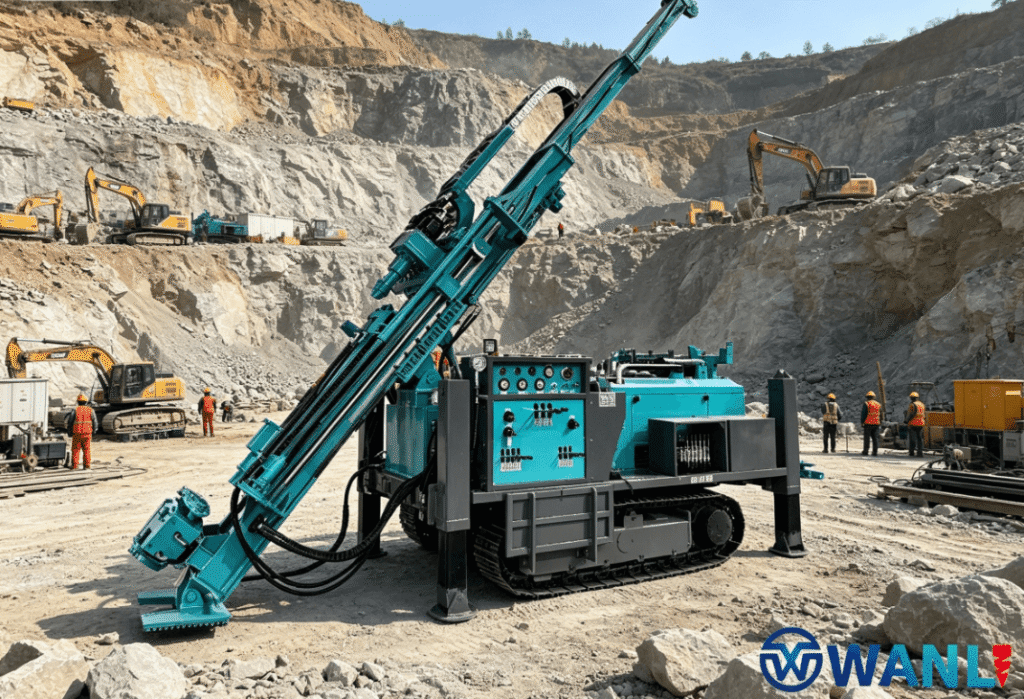
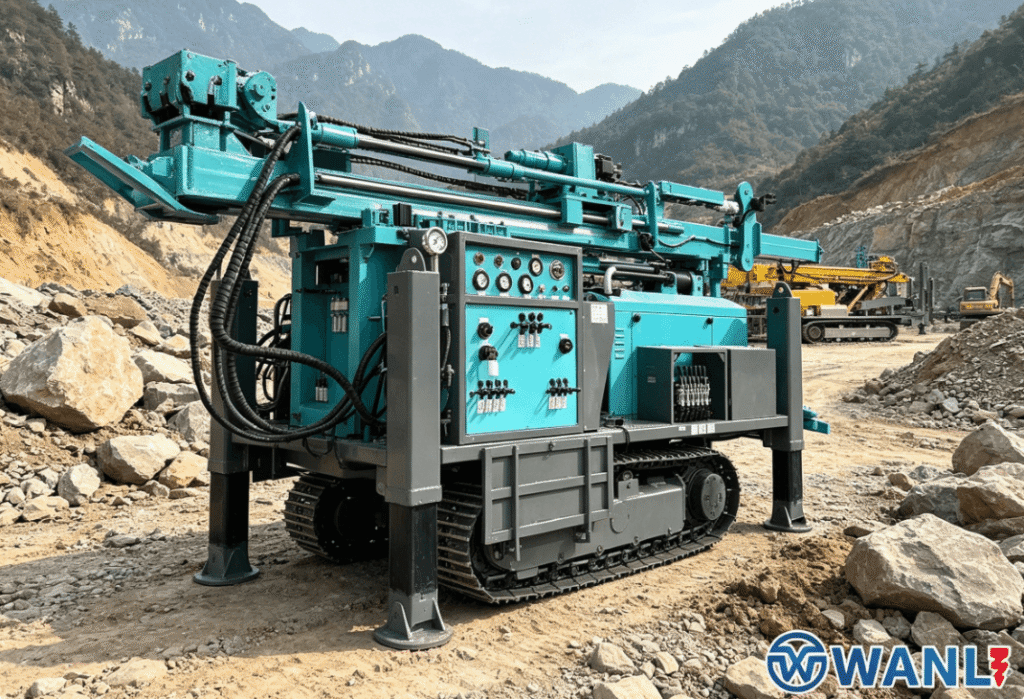
The capabilities of the equipment, such as those found in the SD Wanli Coring Drilling Rig series, provide the foundation for efficiency. A mismatch between rig capacity and project requirements is a leading cause of inefficiency.
Spindle Speed (RPM): For diamond coring, high RPM is often required to allow the diamonds to “micro-chip” the rock. Rigs that offer a wide range of gear speeds allow operators to shift from high-torque/low-speed (for difficult overburden) to high-speed/low-torque (for hard competent rock).
Feed Stroke and Pullback Capacity: A longer feed stroke reduces the frequency of “chucking,” or resetting the drill string, which directly increases the active drilling time per hour.
Torque vs. Depth: As a borehole gets deeper, the friction between the drill rods and the hole wall increases. A rig must have sufficient “reserve torque” to maintain rotation speeds at the bottom of a 600m or 1000m hole.
Diamond Bit Selection and Matrix Matching
The drill bit is the “business end” of the operation. Choosing the wrong bit is perhaps the most common reason for poor efficiency in the field.
| Rock Type | Recommended Bit Type | Matrix Hardness | Key Consideration |
| Soft/Sedimentary | Surface Set Diamond | Hard Matrix | High fluid bypass to prevent clogging |
| Medium/Hard | Impregnated Diamond | Medium Matrix | Balanced wear rate to expose new diamonds |
| Ultra-Hard/Ignious | Impregnated Diamond | Soft Matrix | “Self-sharpening” effect is critical |
Efficiency is maximized when the wear rate of the bit matrix matches the abrasiveness of the rock. If the matrix is too hard, the diamonds will become “polished” and stop cutting; if it is too soft, the bit will wear out before its time, leading to frequent, time-consuming rod pulls.
Drilling Fluid Dynamics (Mud Program)
Drilling fluid is often misunderstood as merely a cooling agent. In reality, it is the “blood” of the borehole. Its properties significantly affect the factors affecting coring drilling efficiency.
Cuttings Removal: The fluid must have enough “carrying capacity” (viscosity) to lift rock chips to the surface. If cuttings settle at the bottom, they are re-ground by the bit, wasting energy and accelerating wear.
Lubrication: Proper additives reduce the friction between the drill string and the casing, allowing more of the rig’s power to be delivered to the bit.
Stabilization: In reactive clays or loose sands, the chemical composition of the mud prevents hole collapse, avoiding the catastrophic efficiency loss of a stuck drill string.
Weight on Bit (WOB) and Controlled Parameters
Efficiency is a delicate balance of physics. The operator must manage the relationship between WOB and RPM.
Increasing the WOB generally increases the ROP, but only up to a “critical point.” Beyond this point, the bit may become “buried,” torque will spike, and the diamonds may shatter due to excessive heat and pressure. Professional engineers use “drilling-off” tests to find the “Sweet Spot”—the specific combination of pressure and rotation that yields the highest penetration rate with the lowest vibration.
Drill String and Core Barrel Design
The choice between Conventional Coring and Wireline Coring is a major strategic decision.
Wireline Coring: This is the industry standard for deep-hole efficiency. It allows the inner tube (containing the core) to be hoisted to the surface via a winch, without pulling the entire drill string. This saves hours of labor as the hole deepens.
Rod Stabilization: High-quality, straight drill rods reduce “harmonic vibration.” Vibration is the enemy of efficiency; it causes premature bit failure, core breakage, and mechanical wear on the rig’s head and bearings.
Human Factors and Maintenance Protocols
Even the most advanced hydraulic rig cannot compensate for poor site management.
Operator Experience: An experienced driller “listens” to the rig. They can sense a change in formation by the vibration in the controls or a subtle needle movement on the pressure gauge, adjusting parameters before a bit burns out.
Preventative Maintenance: NPT (Non-Productive Time) caused by hydraulic leaks, engine failure, or snapped cables is a total efficiency killer. Rigorous daily inspections of the cooling system, lubrication points, and wire ropes are mandatory for high-performance operations.
Technical Performance Summary
To optimize coring drilling efficiency, one must view the rig, the bit, the fluid, and the formation as a single integrated system. When these factors are aligned—specifically matching the rig’s RPM capabilities with the correct impregnated bit matrix for the local geology—the cost-per-meter drops significantly.
For projects involving deep mineral exploration or complex geotechnical sampling, selecting a rig with a high power-to-weight ratio and versatile spindle speeds is the most effective way to mitigate the external variables of the job site.
FAQ
Q: How does spindle speed (RPM) specifically impact diamond bit life?
A: Higher RPM increases the “surface feet per minute” of the diamonds. In hard rock, high RPM is necessary to maintain a cutting action. However, if the RPM is too high for the cooling capacity of the mud, the diamonds will suffer thermal degradation (graphitization), causing the bit to fail prematurely.
Q: Why is “Core Recovery” considered a part of drilling efficiency?
A: If a driller reaches the target depth quickly but only recovers 50% of the core, or if the core is highly fragmented, the drilling may need to be repeated (re-drilled). True efficiency is “successful meters per day,” where success is defined by high-quality, intact core samples that geologists can analyze accurately.
Q: Can I use the same rig for both soil sampling and hard rock coring?
A: Yes, provided the rig has a versatile transmission. Soil sampling (like SPT) requires high torque and lower speeds, whereas diamond coring requires high stability and high RPM. Rigs like the crawler-mounted units from SD Wanli are designed to handle these transitions by offering multiple gear ratios.
Q: What is the most common cause of “Polished Diamonds”?
A: This usually occurs when the Weight on Bit (WOB) is too low or the RPM is too high for a hard formation. The diamonds rub against the rock without penetrating it, creating enough heat to round off their sharp edges. Increasing WOB or switching to a softer matrix bit usually solves this.
Reference Sources
ASTM D2113: Standard Practice for Rock Core Drilling and Sampling of Rock for Site Investigation.
The International Society for Rock Mechanics (ISRM): Suggested Methods for Rock Characterization and Testing.
Australian Drilling Industry Training Committee (ADITC): The Drilling Manual (5th Edition).
Diamond Core Drilling Manufacturer’s Association (DCDMA): Standards for drill rods, casings, and core barrels.