When contractors screen options for the best crawler drilling rig for mining and geological exploration, the winning machine is rarely the one with the biggest brochure number—it is the one that matches hole size, rock hardness, compressor supply, and site mobility without inflating owning-and-operating cost. The rig described below (78 kW Yuchai, φ90–152 mm, 3″/4″ DTH, 2400 N·m rotary head, 4800 kg crawler chassis) is a textbook example of that balance: a mid-weight surface DTH unit built for open-pit blast holes, exploration percussion holes, quarry production drilling, and slope/anchor work in F6–F20 rock.
Why This Configuration Ranks Among the Best Crawler Drilling Rigs for Mining
Mining buyers usually weigh four things: power-to-weight ratio, DTH hammer match, terrain mobility, and service simplicity. This rig scores well on all four.
- Power system: Yuchai diesel engine, rated at 78 kW. Proven in Chinese-engineered drill rigs for fuel economy, parts availability, and altitude/heat tolerance.
- Drilling envelope: φ90–152 mm hole diameter, economic drilling depth configured via φ64 mm × 2000 mm + φ64 mm × 3000 mm drill rods (flexible rod layout for shallow production and deeper exploration setups).
- DTH compatibility: Matched to 3″ and 4″ DTH hammers, the global standard for 90–152 mm blastholes. Working pressure 0.8–1.6 MPa, air consumption 9–15 m³/min—pairs with a mid-size portable screw compressor instead of a heavy dedicated booster.
- Rotary performance: Max rotary torque 2400 N·m, speed 0–150 rpm. Enough torque to back-ream, ream through fractures, and keep the bit rotating in F6–F20 hardness without stalling.
- Feed system: Hydraulic cylinder + chain, giving controlled thrust for straight holes and stable pullback during rod handling.
- Mobility: Crawler travel 0–2 km/h, gradeability 30°, ground clearance 450 mm. It climbs muck piles, bench edges, and exploration ridges that wheeled rigs cannot reach.
- Footprint: 5700 × 2100 × 2300 mm transport size, 4800 kg operating weight. Light enough for a 10-t flatbed move between benches, heavy enough to stay planted under DTH recoil.
- Diesel capacity: 70 L tank—sized for a full shift with a compressor trailer, no daily refuel run.
- Leveling: ±10° horizontal leveling angle, essential for vertical-hole accuracy on sloping benches.
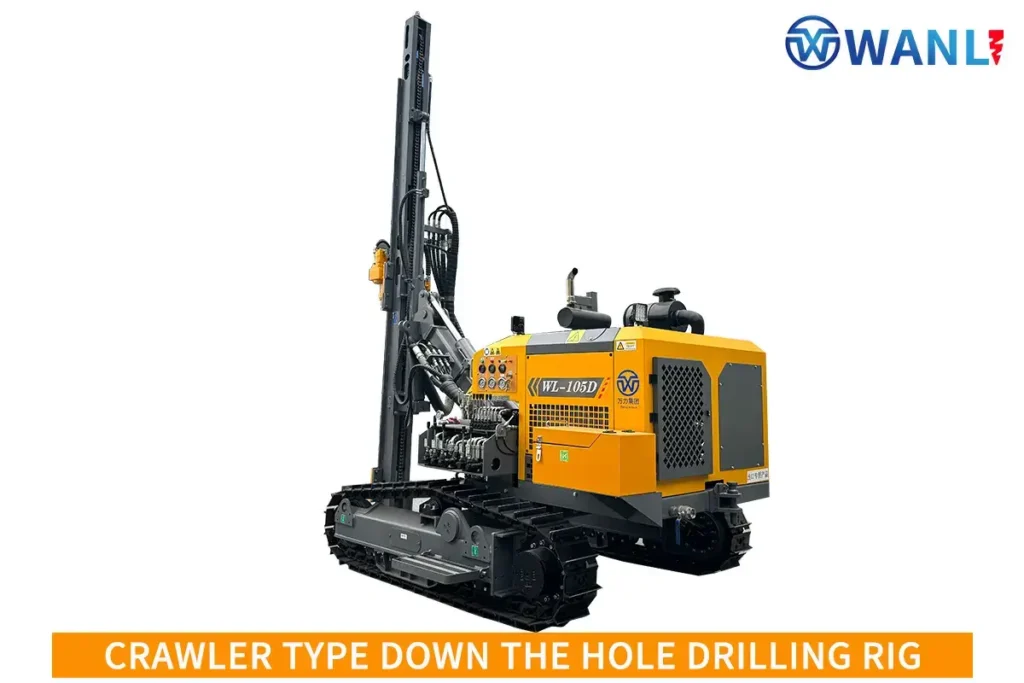
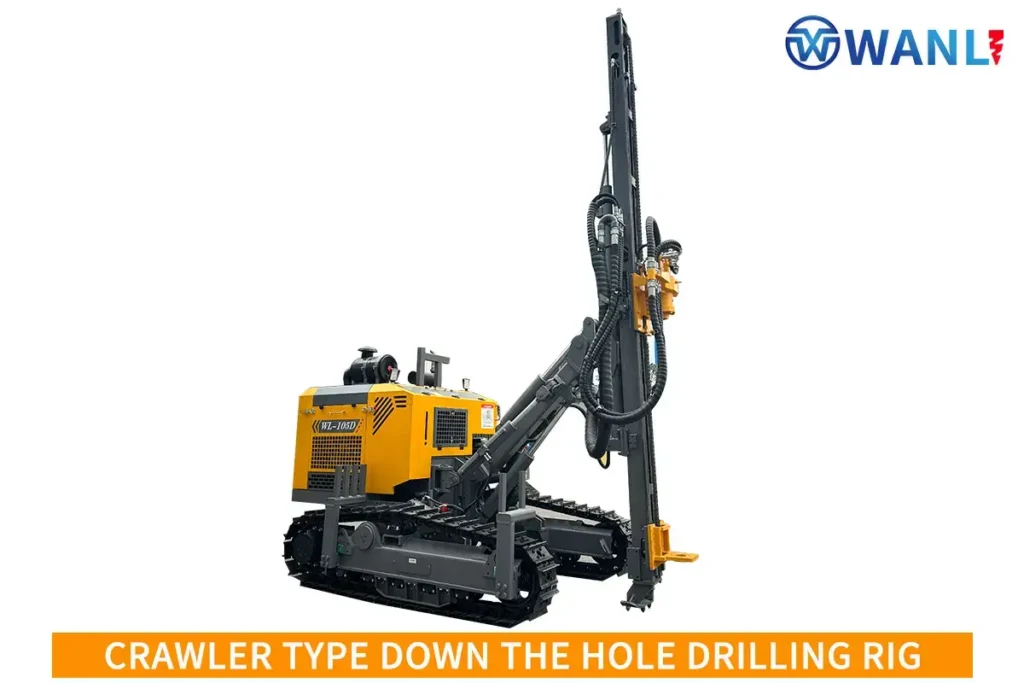
Technical Specification Table
| Parameter | Value |
| Supporting power | Yuchai diesel, rated 78 kW |
| Drilling diameter | φ90–152 mm |
| Economic drilling depth | Configured with φ64×2000 mm + φ64×3000 mm rods |
| DTH hammer | 3″ / 4″ |
| Working pressure | 0.8–1.6 MPa |
| Air consumption | 9–15 m³/min |
| Max rotary torque | 2400 N·m |
| Rotary speed | 0–150 rpm |
| Feed method | Hydraulic cylinder + chain |
| Travel speed | 0–2 km/h |
| Gradeability | 30° |
| Ground clearance | 450 mm |
| Machine weight | 4800 kg |
| Overall dimensions | 5700 × 2100 × 2300 mm |
| Rock hardness | F6–F20 |
| Diesel tank volume | 70 L |
| Leveling angle | ±10° |
These numbers mirror the PDKJ-617-class surface DTH rig already field-proven in hard-rock mining and construction blasting, confirming the configuration is not a spec-sheet fantasy but a shipped product tier.
Application Fit: Where It Becomes the Best Crawler Drilling Rig for Mining Jobs
- Open-pit metal/non-metal mines – 90–152 mm blast holes in iron ore, limestone, granite, basalt (F6–F20).
- Geological exploration – Percussion/pre-collared holes for geochem and geotech sampling where core recovery is not mandatory but penetration rate is.
- Quarry production – Daily bench drilling with fast repositioning (2 km/h crawler, 4800 kg class).
- Slope stabilization & anchoring – ±10° leveling and 30° climb let it work cut slopes directly.
- Remote exploration camps – 70 L diesel + 9–15 m³/min air demand runs off a single towed compressor.
For deep core mineral exploration (NQ/HQ diamond core at 300 m+), this is not the right tool—but for surface DTH exploration and production blasting, it sits in the sweet spot.
Buying Insight: What “Best” Really Means Here
The phrase best crawler drilling rig for mining is contextual. If your holes are 90–152 mm, your rock is F6–F20, your compressor is 9–15 m³/min at ≤1.6 MPa, and your site has no road—then a 78 kW Yuchai + 2400 N·m rotary head + 4800 kg crawler is objectively near-optimal. You avoid the 100+ kW engine penalty, the 6–8 t transport permit headache, and the oversized compressor bill, while keeping DTH penetration competitive with heavier rigs.
Maintenance-wise, the cylinder-chain feed and centralized crawler hydraulics keep wearable parts cheap and familiar to any excavator/DRT mechanic. That is why this class dominates mid-size mining contractors in Asia, Africa, and Latin America.
Closing
A crawler drilling rig for mining does not need to be the largest machine on the bench; it needs to drill the right hole, in the right rock, from the right compressor, and relocate before the blast crew waits. With a 78 kW Yuchai heart, 3″/4″ DTH range, 2400 N·m rotary, and a 4800 kg go-anywhere crawler frame, this rig earns its place on the shortlist for the best crawler drilling rig for mining and geological exploration in the 90–152 mm DTH segment.
If you want, I can also produce a compressor-matching sheet (9–15 m³/min @ 1.6 MPa models) or a Chinese/English bilingual spec sheet formatted for Alibaba, Made-in-China, or exhibition catalogs.