Choosing an RC drilling rig manufacturer is a procurement decision, not simply a search for the lowest equipment price. The right supplier should be able to match the rig, dual-wall drilling system, air management, mobility package, sampling workflow, documentation and after-sales support to your exploration program. This guide explains how to evaluate a manufacturer and what to confirm before requesting a quotation from Wanli or another supplier.
Reverse circulation (RC) drilling returns cuttings through the inner tube of a dual-wall rod. A pneumatic hammer and bit break the formation, while compressed air helps lift the sample to a cyclone and collection system.1 In mineral exploration, the method is attractive when a project needs many labelled samples and a practical production rate, but its suitability still depends on geology, hole design, water conditions, access and the required level of geological information
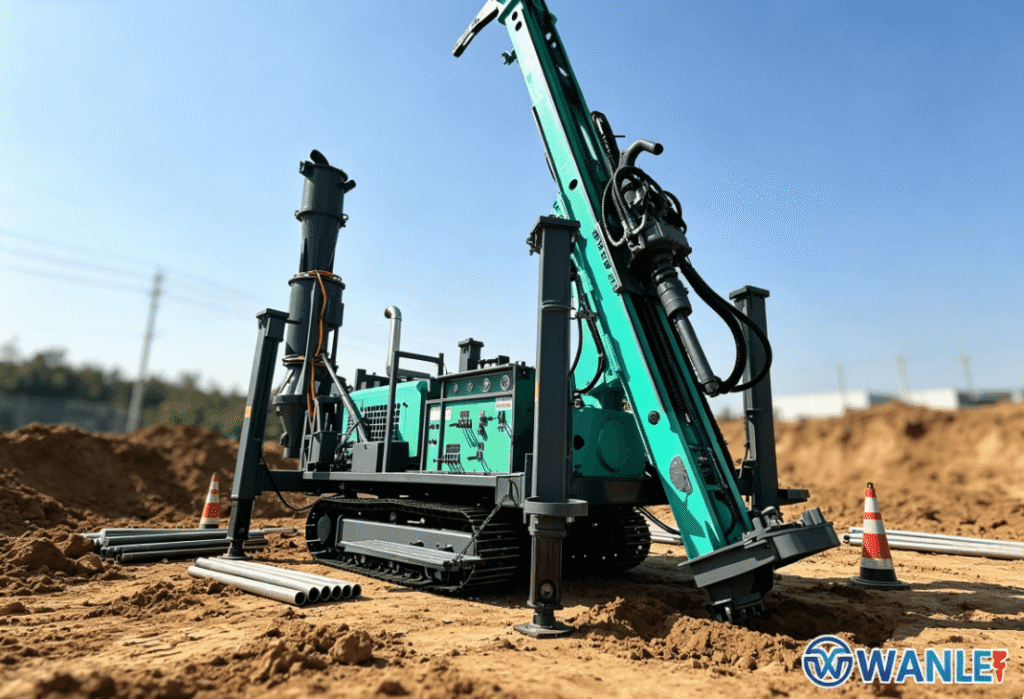
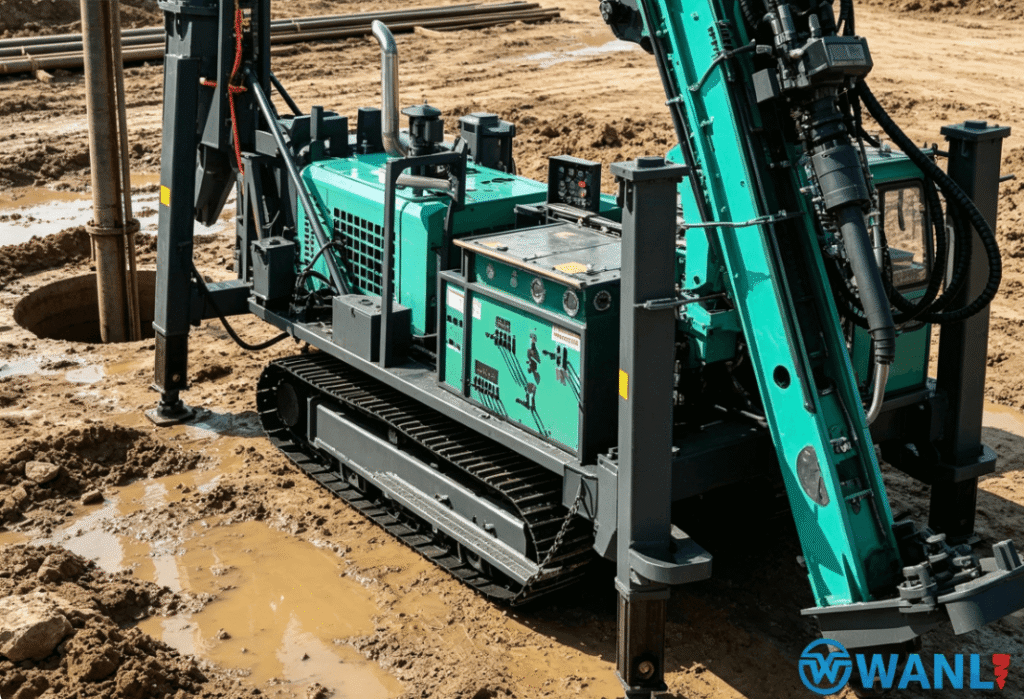
Figure 1. Crawler-mounted RC reverse circulation drilling rig shown on the official Wanli product page. View the source product page.
What buyers should expect from an RC drilling rig manufacturer
A manufacturer should begin with the drilling application rather than a generic catalogue label. Tell the supplier the target commodities, expected overburden and rock types, planned hole depth, hole diameter, inclination, water conditions, altitude, access constraints and annual metres. Also describe the sample-quality and laboratory requirements. These details determine whether a standard RC package is appropriate or whether the project needs additional air, water, mud, rod-handling or support equipment.
Wanli’s public product page describes its RC reverse circulation drilling rig as a full-hydraulic-drive machine with reverse-circulation slag discharge. The page also states that the rig is intended for cobble, gravel and other complex formations, and that its crawler chassis is designed for flexible relocation.2 These are supplier-published descriptions, not independent performance results. The exact model, configuration and project suitability should be confirmed in writing before purchase.
| Buying question | Why it matters | What to request in writing |
|---|---|---|
| What formation will be drilled? | Ground conditions influence bit choice, air demand, wear and hole stability. | Recommended configuration, formation assumptions and exclusions. |
| What depth and diameter are required? | Catalogue capability can vary with rod, hammer, bit, geology and angle. | Rated depth and diameter for the proposed configuration, with conditions. |
| How will the rig move on site? | Exploration programs often require frequent relocation and uneven access. | Crawler dimensions, gradeability, transport weight and setup procedure. |
| How will samples be collected? | Sample handling affects contamination control, logging and laboratory readiness. | Cyclone, splitter, hose, sample-bag and dust-control arrangement. |
| What support is included? | Downtime can erase the benefit of a lower purchase price. | Parts list, manuals, training, warranty and response process. |
How to Choose an RC Drilling Rig Manufacturer
Choosing an RC drilling rig manufacturer should start with the requirements of the drilling program rather than the name of a machine or its headline specifications. A suitable manufacturer should be able to translate the project requirements into a complete drilling configuration and explain the assumptions behind its recommendations.
First, confirm the manufacturer’s technical capability. Ask whether the company can provide a configuration that matches the planned hole depth, diameter, drilling angle, formation and expected water conditions. The manufacturer should be able to identify the appropriate rig, rod system, hammer, bit and air package for the proposed application rather than providing a generic specification sheet.
Second, review the manufacturer’s approach to air management and sampling. RC drilling depends on the interaction between the dual-wall drill string, hammer, compressed-air system and surface sample collection equipment. The quotation should therefore make clear whether the compressor, booster, cyclone, splitter, hoses and dust-control equipment are included or supplied separately.
Third, evaluate mobility and site compatibility. Crawler dimensions, transport weight, gradeability, setup requirements and available power can affect whether a rig is practical for a particular exploration site. These factors should be reviewed together with the drilling plan rather than treated as separate equipment specifications.
Technical documentation and after-sales support are also important. Request the technical datasheet for the exact quoted configuration, general arrangement drawings, recommended spare-parts and consumables lists, maintenance information, warranty terms and commissioning procedures. Clarify how technical support is provided and which parts can be supplied locally or shipped from the manufacturer.
Finally, compare manufacturers on a like-for-like basis. A lower base-machine price does not necessarily represent a lower project cost if compressors, drilling tools, sampling equipment, spare parts, training or commissioning are excluded. A manufacturer that clearly defines the scope of supply and identifies configuration assumptions can make the procurement process easier to evaluate and reduce uncertainty before the purchase order is issued.
Match the RC rig to the exploration method
RC drilling is commonly selected for rapid collection of crushed rock samples rather than continuous intact core. Epiroc explains that RC can produce a large number of labelled sample bags in a short time and that samples may be sent to a laboratory during or after drilling.3 That workflow can support exploration programs and grade-control decisions, provided the drilling and sampling procedures are properly managed.
The method is not automatically the best choice for every geological question. If the program needs continuous structural, geotechnical or oriented core, diamond coring may be more suitable. If shallow reconnaissance is the priority, another air drilling method may offer a better cost and access profile. A buyer should therefore compare methods against the decision the data must support, not only against metres drilled per day.
| Project requirement | RC drilling may fit when… | Confirm before ordering |
|---|---|---|
| Early-stage mineral targeting | The team needs repeated chip samples over many locations. | Expected sample recovery, contamination controls and logging workflow. |
| In-pit grade control | Shorter, repeatable holes and labelled samples support operational decisions. | Hole pattern, angle, bench access and production integration. |
| Hard-rock exploration | The selected hammer, bit and air package suit the formation. | Rock strength, abrasiveness, water inflow and consumables plan. |
| Structural or geotechnical investigation | Chips are sufficient for the decision. | Whether intact core, orientation or geotechnical indices are required. |
RC Drilling vs Diamond Drilling vs Air Core
RC drilling is one of several drilling methods available for mineral exploration. The appropriate method depends on the type of geological information required, the ground conditions, the planned drilling depth and the way samples will be used. Comparing the drilling methods before selecting equipment can help prevent a mismatch between the rig and the exploration objective.
| Factor | RC Drilling | Diamond Drilling | Air Core |
|---|---|---|---|
| Sample type | Crushed rock chips | Continuous core | Loose or unconsolidated samples |
| Typical use | Mineral exploration and grade control | Geological, structural and geotechnical investigation | Shallow reconnaissance in suitable formations |
| Sample workflow | High-volume labelled sample collection | Core recovery, orientation and detailed logging | Rapid sample collection |
| Structural information | More limited than core | Strong | Limited |
| Main equipment consideration | Air system, dual-wall rods and sample collection | Core system, rods and core handling | Air system and ground suitability |
| Key limitation | Less direct structural information than continuous core | Generally slower and more involved sample handling | Limited by ground conditions and application |
RC drilling can be a practical choice when an exploration program requires repeated sampling across many holes and the available geological information can be obtained from rock chips. Diamond drilling may be more appropriate when continuous intact core is required for structural interpretation, detailed geological logging or geotechnical assessment. Air-core drilling can be considered for suitable shallow formations where rapid reconnaissance and access are priorities.
The choice should therefore be based on the geological decision the drilling data needs to support, not simply on drilling speed or equipment price. Before requesting an RC drilling rig quotation, buyers should confirm that chip samples provide sufficient information for the intended exploration program and that the proposed RC configuration is appropriate for the expected formation and water conditions.
Configuration points to put into the RFQ
A useful RFQ gives the manufacturer enough information to quote a complete drilling system. Ask for the rig model and base configuration, rated pullback and rotary torque, mast travel, rod size, maximum recommended depth, hole-diameter range and permitted drilling angles. Request the assumptions behind every figure. A maximum depth without the rod, hammer, air pressure, ground type and inclination is not a reliable project estimate.
The air system deserves special attention. RC sampling depends on airflow through the dual-wall string and the surface sample path. The RFQ should identify whether the package includes a compressor, booster, hoses, cyclone, splitter, dust suppression and pressure monitoring, or whether these are supplied separately. Ask the manufacturer to state the required air volume and pressure for the proposed hammer and diameter, and to distinguish standard supply from optional equipment.
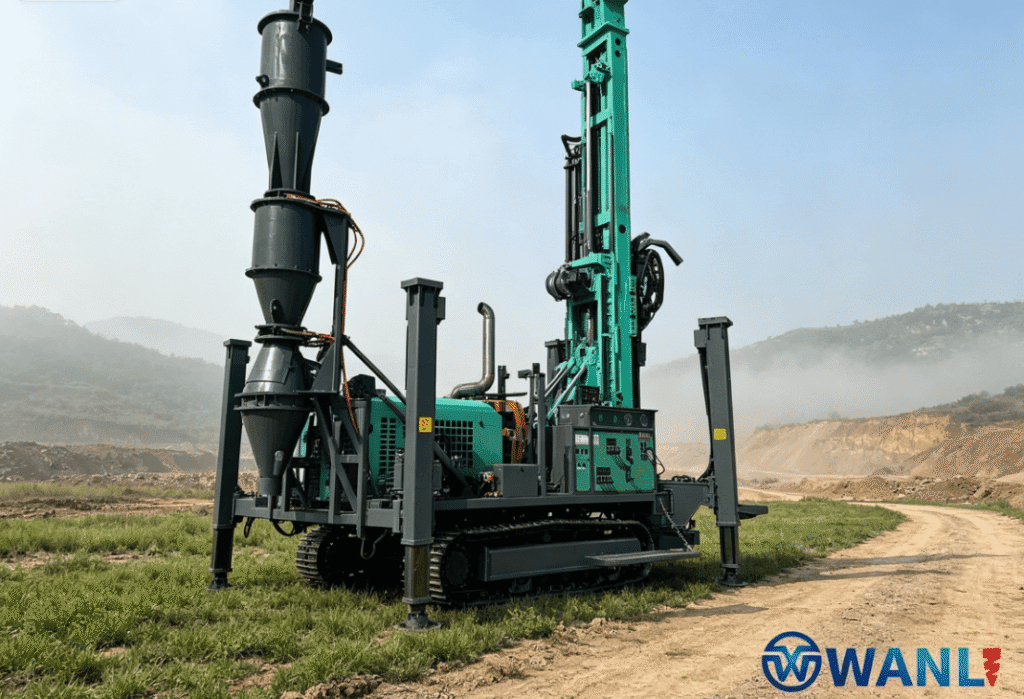
Wanli publicly presents the referenced rig as customizable and suitable for complex formations, but the checked page does not publish a model-specific engine, compressor, depth, diameter, certification, warranty, stock position, delivery time or price.2 Those items should be treated as open commercial and technical questions in the RFQ, not inferred from promotional wording.
Sampling and quality controls
A manufacturer should explain the complete path from the bit to the sample bag. Confirm the dual-wall rod standard, hammer compatibility, deflector, cyclone, splitter and sample-bag arrangement. Ask how the proposed design addresses wet holes, fines, dust and possible cross-contamination between intervals. RCDrilling.com describes the general process as air moving down the annulus while water and cuttings travel up the inner tube to a cyclone, where the material is collected for sampling.1
That description explains the method, but it does not validate a particular supplier’s sampling accuracy. Include a factory acceptance test or site commissioning checklist covering air leaks, sample flow, controls, emergency stops, rod handling and documentation. If assay quality is critical, define the operating and cleaning procedures that the drilling contractor must follow.
Evaluate the manufacturer beyond the machine
The purchase decision should include lifecycle support. Ask for a recommended spare-parts list for the first operating period, consumable cross-references, maintenance intervals, hydraulic and electrical schematics, troubleshooting instructions and training scope. Clarify which parts are standard, which are custom, and which can be sourced locally. Also ask how technical support is delivered across your operating time zone.
A professional supplier should make the commercial boundary clear. The quotation should separate the base rig, drilling tools, air equipment, transport preparation, commissioning, training, optional accessories, taxes and shipping. Warranty duration and exclusions should be written into the offer. Do not assume that a phrase such as “after-sales service” includes field technicians, free replacement parts or guaranteed response times.
| Commercial and technical document | Purpose in a buying decision |
|---|---|
| Itemised quotation | Prevents missing equipment and makes competing offers comparable. |
| Technical datasheet | Records dimensions, weights, capacities and operating conditions for the quoted configuration. |
| General arrangement drawing | Supports transport planning, site access checks and foundation or clearance review. |
| Parts and consumables list | Helps estimate downtime risk and operating cost. |
| Warranty and service terms | Defines remedies, exclusions, response expectations and buyer responsibilities. |
| Inspection and commissioning plan | Creates an objective handover record before shipment or site acceptance. |
Why consider Wanli for an RC drilling RFQ?
Wanli’s official catalogue includes an RC Reverse Circulation Drilling Rig category and related RC products, including an RC rock-powder sampling drilling rig.2 The product page provides a direct Get a Quote path and links to the company’s product catalogue, FAQ and contact pages. For a buyer, the practical next step is to send a project brief and request a configuration-specific proposal rather than asking only for a headline price.
Use Wanli’s RC reverse circulation drilling rig category to review related products, then use the contact page to submit the following information: target depth and diameter, drilling angle, formation description, expected water conditions, site elevation, required mobility, power availability, sample system, destination country and desired delivery window. Ask the sales team to mark every figure as rated, recommended, optional or subject to field conditions.
For broader navigation, buyers can compare the all-products catalogue, review the company’s FAQ and learn more on the About Us page. These pages should support—not replace—a written technical and commercial review.
A practical RFQ checklist
Before comparing offers, prepare a one-page drilling brief. State the exploration objective, hole schedule, required sample interval, expected formation, access limitations and site utilities. Include drawings or photographs of the drill pads where possible. Then ask each RC drilling rig manufacturer to return a completed compliance matrix showing what is included, excluded and conditional.
The final selection should be based on fit, evidence and supportability. Compare like-for-like configurations, not isolated claims about speed or depth. Require the supplier to identify assumptions and provide references to the exact datasheet or drawing. If an important requirement cannot be confirmed, keep it as a contract hold point before issuing a purchase order.
What Should an RC Drilling Rig Quotation Include?
An RC drilling rig quotation should describe the complete configuration required for the proposed drilling program rather than provide only a price for the base machine. Different suppliers may include different equipment in their standard packages, so an itemised quotation makes competing offers easier to compare.
At a minimum, the quotation should identify the base drilling rig, mast and hydraulic system, crawler or mobility package, drill rods, hammer and bits, and the rated drilling parameters for the proposed configuration. The supplier should state the assumptions behind depth, diameter, drilling angle and performance figures, including the formation and tooling conditions where relevant.
The air and sampling systems should be listed separately. Buyers should confirm whether the quotation includes a compressor, booster, hoses, cyclone, splitter, pressure monitoring and dust-control equipment. The manufacturer should also identify the required airflow and pressure for the proposed hammer, rod and hole-diameter configuration.
Drilling tools and consumables should be clearly defined. Ask for the recommended rod specifications, hammer type, bit options, initial consumables package and expected replacement items. A recommended spare-parts list for the initial operating period can also help the buyer estimate downtime risk and operating costs.
The commercial section should separate the base rig from optional equipment, commissioning, operator training, spare parts, transport preparation, shipping, taxes and other applicable charges. Warranty duration, exclusions and after-sales support should also be stated in writing.
A useful quotation should therefore allow the buyer to answer five basic questions: What equipment is included? What equipment is optional? Under what conditions are the stated specifications valid? What support is provided after delivery? And what is the complete delivered cost?
Comparing complete, equivalent configurations is more useful than comparing headline machine prices. If two quotations use different drilling tools, air packages or sampling systems, their prices may not represent equivalent solutions even when the machines appear similar on paper.
Request a configuration-specific quotation
Wanli’s public RC product page establishes a starting point: a full-hydraulic crawler-mounted RC rig described for reverse-circulation discharge and complex formations.2 The next step is project matching. Send your geology, hole plan and operating conditions through the official contact channel and request a written RFQ covering the machine, tools, air package, sampling line, documentation, warranty, commissioning, delivery and price.
An effective RFQ protects both buyer and manufacturer. It converts a broad request for an “RC drilling rig for mining exploration” into a defined configuration that can be reviewed, tested and supported.
Frequently asked questions
1. What does an RC drilling rig manufacturer supply?
The scope varies. It may include the rig, mast, hydraulic system and crawler chassis, while drilling tools, compressor, booster, cyclone, splitter, hoses and spares may be separate or optional. Request an itemised quotation and a complete scope of supply.
2. Is RC drilling suitable for every mining exploration project?
No. RC is well suited to many programs requiring crushed samples and repeatable drilling, but diamond coring may be better when continuous core or structural information is essential. Match the method to the geological decision and sample requirements.
3. What depth can a Wanli RC rig drill?
The checked Wanli product page does not publish a model-specific depth rating. Ask for the rated depth for the quoted rod, hammer, bit, hole diameter, angle, air package and formation; do not use a generic industry figure as a guarantee.
4. Should the RFQ include an air compressor and sampling system?
Yes, unless these items are already available and technically compatible. Request the required airflow and pressure, compressor or booster scope, cyclone, splitter, hoses, dust control and sample-bag arrangement as separate line items.
5. How can buyers compare RC drilling rig manufacturers fairly?
Use the same project brief and compliance matrix for every supplier. Compare the complete delivered configuration, documented capacities, consumables, warranty, commissioning, training, spare-parts plan, delivery terms and exclusions—not only the base-machine price.
References
- RCDrilling.com. “What is RC Drilling?”
https://www.rcdrilling.com/rc-drilling-guide/what-is-rc-drilling/ - Shandong Wanli Construction Machinery Co., Ltd. “RC Reverse Circulation Drilling Rig.”
https://sdwanli.com/product/rc-reverse-circulation-drilling-rig/rc-reverse-circulation-drilling-rig/ - Epiroc. “RC Drill Rig | Reverse Circulation Drilling.”
https://www.epiroc.com/en-us/products/drill-rigs/exploration-drill-rigs/reverse-circulation-drill-rigs