Procuring a 300m water well drilling rig represents a significant capital investment for any drilling contractor or industrial project manager. At this depth, the geological challenges shift from simple soil penetration to complex rock formations, requiring equipment that balances high-pressure pneumatic systems with robust mechanical torque.
Finding the right 300m water well drilling rig supplier involves more than comparing price tags. It requires a deep dive into engineering specifications, manufacturing tolerances, and long-term after-sales support. This guide outlines the technical benchmarks and procurement logic essential for securing a high-performance rig.
Why the 300m Depth Tier Demands Higher Engineering Standards
In the drilling industry, 300 meters (approx. 984 feet) is a critical threshold. It is the point where hydrostatic pressure and drill string weight necessitate advanced hydraulic management. A rig designed for 100m will likely experience hydraulic overheating or structural fatigue if pushed to 300m regularly.
When evaluating a supplier, the first technical audit should focus on the lifting force and rotation torque. For a 300m deep hole, a lifting force of at least 15–20 tons is typically required to manage the weight of the drill pipes and the friction of the borehole. If a supplier cannot provide detailed pressure-flow curves for their hydraulic pumps, they likely lack the engineering depth required for professional-grade machinery.
Key Technical Specifications for 300m Rigs
Before initiating an RFQ (Request for Quote), procurement teams must align on the following technical parameters. These specs distinguish a reliable industrial rig from an entry-level machine.
| Feature | Industrial Requirement (300m Depth) | Impact on Performance |
| Drilling Diameter | 140mm – 350mm | Determines the casing size and water yield. |
| Lifting Force | 150kN – 220kN | Essential for pulling out of “stuck” scenarios at depth. |
| Rotation Torque | 4,000N.m – 8,500N.m | Necessary for cutting through hard rock/granite. |
| Walk Speed | 2.0 – 3.5 km/h | Crucial for crawler-mounted rigs in rough terrain. |
| Air Consumption | 17–31 m³/min | Required for DTH (Down-the-Hole) hammer efficiency. |
Evaluating Supplier Manufacturing Capability
A reputable 300m water well drilling rig supplier should operate as an OEM (Original Equipment Manufacturer) rather than a mere trading entity. Direct manufacturers offer several advantages that are critical for long-term ROI:
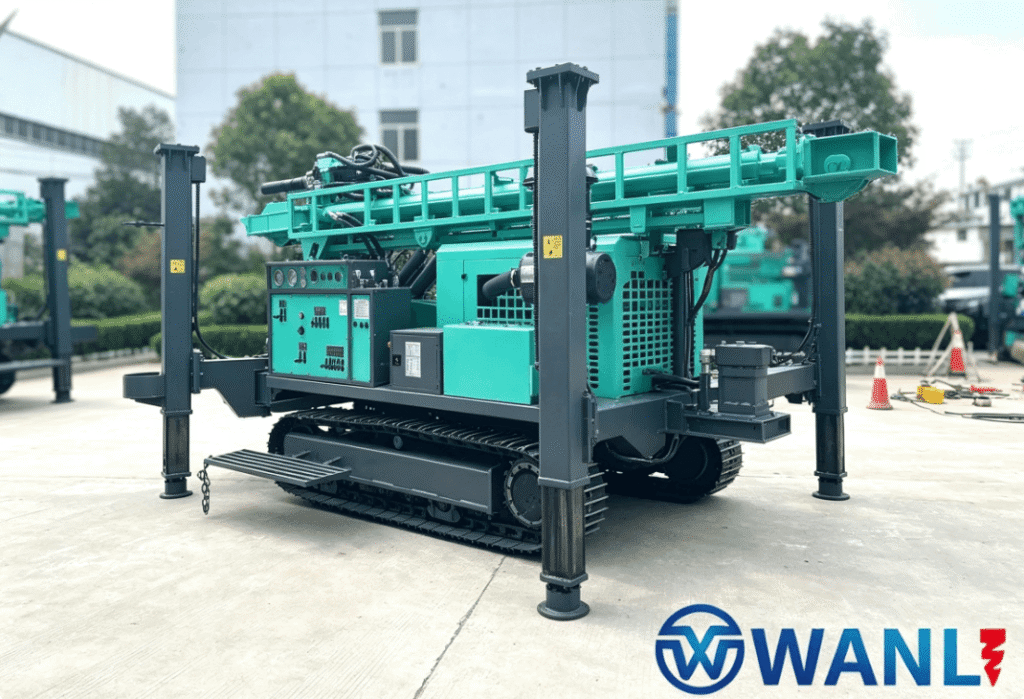
- Customization (ODM Services): Deep-well drilling environments vary. You may require a crawler-mounted chassis for mountainous terrain or a truck-mounted unit for urban infrastructure projects. Suppliers like Shandong Wanli specialize in modular designs that allow for specific engine upgrades (e.g., Quanchai or Cummins) based on regional emission standards.
- Material Integrity: The mast (derrick) must be constructed from high-strength manganese steel. Ask your supplier for material certifications. Low-grade steel will warp under the cyclic loading of a 300m drill string, leading to catastrophic failure.
- Hydraulic System Components: Top-tier suppliers use reputable valve blocks and motors. Reliability at 300m depends on the precision of the hydraulic control system to prevent “bit bouncing” or inconsistent pressure application.
Matching Rig Types to Geological Applications
The “best” rig is entirely dependent on the strata you intend to penetrate. A transactional mistake often made is purchasing a rig without considering the flushing medium (air vs. mud).
Pneumatic DTH Rigs (Hard Rock)
For areas with granite, limestone, or basalt, a pneumatic DTH (Down-the-Hole) rig is non-negotiable. These rigs use high-pressure air compressors to drive a hammer at the bottom of the hole. Suppliers focusing on these units must ensure the rig’s manifold can handle pressures exceeding 2.5 MPa.
Hydraulic Mud Rigs (Soft Soil/Sand)
In sedimentary basins or sandy layers, mud circulation is required to stabilize the borehole wall. Here, the supplier’s mud pump integration is the priority. The rig must have a high-torque rotary head to handle the viscous drag of the mud and cuttings.
Procurement Workflow: From RFQ to Delivery
When you move into the transactional phase with a supplier, follow this structured workflow to mitigate risk:
- Step 1: Technical Alignment: Submit your required drilling depth, maximum diameter, and primary rock type. Request a “Project Suitability Report” from the supplier.
- Step 2: Component Verification: Confirm the brands of the hydraulic pumps, engines, and crawler tracks. For international buyers, ensure parts are locally serviceable or that the supplier carries a 5-year spare parts inventory.
- Step 3: Factory Acceptance Test (FAT): If purchasing multiple units, arrange a video inspection or a third-party audit (SGS/TÜV) to witness the rig’s lifting and rotation capabilities under load.
- Step 4: Logistics & Compliance: Ensure the rig meets CE or ISO 9001 standards. Verify the shipping dimensions; a 300m rig often requires a 40HQ container, and the mast may need disassembly.
Leveraging the Shandong Wanli Advantage
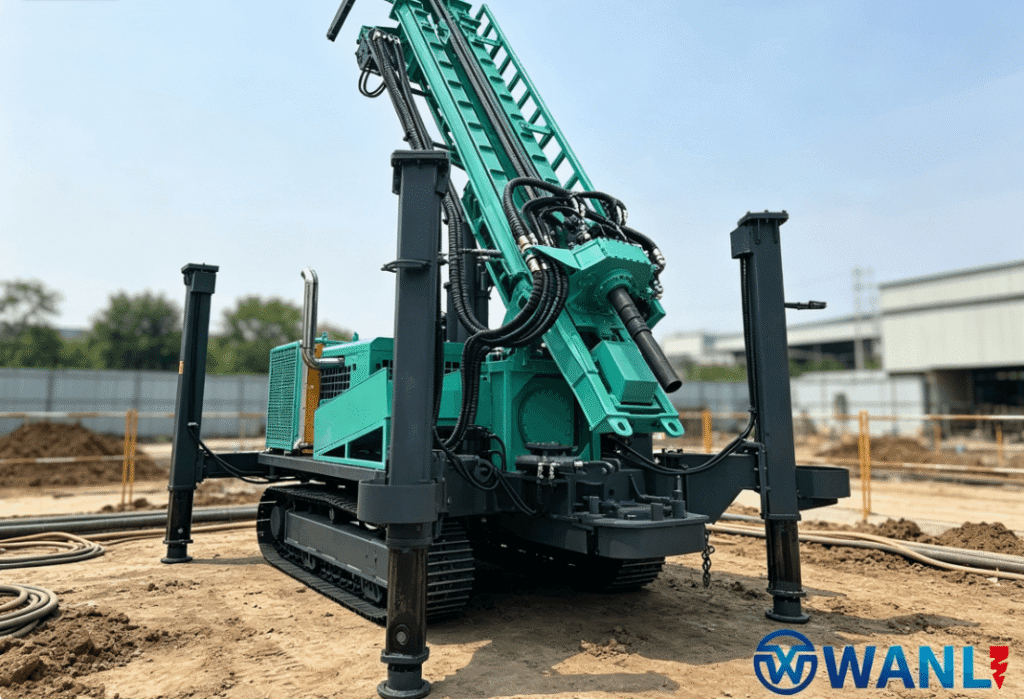
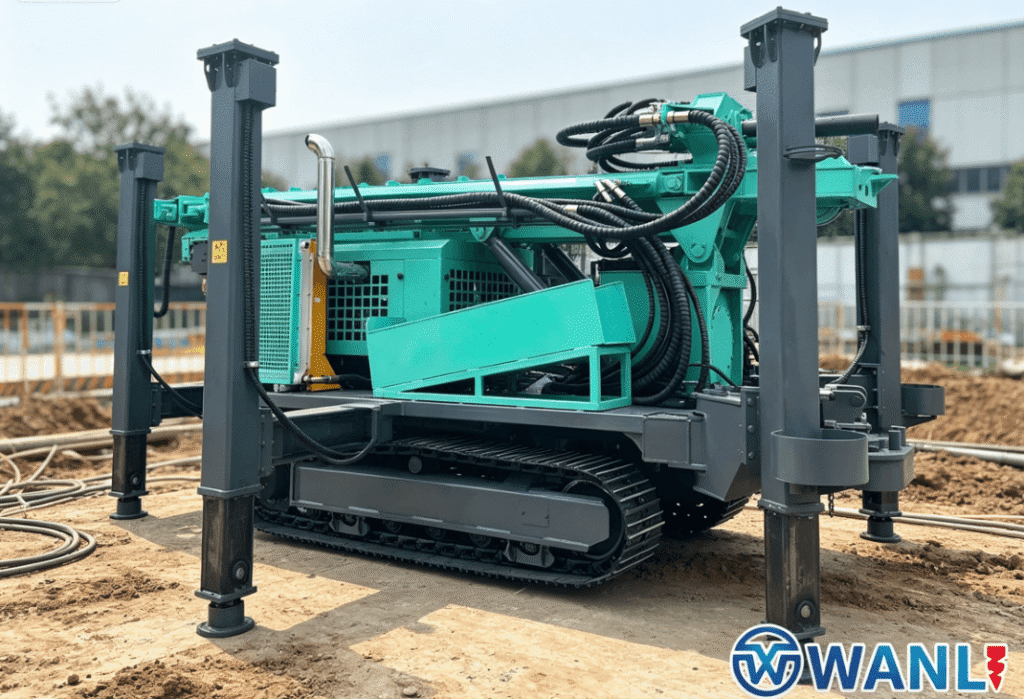
For buyers seeking a balance between heavy-duty performance and cost-efficiency, Shandong Wanli’s Water Well Drilling Rigs provide a specialized range of crawler-mounted pneumatic units. Their 300m-class rigs are engineered with multi-speed hydraulic rotation heads and heavy-duty outriggers, ensuring stability during deep-hole operations. By controlling the manufacturing process, they offer the customization needed for specific geological conditions, such as reinforced masts for high-torque applications.
FAQ
What is the lead time for a custom 300m drilling rig?
Standard models are often in stock or require 15–20 days for assembly. Fully customized rigs (specific engine brands or specialized chassis) typically have a lead time of 30–45 days.
Can a 300m rig be used for smaller 100m projects?
Yes, but it is less fuel-efficient. However, it provides a “safety margin.” Using a 300m rig for 100m projects reduces strain on the hydraulic system, potentially doubling the lifespan of the machine.
What is the MOQ for industrial water well rigs?
For most direct manufacturers, the MOQ is 1 unit. However, purchasing a “package” (including drill pipes, hammers, and bits) often results in significant shipping and volume discounts.
How do I handle maintenance in remote regions?
Choose a supplier that uses “standardized” hydraulic fittings and world-renowned engine brands. This ensures that even if you are in a remote mining site, your local mechanics can source filters and seals without waiting for international air freight.
Reference Sources
- ISO 9001:2015 – Quality Management Systems for Drilling Equipment Manufacturing.
- API Spec 4F – Specification for Drilling and Well Servicing Structures (American Petroleum Institute).
- SGS Group – Industrial Manufacturing Verification and Inspection Standards for Heavy Machinery.
- National Ground Water Association (NGWA) – Technical Guidelines for Deep Well Drilling Rig Safety.