Drilling a water well is a high-stakes engineering project where small oversights lead to massive financial losses. Whether you are managing an agricultural irrigation project or an industrial water supply, the difference between a high-yield borehole and a “dry hole” often comes down to technical precision during the initial phases.
In the global drilling industry, we see project managers encounter the same hurdles repeatedly. This guide analyzes the most common water well drilling mistakes from an engineering perspective and provides actionable strategies to mitigate risk.
Inadequate Geological and Hydrogeological Assessment
The most expensive mistake in drilling is “blind drilling”—starting a borehole without a comprehensive understanding of the subsurface lithology.
Many operators rely solely on anecdotal evidence from neighboring properties. However, groundwater distribution is rarely uniform. Forgetting to perform a proper geophysical survey (such as electrical resistivity tomography) can lead to drilling in areas with low permeability or high salinity.
How to Avoid It:
Conduct Geophysical Surveys: Use resistivity meters to identify saturated zones and depth to bedrock.
Analyze Historical Data: Review local borehole logs to understand the stratigraphy (e.g., alternating layers of clay, sand, or fractured rock).
Define the Aquifer Type: Determine if you are targeting a confined or unconfined aquifer, as this dictates the drilling method.
Mismatched Drilling Rig Specifications
Selecting a rig based on price rather than technical suitability is a frequent cause of project failure. A rig underpowered for the terrain will suffer from excessive vibration, hydraulic overheating, and premature bit wear.
For example, using a light-duty rotary rig in hard granite formations often results in a “stuck pipe” or complete refusal. Conversely, over-specifying a rig for shallow, soft-soil applications leads to unnecessary fuel consumption and mobilization costs.
Technical Consideration:
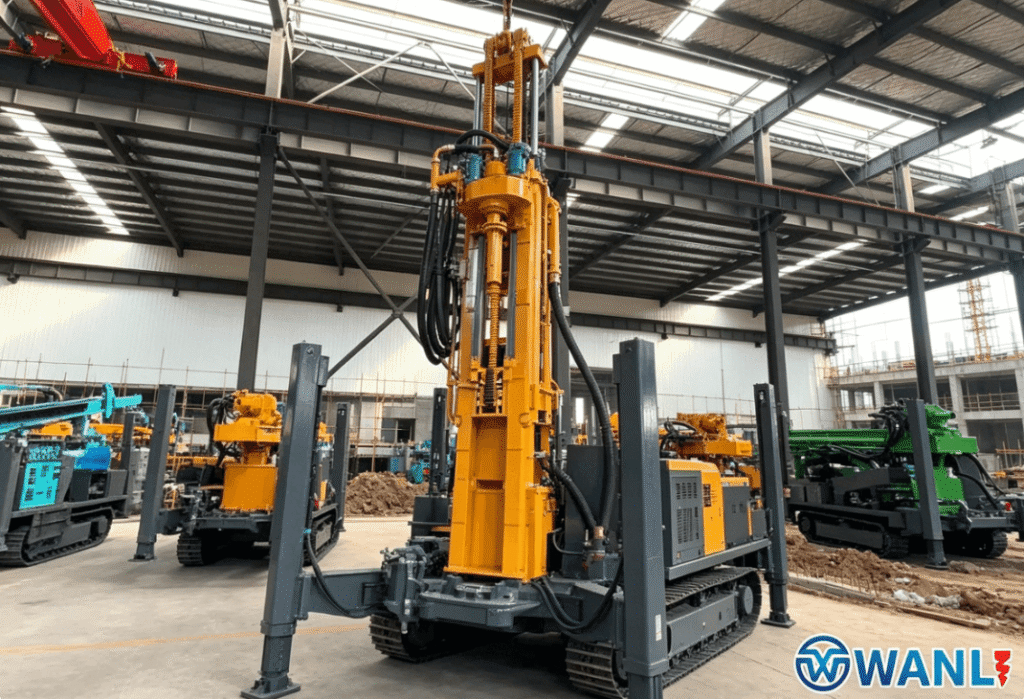
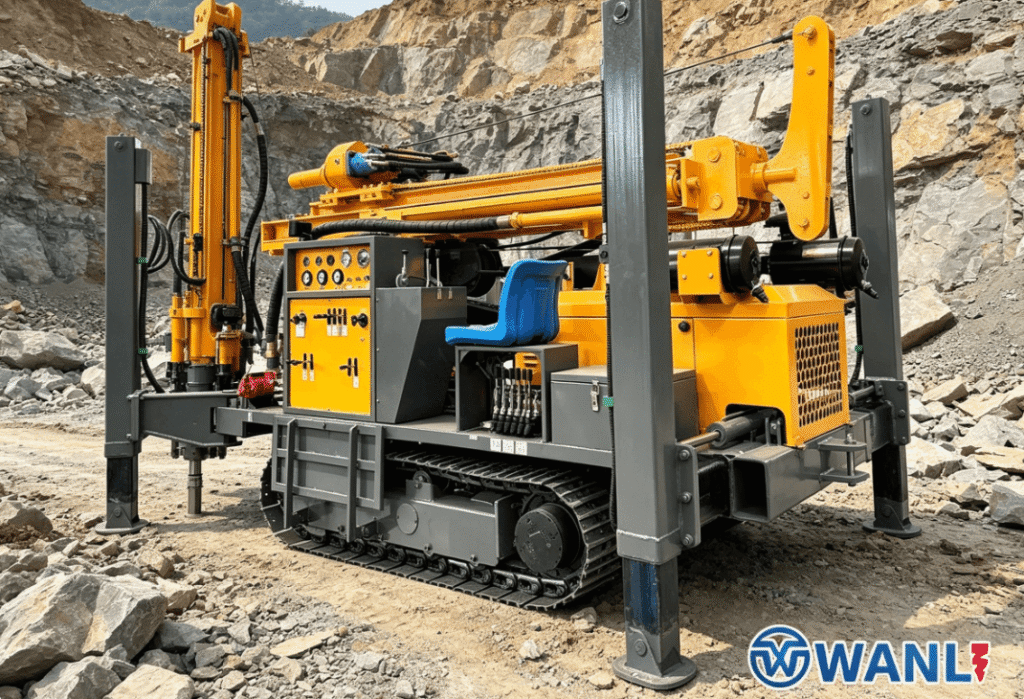
Modern crawler-type water well drilling rigs, such as those engineered by Shandong Wanli, are designed to bridge these gaps. For deep-hole applications (300m–600m), a rig must possess:
High Lifting Force: To handle the weight of long drill strings.
Dual-System Capability: The ability to switch between mud drilling (for loose formations) and DTH (Down-The-Hole) air drilling for hard rock.
High Torque Rotaries: Necessary for maintaining penetration rates in varying geological strata.
Improper Drilling Fluid Management
In rotary drilling, the “mud” (drilling fluid) serves three critical functions: cooling the bit, lifting cuttings to the surface, and maintaining borehole stability through hydrostatic pressure.
A common mistake is failing to monitor mud viscosity and density. If the mud is too thin, it won’t lift heavy rock chips, leading to “re-grinding” and bit damage. If it is too thick, the pump pressure spikes, potentially “fracturing” the formation and causing a loss of circulation.
Prevention Strategy:
Use Bentonite Additives: In sandy formations, use high-quality bentonite to create a “filter cake” on the borehole wall, preventing cave-ins.
Monitor Sand Content: Use a sand content kit regularly. Excessive sand in the mud acts as an abrasive, destroying the internal components of your mud pump.
Incorrect Casing and Screen Placement
A well is only as good as its completion. Placing the well screen in the wrong section—such as a clay layer instead of a high-yield sand-and-gravel layer—will result in a dry well or extremely low flow rates.
Furthermore, choosing the wrong slot size for the screen can lead to “sanding.” If the slots are too large, the well will continuously pump sand, which ruins plumbing fixtures and erodes pump impellers.
The Solution:
Sieve Analysis: Perform a grain-size analysis of the aquifer material to select the correct screen slot size.
Gravel Pack Precision: Ensure the gravel pack (filter media) is clean, rounded, and properly sized to bridge the gap between the formation and the screen.
Neglecting the “Development” Phase
Many operators stop as soon as they hit water. This is a critical error. Well development is the process of cleaning the borehole and the surrounding aquifer to maximize water flow.
Skipping or rushing this step leaves drilling mud and fine sediments clogging the pore spaces of the aquifer. This results in poor yield and “cloudy” water that may never clear up.
Best Practices:
Surging and Jetting: Use a surge block or high-pressure water jetting to break up the filter cake.
Over-Pumping: Pump at a higher rate than the intended usage to stabilize the formation.
Failure to Ensure Borehole Verticality
In deep-well drilling, maintaining a “straight” hole is vital. If the borehole deviates (becomes crooked), it creates massive friction on the drill string. More importantly, it may become impossible to install the permanent casing or the submersible pump.
Prevention:
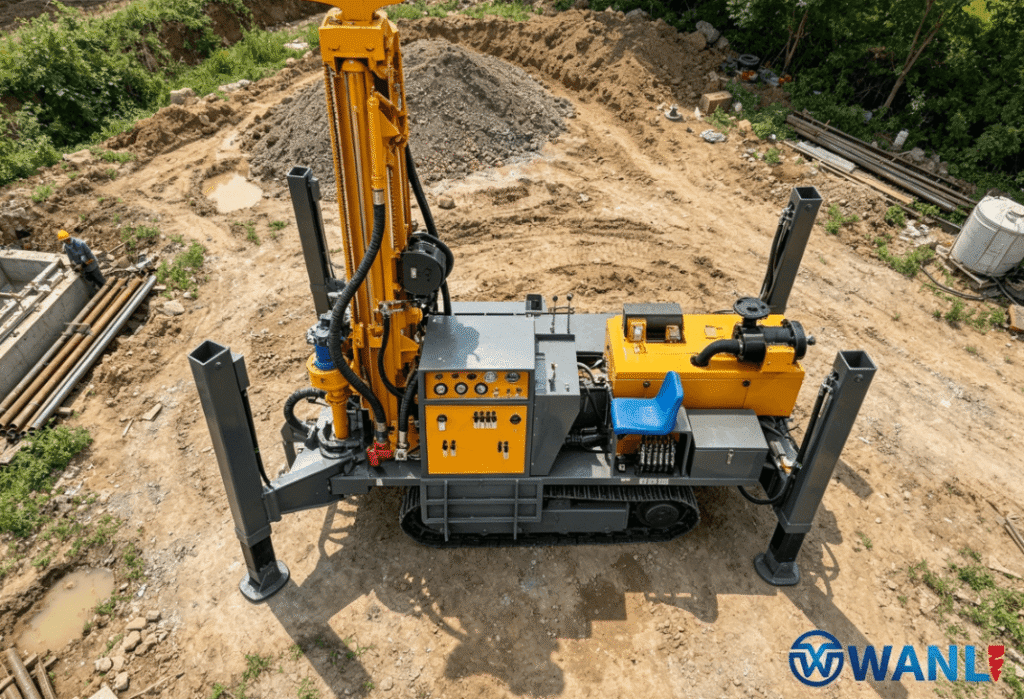
Leveling the Rig: Ensure the drilling rig is perfectly leveled using hydraulic jacks before spudding.
Weight on Bit (WOB) Control: Avoid applying excessive downward pressure in transitioning formations, which can “push” the bit off-course.
Summary of Mistakes vs. Technical Solutions
| Mistake | Potential Impact | Engineering Solution |
| Poor Site Selection | Dry hole, high salinity | Geophysical resistivity surveys |
| Underpowered Rig | Stuck pipes, hydraulic failure | Match rig torque/lift to depth/rock hardness |
| Mud Loss | Borehole collapse | Add loss-circulation materials (LCM) |
| Incorrect Screening | Sand infiltration, low yield | Sieve analysis and precise slot selection |
| Incomplete Development | Turbid water, pump damage | Extended surging and air-lift development |
Choosing the Right Infrastructure
From a manufacturing and procurement perspective, avoiding these mistakes starts with the equipment. Reliability in the field is dictated by the quality of the hydraulic systems and the durability of the chassis. When evaluating a water well drilling rig provider, engineers look for multi-functionality—the ability to adapt to different drilling methodologies (Air/Mud/Hammer) without changing the entire platform. This versatility allows operators to adjust to unexpected geological changes mid-project, effectively “future-proofing” the drilling operation.
FAQ
Q1: How do I know if I should use Mud Drilling or Air Drilling (DTH)?
It depends on the formation stability. Use Mud Drilling for unconsolidated formations (sand, gravel, clay) to prevent the hole from collapsing. Use Air Drilling with a DTH hammer for consolidated hard rock (granite, limestone) for much faster penetration rates.
Q2: Why is my new well pumping sand?
This is typically caused by an improperly sized well screen or a failure to install a proper gravel pack. It can also happen if the well was not developed long enough to remove the “fines” from the aquifer.
Q3: What is the most common reason for a drilling rig to break down?
Most mechanical failures in the field stem from hydraulic contamination or cooling system neglect. In high-ambient temperature environments, the hydraulic oil must be kept within specific temperature ranges to maintain viscosity and protect the pumps.
Q4: How deep should a water well be?
Depth is determined by the local static water level and the desired yield. A professional driller will continue until they reach a “water-bearing zone” with sufficient recharge capacity, which could be 50 meters or 500 meters depending on the region.
Reference Sources
National Ground Water Association (NGWA): Guidelines on well construction and aquifer protection.
ISO 22475-1: Geotechnical investigation and testing — Sampling methods and groundwater measurements.
SGS Industrial Services: Technical whitepapers on borehole integrity and geological risk management.