Selecting the right drilling methodology is often the most critical decision in any geotechnical, mining, or construction project. The choice between core drilling and rotary drilling isn’t just about making a hole in the ground; it dictates the quality of geological data you collect, the speed of your operation, and the ultimate ROI of the exploration phase.
For project managers and lead engineers, understanding the mechanical nuances of these two methods is essential. While both utilize rotation to penetrate subsurface formations, their objectives—and the results they yield—are fundamentally different. One prioritizes the “package” (the sample), while the other prioritizes the “pathway” (the borehole).
The Mechanics of Subsurface Penetration
To distinguish core drilling vs rotary drilling, we must first look at how they interact with the lithology.
Core drilling is a precise surgical procedure. It utilizes a hollow cylindrical bit—usually impregnated with industrial-grade diamonds or tungsten carbide—to cut a circular groove. Instead of pulverizing the entire diameter of the hole, it preserves a central cylinder of rock or soil. As the rig advances, this “core” slides into a core barrel. This method is the gold standard for geological mapping because it provides a chronological, physical record of the strata.
Rotary drilling, conversely, is a process of total displacement. It uses a solid bit (such as a tricone or PDC bit) to grind, crush, or scrape the entire cross-section of the hole into small fragments known as “cuttings.” These cuttings are then flushed to the surface using drilling fluids (mud) or compressed air. The primary goal here is hole completion—whether for oil extraction, water wells, or blast holes—rather than the extraction of an intact specimen.
Core Drilling vs Rotary Drilling: Technical Comparison
| Feature | Core Drilling | Rotary Drilling |
| Primary Objective | High-fidelity sample recovery (Coring) | High-speed borehole creation |
| Sample Form | Intact solid cylinders (Cores) | Loose chips and fragments (Cuttings) |
| Cutting Action | Kerf cutting (annular) | Full-face crushing/grinding |
| Common Bit Types | Diamond Impregnated, Surface Set | Tricone, PDC, Drag Bits |
| Geological Accuracy | Superior (shows fractures/bedding) | Moderate (indicates lithology change) |
| Penetration Rate | Slower (requires careful handling) | Significantly faster |
| Depth Capability | Highly effective at extreme depths | High, but limited by torque/pressure |
When Precision Dictates the Method: The Case for Coring
In mineral exploration and geotechnical engineering, the “blind” nature of rotary drilling is often an unacceptable risk. Core drilling is non-negotiable when you require:
Structural Integrity Data: To calculate the Rock Quality Designation (RQD), engineers must see the natural fractures, veins, and bedding planes in situ. Rotary cuttings provide zero information on the orientation or frequency of these fractures.
Mineral Grade Verification: For precious metal mining, knowing exactly where a vein starts and ends is the difference between a profitable mine and a failed investment. Core samples provide the exact depth and thickness of ore bodies.
Hard Rock Performance: In formations with high Mohs hardness, diamond core bits often outperform rotary bits by maintaining a sharper cutting edge through the grinding of the diamond matrix.
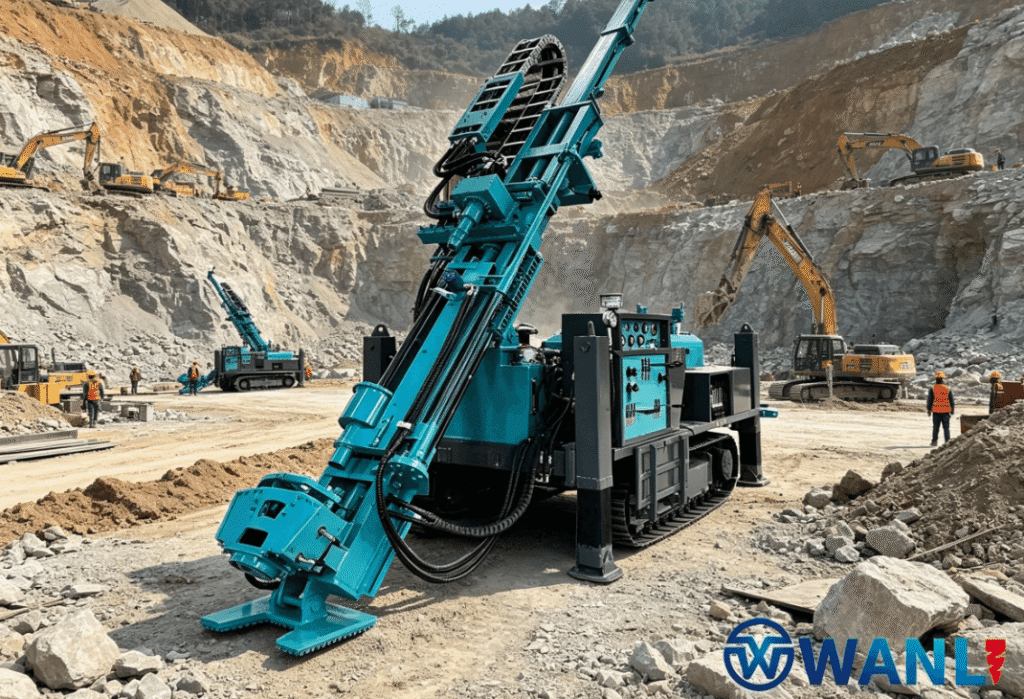
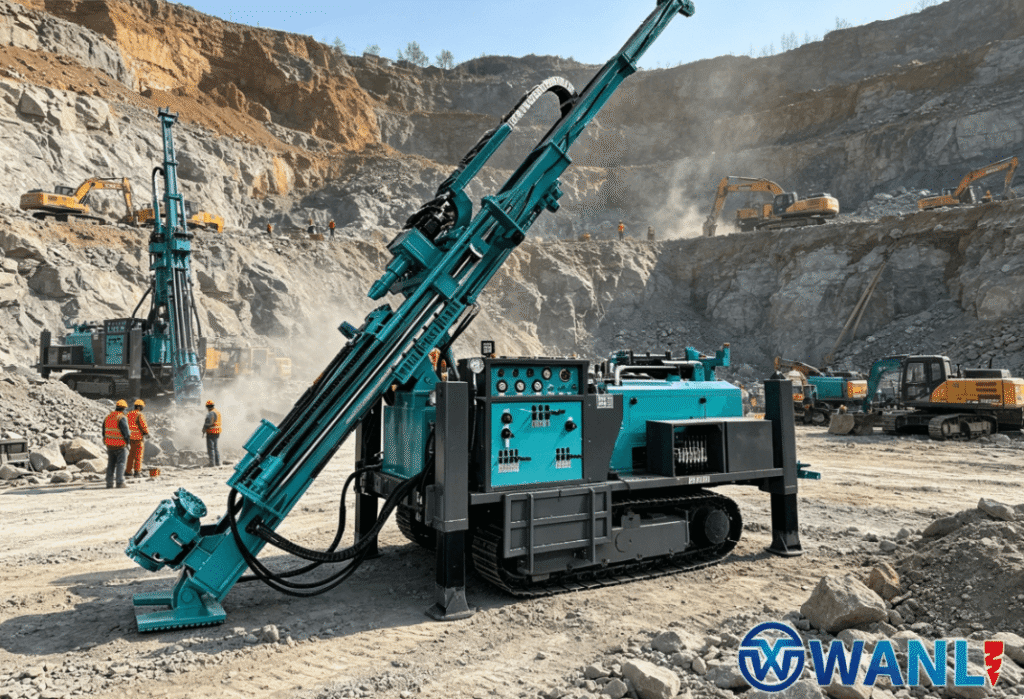
Modern core drilling systems, such as those found in SDWanli’s specialized coring rigs, utilize hydraulic top-drive systems to maintain precise “weight-on-bit” (WOB). This precision prevents the core from being crushed by the very machine trying to extract it.
When Efficiency Wins: The Rotary Advantage
Rotary drilling is the workhorse of industrial production. If the geology is already well-understood from previous coring phases, continuing to core is an unnecessary expense.
Production Speed: In quarrying and open-pit mining, rotary rigs can drill hundreds of meters of blast holes in a single shift.
Cost-Effectiveness: Because there is no need to “trip” the drill string to retrieve a core barrel every few meters, the “on-bottom” time is much higher.
Large Diameter Requirements: If the project requires a 12-inch or 24-inch hole for a water well or foundation pile, rotary drilling is the only viable mechanical option.
Geological Constraints and Fluid Management
The choice between these methods also hinges on the “circulating medium.” In core drilling, the fluid (often water or specialized polymers) must be carefully balanced to cool the diamond bit without washing away soft portions of the core.
In rotary drilling, the “drilling mud” serves a more mechanical role. It must be dense enough to carry heavy rock chips several hundred meters to the surface and provide enough hydrostatic pressure to prevent the borehole walls from collapsing. For engineers, monitoring the “return” of these cuttings provides a rough log of the geology, though there is a significant “lag time” between the bit hitting a new formation and the chips reaching the surface.
Equipment Selection: Matching the Rig to the Mission
Choosing the right rig involves more than just picking a method; it requires matching the machine’s torque and hoisting capacity to the target depth.
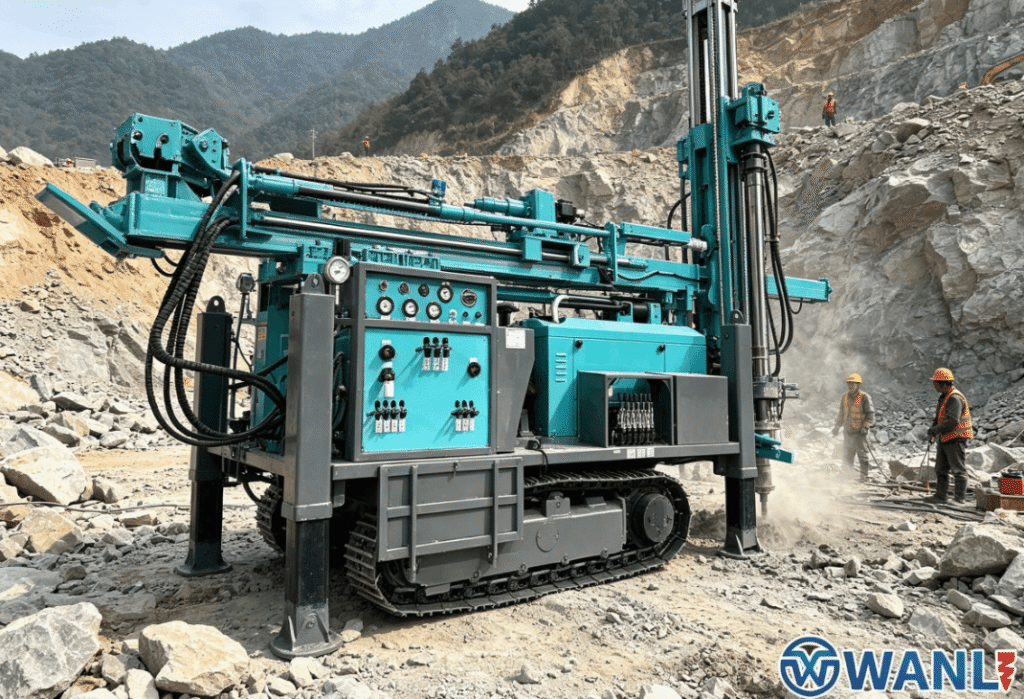
For high-precision exploration, specialized coring drilling rigs are designed with high-RPM spindles. Unlike heavy rotary rigs that rely on massive torque to crush rock, coring rigs rely on the peripheral speed of the diamond bit to “cut” the rock.
Key Selection Factors for Project Leads:
Terrain Accessibility: Crawler-mounted rigs are essential for remote exploration where core samples are most needed.
Automation: Modern hydraulic systems allow for finer control over the feed pressure, which is critical when transitioning between hard rock and soft clay layers to ensure the core barrel doesn’t jam.
Depth Capacity: Ensure the rig’s hoist capacity can handle the weight of the drill string at the maximum projected depth, plus a safety margin for “stuck pipe” scenarios.
Summary of Industrial Application
For the initial “Search” and “Identify” phases of a project, Core Drilling is the industry standard. It provides the empirical evidence required for environmental reports, safety certifications, and investment portfolios.
Once the “Development” and “Extraction” phases begin, Rotary Drilling takes over. Its ability to move vast amounts of material quickly makes it the backbone of infrastructure and resource production.
FAQ
Q: Can a rotary rig be converted for core drilling?
A: While some “multi-purpose” rigs exist, they are usually optimized for one method. True core drilling requires higher RPMs and more sensitive feed control than a standard heavy-duty rotary rig typically provides. Using a heavy rotary rig for delicate coring often results in “core wash” or poor recovery rates.
Q: Which method is better for environmental site assessments?
A: Core drilling is generally preferred. Because it produces an intact sample, environmental consultants can identify specific “plumes” of contamination at exact depths, which is impossible with the mixed-up cuttings produced by rotary drilling.
Q: Is core drilling always more expensive?
A: On a “per meter” basis, yes. However, if rotary drilling provides poor data that leads to a construction failure or a missed ore body, the “cost of error” far outweighs the initial savings.
Q: What is “Wireline” core drilling?
A: This is a specialized form of core drilling where the core barrel is pulled to the surface through the center of the drill rods using a winch (wireline). This eliminates the need to remove all the rods to get the sample, making it significantly faster and safer for deep-hole exploration.
Reference Sources:
ASTM D2113: Standard Practice for Rock Core Drilling and Sampling of Rock for Site Investigation.
Australian Drilling Industry Training Committee (ADITC): The Drilling Manual.
ISO 22475-1: Geotechnical investigation and testing — Sampling methods and groundwater measurements.
SGS Global: Mineral Exploration and Core Handling Standards.