Selecting the wrong drilling platform is one of the most common causes of project delays and budget overruns in the water well and geotechnical industries. The decision between a truck-mounted rig and a crawler-mounted rig isn’t just about price—it’s about the physics of the job site and the logistics of your operation.
For an engineering firm or a drilling contractor, this choice dictates how quickly you can mobilize, what types of terrain you can penetrate, and the long-term maintenance overhead of your fleet. This guide breaks down the technical and operational differences to help you match the machinery to your specific project requirements.
The Core Engineering Philosophy: Mobility vs. Stability
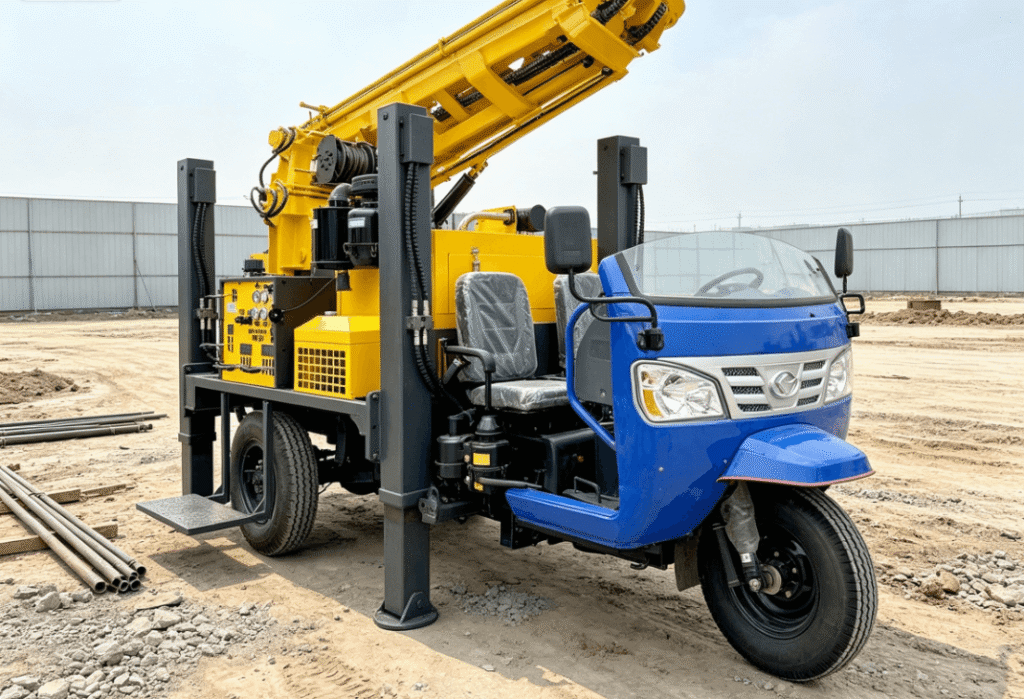
At the fundamental level, the difference lies in the “carrier.” A truck-mounted rig utilizes a standard or reinforced commercial truck chassis. In contrast, a crawler rig uses a dedicated track system, often powered by a hydraulic motor.
Truck-mounted rigs are designed for high-speed transit. They can travel on public highways at standard speeds, eliminating the need for secondary transport vehicles. Crawler rigs, however, are designed for “at-site” maneuverability. While they require a low-bed trailer for long-distance transport, their ability to navigate mud, sand, and steep inclines is unmatched.
Truck-Mounted Drilling Rigs: The Logistics Powerhouse
Truck-mounted rigs are the preferred choice for projects spread across large geographical areas where road infrastructure is relatively developed. If your project involves drilling multiple shallow-to-medium depth wells across different villages or urban sites, the truck-mounted configuration is superior.
Key Advantages:
- Rapid Deployment: You can drive the rig directly from the yard to the site at 80 km/h. There is no need to wait for a third-party logistics provider or a heavy-duty trailer.
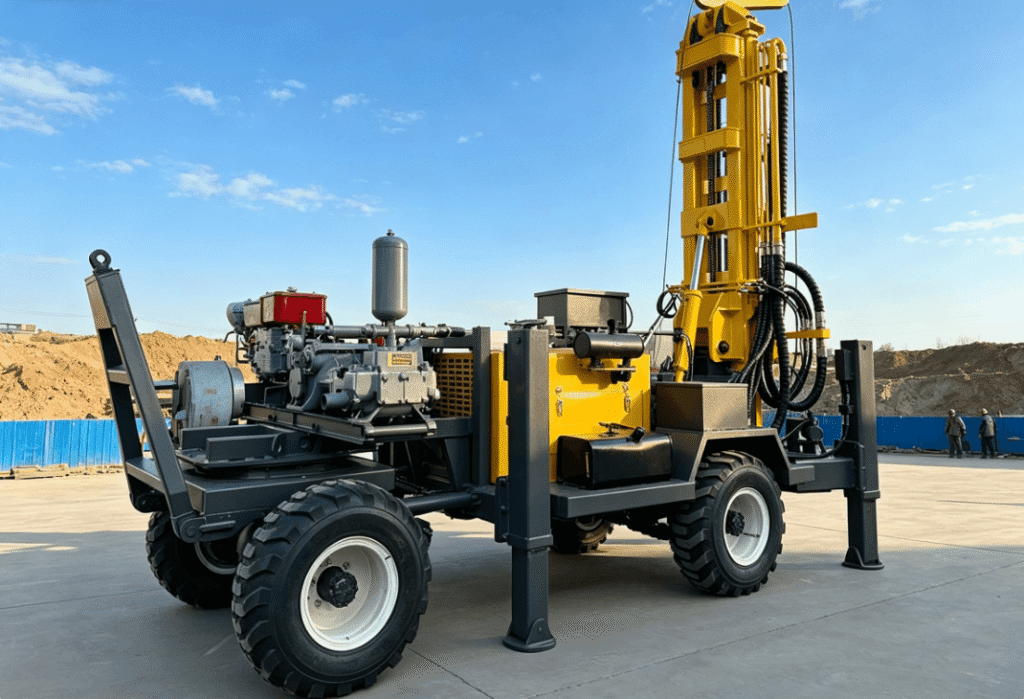
- Integrated Power: Most modern truck rigs, such as those seen in the SD Wanli SW-series, utilize the truck’s engine via a Power Take-Off (PTO) system or a secondary deck engine. This consolidation simplifies fueling.
- Lower Transport Costs: By eliminating the need for a “hauler” and a “trailer,” the operational cost per kilometer is significantly lower.
Technical Constraints:
The primary limitation of a truck-mounted rig is its footprint and weight distribution. Because they rely on tires, they have high ground pressure. On soft or swampy ground, a truck rig risks getting bogged down. Furthermore, they require a relatively flat, leveled area and the deployment of heavy-duty hydraulic outriggers to ensure a vertical bore.
Crawler-Mounted Rigs: The Off-Road Specialist
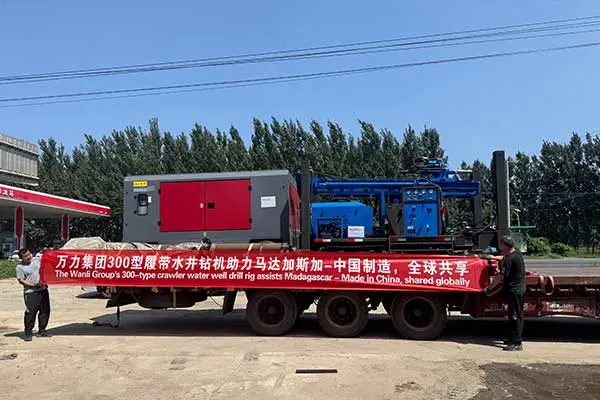
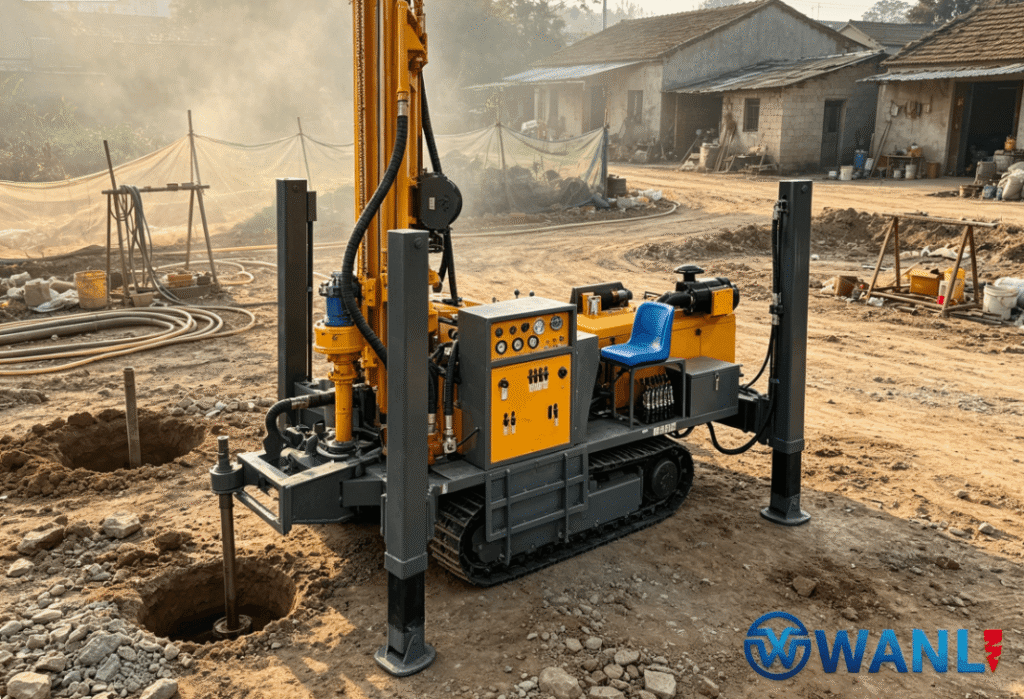
When the pavement ends, the crawler rig begins. Crawler-mounted drilling rigs are engineered for “challenging” environments—mountainous regions, soft agricultural soil, or tight construction sites where a 10-meter truck cannot turn.
Key Advantages:
- Low Ground Pressure: The wide surface area of the tracks (whether steel or rubber) distributes the machine’s weight. This allows the rig to “float” over mud or sand that would swallow a truck’s tires.
- Superior Gradeability: Crawler rigs can typically climb slopes of 20° to 30°, making them essential for mining exploration or remote mountain well-drilling.
- Compact Footprint: Without the long cab and chassis of a truck, crawler rigs can rotate 360 degrees (in some configurations) and operate in confined spaces where a truck cannot maneuver.
Technical Constraints:
The “hidden cost” of a crawler rig is the logistics. You cannot drive a tracked machine on a paved highway without damaging the road and the tracks. Every move between sites requires a trailer, which adds to the mobilization and demobilization (Mob/Demob) budget.
Technical Head-to-Head: Performance Comparison
| Feature | Truck-Mounted Rig | Crawler-Mounted Rig |
| Travel Speed | 70–90 km/h (Highway) | 2–5 km/h (Site only) |
| Terrain Suitability | Paved roads, firm dirt, flat plains | Mud, sand, rock, steep slopes |
| Setup Time | Moderate (Leveling & Outriggers) | Fast (Self-leveling capabilities) |
| Ground Pressure | High (Concentrated on tires) | Low (Distributed over tracks) |
| Turning Radius | Large (Requires wide access) | Zero/Small (Can pivot in place) |
| Logistics | Self-propelled | Requires Low-bed Trailer |
Application Mapping: Which Fits Your Project?
Scenario A: Rural Water Development & Irrigation
If you are a government contractor or a large-scale farm owner needing to drill 200m to 600m wells across multiple locations, a truck-mounted rig is the logical choice. The ability to move from Site A to Site B in a single afternoon increases your annual “holes drilled” metric, directly impacting ROI.
Scenario B: Remote Mining Exploration or Foundation Piling
In projects located in virgin forests, hilly terrain, or soft coastal areas, a crawler-mounted rig is mandatory. A truck rig would require expensive temporary road construction just to reach the drill point. The crawler rig’s ability to “walk” through the bush saves thousands in site preparation costs.
Scenario C: Urban Geotechnical Investigation
For soil sampling in tight urban alleys or between existing structures, the compact nature of a crawler rig is often preferred. However, if the sites are 50km apart within a city, a small-chassis truck rig might be more efficient to avoid constant loading/unloading.
Engineering Considerations for Professional Buyers
When evaluating rigs from manufacturers like SD Wanli, consider the following engineering specs beyond just the mounting type:
- Hydraulic System Capacity: Ensure the pump can handle the torque required for your specific strata (e.g., hard rock vs. loose gravel).
- Pull-back Force: Whether truck or crawler, the rig must have the lifting capacity to retrieve the drill string from the maximum depth.
- Chassis Durability: For truck rigs, verify if the chassis is a standard commercial model (easier to find spare parts) or a custom build. For crawlers, check the track material—rubber tracks are better for urban pavement, while steel tracks are required for sharp rocky terrain.
The “Total Cost of Ownership” (TCO) Perspective
From a B2B procurement standpoint, the “best” rig is the one that minimizes the cost per meter drilled.
- Truck-mounted rigs have lower transport costs but higher maintenance on the truck engine and tires.
- Crawler rigs have higher transport costs but tend to have longer lifespans in rugged environments because they aren’t subjected to the vibrations of high-speed road travel.
FAQ
Q1: Can I convert a crawler rig to a truck-mounted rig later?
Technically, the drilling deck can sometimes be remounted, but it is not a “plug-and-play” process. It requires significant structural engineering, PTO recalibration, and weight distribution analysis. It is almost always more cost-effective to buy the correct configuration from the start.
Q2: Which rig is safer on uneven ground?
The crawler rig is inherently more stable due to its lower center of gravity and wider base. However, truck rigs are perfectly safe if the hydraulic outriggers are deployed on “swamp mats” or solid ground according to the manufacturer’s load chart.
Q3: Does the mounting type affect drilling depth?
No. The drilling depth is determined by the hoist capacity, torque, and the power of the mud pump or air compressor. Both truck and crawler versions can reach depths exceeding 600-1000 meters depending on the model.
Q4: What are the maintenance differences?
Truck rigs require standard automotive maintenance (oil changes, brakes, tires) plus the drilling system maintenance. Crawler rigs require hydraulic track motor service and tension adjustments, but they lack the complexities of a multi-speed road transmission and emissions systems found in modern trucks.
Reference Sources
- ISO 21467: Earth-moving machinery and mobile road construction machinery — Rock drilling rigs — Safety.
- International Association of Drilling Contractors (IADC): “Drilling Manual – Land Rig Components.”
- National Ground Water Association (NGWA): “Best Practices for Selecting Well Drilling Equipment.”
- Manufacturer Data: Technical specifications for the SW-series (Shandong Wanli Machinery Co., Ltd).