Selecting a professional borehole drilling rig is a high-stakes capital investment that dictates the operational efficiency of water well projects, geothermal installations, and mining exploration. For site engineers and procurement managers, the challenge lies not just in “finding a machine,” but in matching specific mechanical torque, lifting capacity, and air pressure requirements to the geological strata of the job site.
Modern drilling systems have evolved beyond simple mechanical rotation. Today’s industry standard focuses on integrated hydraulic control, high-efficiency DTH (Down-The-Hole) technology, and multi-terrain mobility. Whether you are expanding a fleet for agricultural irrigation or specialized industrial water supply, understanding the technical nuances of these systems is the difference between a profitable borehole and a stalled project.
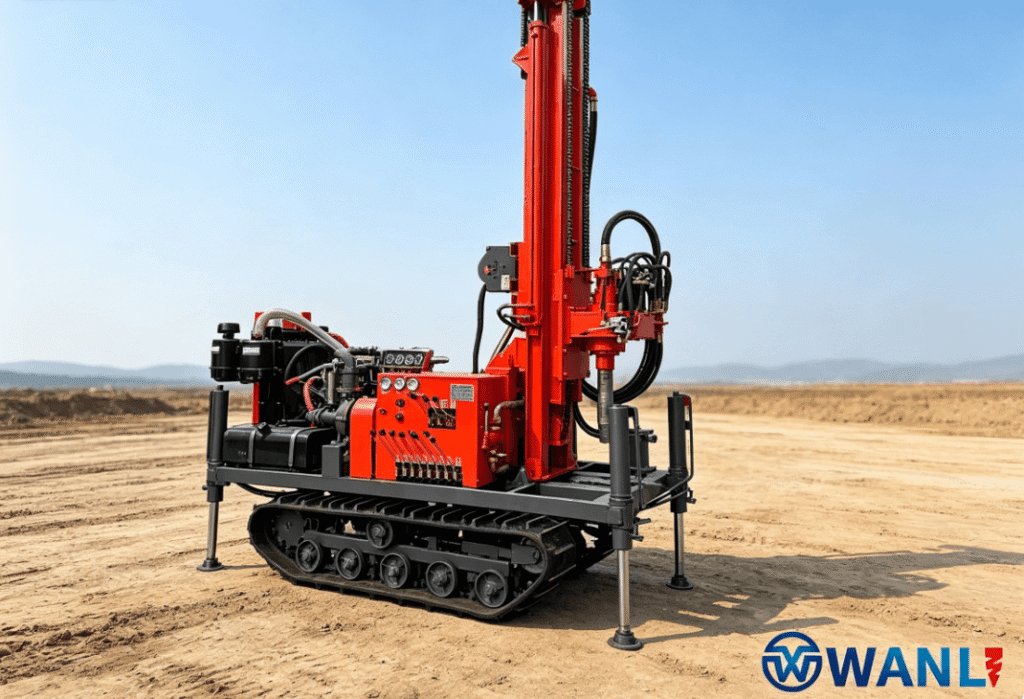
Primary Classification: Pneumatic DTH vs. Hydraulic Mud Rotary
The first technical decision in the procurement process involves the drilling method. While some rigs are versatile, most are optimized for specific flushing media.
- Pneumatic DTH Drilling Rigs: These are the preferred choice for hard rock formations (granite, limestone, basalt). They utilize high-pressure air compressors to drive a hammer that fractures the rock. These systems, like those found in the SDWanli Water Well Series, are valued for their extreme speed in consolidated strata.
- Hydraulic Mud Rotary Rigs: These utilize a drill bit attached to a rotating string, with “mud” (bentonite slurry) pumped down to stabilize the borehole wall and carry cuttings to the surface. This is essential for unconsolidated formations like sand, silt, or clay where the hole might otherwise collapse.
Technical Insight: If your project involves varied geography, look for “Multi-functional” rigs that allow for a quick swap between air-flushing and mud-pumping configurations.
Critical Engineering Specifications for Evaluation
When reviewing technical data sheets, focus on these four performance indicators. These parameters directly impact the rig’s ability to reach target depths without mechanical failure.
A. Lifting Force and Pull-Down Capacity
The “lifting force” (measured in kilonewtons or tons) determines how much weight the rig can pull out of the hole. As you drill deeper, the weight of the drill pipes (the “drill string”) increases significantly. For a 300-meter borehole, a rig with a 15-20 ton lifting capacity provides the necessary safety margin to prevent getting stuck.
B. Rotation Torque
Torque is the rotational force required to turn the bit against the resistance of the earth. High-torque heads are vital when using large-diameter bits (e.g., 200mm to 350mm). Insufficient torque leads to “stalling,” which can overheat hydraulic motors and damage the transmission.
C. Feed Stroke (Tower Height)
The length of the feed stroke determines the length of the drill pipes you can use. A 3.4-meter stroke typically accommodates 3-meter drill pipes. Longer strokes reduce the frequency of stopping to add new pipes, thereby increasing the “drilling meters per hour” efficiency.
D. Engine Power and Hydraulic Systems
The power source (often Cummins, Yuchai, or Quanchai diesel engines) must support both the rotation head and the auxiliary hydraulic cylinders. Look for dual-pump or triple-pump hydraulic systems; these allow for simultaneous operations (like rotating and lifting) without a drop in pressure.
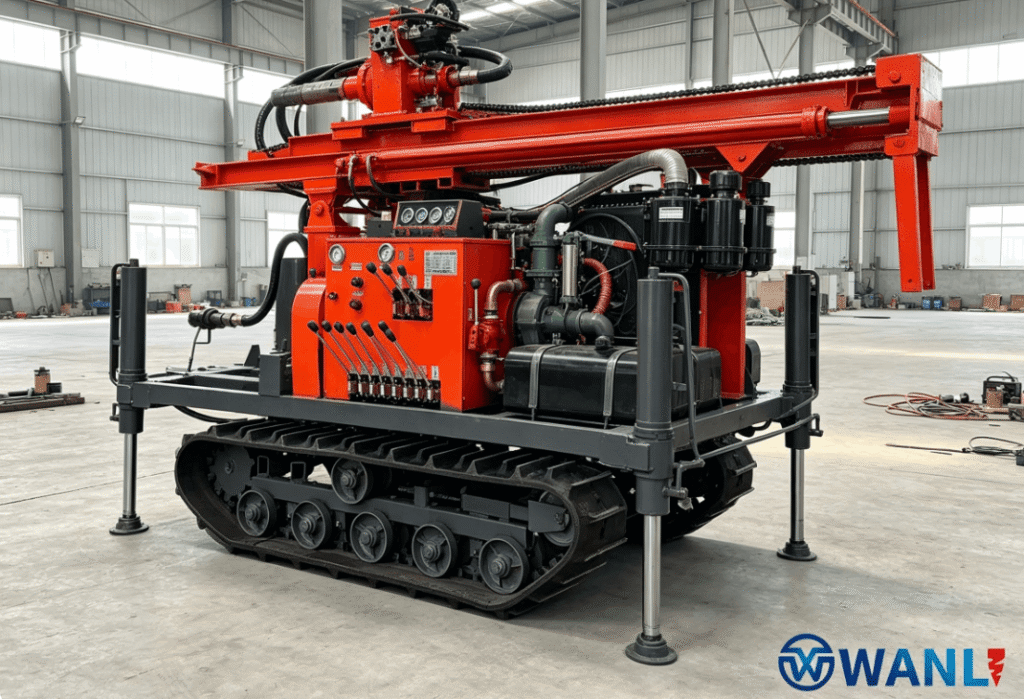
Comparison of Drilling Rig Platforms
The mobility of a borehole drilling rig impacts logistics costs and site accessibility.
| Feature | Crawler-Mounted (Rubber/Steel) | Trailer-Mounted / Truck-Mounted |
| Terrain Suitability | Excellent for soft soil, mud, and slopes. | Limited to graded roads and firm ground. |
| Stability | High; low center of gravity. | Medium; requires heavy outriggers. |
| Logistics | Needs a flatbed trailer for long-distance transport. | Can be towed or driven directly to the site. |
| Set-up Time | Very fast (self-propelled on-site). | Longer (requires leveling and hitching). |
| Ideal Use Case | Remote mining, mountain wells, construction sites. | Urban water wells, farm irrigation with road access. |
Geological Constraints and Bit Selection
A rig is only as effective as its interface with the ground. Professional operators must match the borehole drilling rig’s power to the expected Protodyakonov hardness (f-scale) of the rock.
- Soft Strata (Sand/Soil): Use a three-wing alloy bit or a PDC (Polycrystalline Diamond Compact) bit with mud circulation.
- Medium Hardness: Roller bits are standard for balanced durability and speed.
- Hard Rock (Quartzite/Granite): DTH hammers with tungsten carbide buttons are mandatory. This requires the rig to be equipped with a high-pressure air compressor (typically 1.7 to 2.5 MPa).
Commercial ROI: Beyond the Purchase Price
From a manufacturing and B2B perspective, the “cheapest” rig often has the highest Total Cost of Ownership (TCO). When evaluating suppliers like SDWanli, consider the following commercial factors:
- Component Standardality: Does the rig use international hydraulic valves and pumps? Using standard parts ensures that if a seal fails in a remote location, a replacement can be sourced locally rather than waiting weeks for an OEM shipment.
- Fuel Efficiency vs. Penetration Rate: A rig that drills 20% faster but consumes 50% more fuel may be less profitable in regions with high diesel costs.
- Customization Capability: For specialized borehole projects (like geothermal loops), the ability to customize the winch capacity or the stabilizer outriggers is a critical value-add from the manufacturer.
Operational Safety and Compliance
In the modern regulatory environment, rigs must meet specific safety standards. Key features to look for include:
- Emergency Stop Systems: Accessible from the operator’s console and the drill floor.
- Pressure Relief Valves: To prevent hydraulic bursts under extreme load.
- Certifications: Ensure the manufacturer adheres to ISO 9001 and CE standards for structural integrity.
Strategic Selection Guidance
For contractors evaluating the SDWanli product lineup, the selection should follow this logic:
- For Residential/Farm Wells (depth <200m): Lightweight crawler rigs with 150-200mm hole diameters offer the best balance of price and maneuverability.
- For Industrial/Geothermal (depth 300m-600m): Heavy-duty pneumatic rigs with high-torque rotation heads and 25-ton lifting capacities are required to handle the increased drill string weight and diameter requirements.
FAQ
Q: What is the average lifespan of a borehole drilling rig?
A: With professional maintenance, a high-quality hydraulic rig has a service life of 10–15 years. The diesel engine typically requires an overhaul at 8,000–10,000 hours, while hydraulic pumps may need replacement or re-sealing every 3,000–5,000 hours depending on the environment.
Q: Can I use a water well rig for core drilling in mining?
A: While possible, it is not ideal. Water well rigs are designed for speed and hole diameter, whereas core drilling requires higher RPMs and specialized wireline systems to retrieve intact geological samples.
Q: What is the typical Lead Time for a custom-configured rig?
A: For standard crawler models, lead times are usually 15–30 days. For custom truck-mounted systems or rigs with specific engine requirements (e.g., Euro V compliance), lead times can extend to 45–60 days.
Q: Does air pressure affect the depth of a borehole?
A: Directly. As the hole gets deeper, the “back pressure” from groundwater increases. You need an air compressor that can overcome this hydrostatic head. For every 10 meters of water in the hole, you need approximately 1 bar (0.1 MPa) of air pressure just to clear the water.
Reference Sources
- American Petroleum Institute (API): Standards for drill pipe threading and casing integrity.
- International Society for Rock Mechanics (ISRM): Rock hardness and drillability index standards.
- ISO 9001:2015: Quality management systems for heavy machinery manufacturing.
- National Ground Water Association (NGWA): Best practices for water well construction and rig safety.