Geological surveys serve as the foundational intelligence for civil engineering, mining, and environmental protection. At the heart of this intelligence-gathering process is borehole drilling equipment. Unlike standard construction drilling, geological survey equipment is designed with a specific mandate: to provide an accurate, undisturbed “window” into the Earth’s subsurface.
For engineers and project managers, selecting the correct drilling rig is not merely a matter of reaching a target depth; it is about ensuring the integrity of the geological data recovered. This article provides a technical overview of the machinery, methodologies, and selection criteria essential for successful subsurface exploration.
What is Geological Borehole Drilling?
Geological borehole drilling is the process of creating narrow, deep vertical or inclined shafts in the ground to extract mineral samples, evaluate soil mechanics, or map stratigraphic layers. While various industries use drilling, a “geological survey” focuses on data acquisition rather than simple excavation.
The equipment used must be capable of handling diverse lithologies—from soft alluvial clays to high-strength metamorphic rock. Depending on the project’s goal, the drilling might be “exploratory” (mapping the area) or “geotechnical” (testing the ground for structural stability).
Why Distinguish Between Core and Non-Core Drilling?
In the context of geological surveys, the primary distinction in equipment functionality lies between core recovery and non-core penetration.
1. How Do Coring Drilling Rigs Work?
Coring is the gold standard for geological surveys. A coring drilling rig uses a hollow drill bit—often impregnated with industrial diamonds—to cut a cylindrical sample of rock.
Sample Integrity: The “core” remains intact inside an inner tube, allowing geologists to see the exact sequence of rock layers (stratigraphy) and identify fractures or mineral veins.
Applications: Mineral exploration, dam site investigation, and deep-seated geological mapping.
2. When is Non-Coring/Destructive Drilling Used?
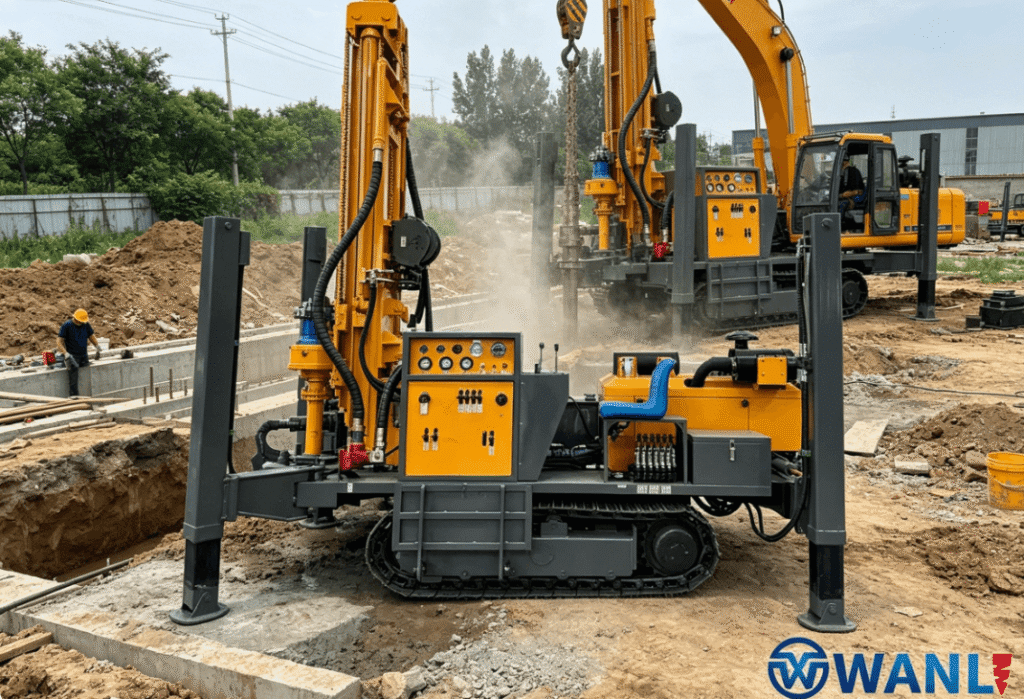
In some surveys, such as those for groundwater mapping or simple depth-to-bedrock checks, water well drilling rigs or rotary rigs are used. These machines grind the rock into small chips (cuttings), which are then flushed to the surface by air or drilling fluid.
Data Method: Geologists analyze the “cuttings” rather than a solid piece of rock. While faster and often more cost-effective for deep penetration, it provides less structural detail than coring.
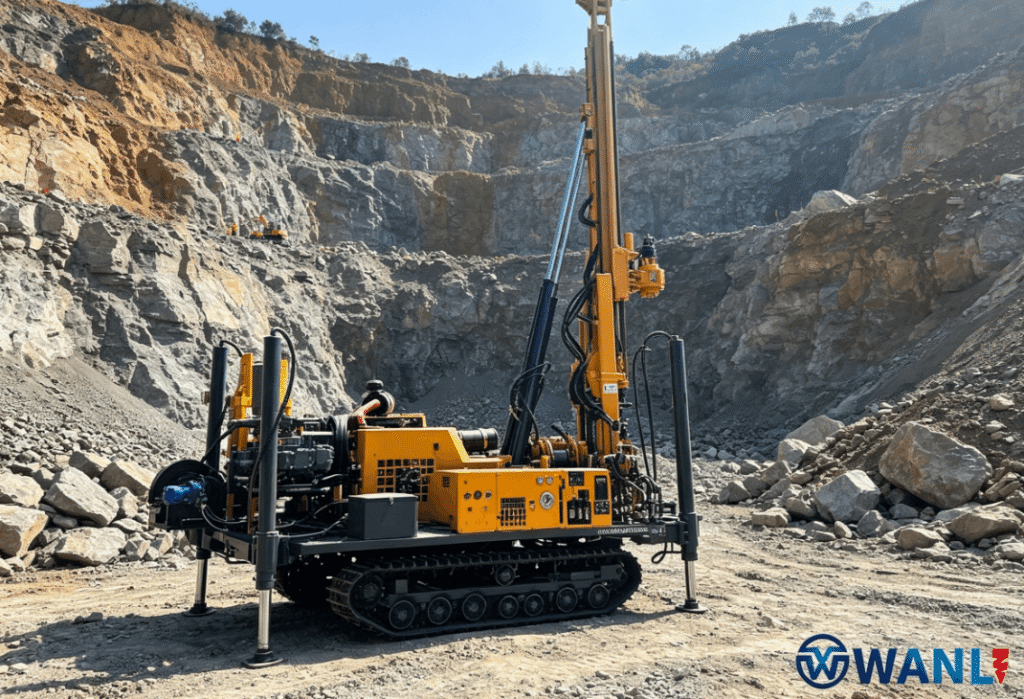
What are the Critical Components of a Geological Drill Rig?
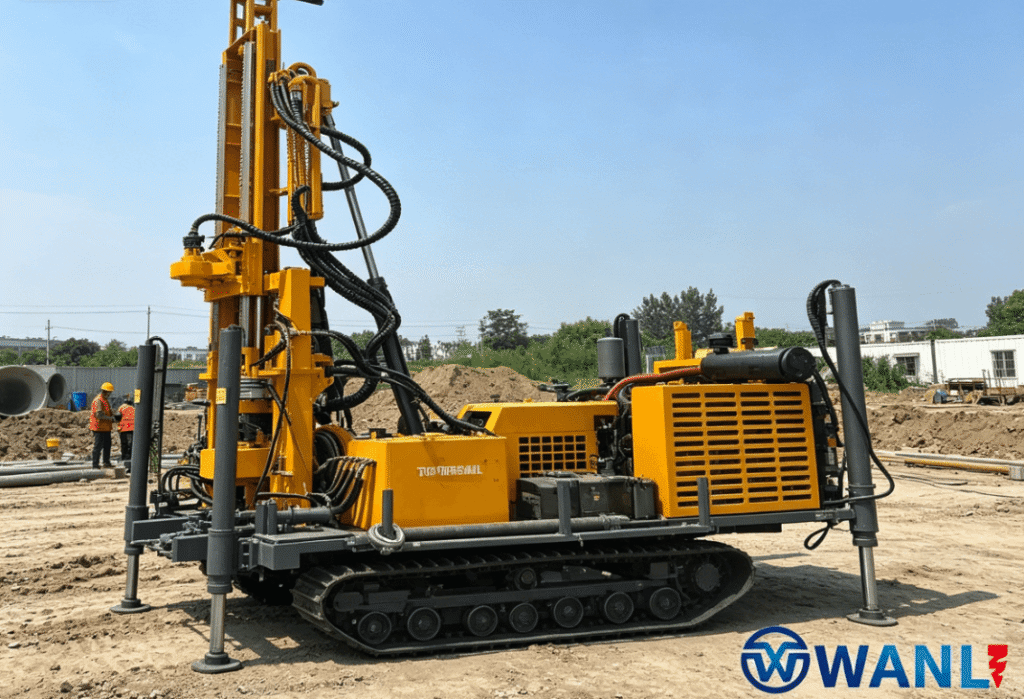
Understanding the anatomy of borehole equipment is vital for evaluating its capability on a job site. A professional-grade geological rig typically consists of several integrated systems:
| Component | Technical Function | Importance in Surveys |
| The Power Pack | Diesel or electric engine providing hydraulic energy. | Determines the torque available for hard rock penetration. |
| The Mast (Derrick) | Vertical structure supporting the drill string. | Must withstand high “pull-back” forces during extraction. |
| Rotary Head | The mechanism that rotates the drill string. | Variable speed control is essential for different soils. |
| The Drill String | A series of hollow rods connected to the bit. | Must be high-strength to prevent snapping at depth. |
| Mud Pump | Circulates fluids or air down the hole. | Cools the bit and removes debris while stabilizing walls. |
Common Methodologies in Geological Surveys
The choice of equipment is often dictated by the “drilling method,” which is selected based on the expected ground conditions.
Diamond Core Drilling: Utilizes a diamond-encrusted bit. It is the preferred method for hard rock exploration where high-quality samples are mandatory.
Reverse Circulation (RC) Drilling: Uses dual-wall drill rods. Air is blown down the outer gap, and cuttings are forced up the inner tube to prevent contamination.
Hollow Stem Auger (HSA) Drilling: Primarily used in environmental surveys for soft soils. The auger acts as a casing to prevent the borehole from collapsing.
Down-the-Hole (DTH) Hammer: A pneumatic hammer located behind the drill bit. It is exceptionally efficient in fractured rock but does not provide a solid core.
Which Factors Influence Equipment Selection?
When engineers evaluate borehole drilling equipment for a specific geological project, they must balance three technical constraints:
Lithology (Rock Hardness): Soft sediments require augers, while igneous rocks like granite require high-speed diamond coring rigs with hydraulic feed systems.
Depth Requirements: Equipment is rated by capacity. A rig designed for 100 meters lacks the hoist capacity and torque required for 1,000-meter mineral surveys.
Site Accessibility: For surveys in remote mountainous regions, modular or man-portable rigs are required. Urban sites often use truck-mounted units for rapid mobilization.
Summary
In the field of geological surveys, the borehole is the only direct evidence of what lies beneath the surface. Using underpowered or inappropriate equipment doesn’t just slow down a project—it risks the loss of critical geological data through sample vibration, contamination, or borehole collapse. Professional-grade machinery ensures that the transition from field exploration to laboratory analysis is scientifically sound.
FAQ
1. What is the difference between a borehole and a well?
A borehole is a general term for any narrow shaft bored into the ground. A well is a specific type of borehole completed with casing and screens to extract a resource, such as water or oil.
2. Why is Wireline Coring preferred over Conventional Coring?
Wireline coring allows the inner tube containing the core sample to be hoisted to the surface via a cable through the drill rods. This saves hours of labor compared to pulling the entire drill string.
3. Can a water well rig be used for geological sampling?
Yes, but with limitations. Most water well rigs use rotary or DTH methods that produce chips rather than solid cores. They are not suitable for detailed geotechnical studies where rock structure must be preserved.
4. How does a geologist know which drill bit to use?
The choice is based on the Mohs scale of mineral hardness. Soft soils use augers; medium-hard rocks use Tungsten Carbide (TC) inserts; the hardest formations require impregnated diamond bits.
Reference Sources
ASTM D2113 Standard Practice for Rock Core Drilling and Sampling.
ISO 22475 Geotechnical Investigation and Sampling Methods.
NGWA Guidelines for Best Practices in Ground Water Exploration.