Selecting a water well drilling rig is a capital-intensive decision where technical specifications directly dictate project success. Whether you are an OEM project manager or a geotechnical engineer, understanding the interplay between mechanical power and geological resistance is critical.
A rig’s performance is not defined by a single metric but by the synergy of its hydraulic system, lifting capacity, and torque. For instance, a rig rated for 300 meters in soft soil may struggle at 150 meters in fractured granite if the axial pressure and air compressor compatibility are mismatched.
Core Depth and Diameter Parameters
The most visible water well drilling rig specifications are maximum drilling depth and borehole diameter. These figures represent the machine’s structural limits.
- Drilling Depth: This is a function of the rig’s drawworks capacity and the weight of the drill string. In the SDWanli FY Series, depth capacities range from 180m to 800m.
- Borehole Diameter: Usually ranging from 140mm to 350mm. Larger diameters require significantly higher torque and flushing fluid volume to clear cuttings from the hole.
When evaluating specs, always consider the “sweet spot.” A rig rated for 600m is most efficient at depths between 300m and 450m. Pushing a machine to its maximum depth capacity continuously increases wear on hydraulic seals and the main winch.
Power Systems and Hydraulic Efficiency
In modern drilling, the engine power (kW) and hydraulic system design are the heart of the operation. Most industrial-grade rigs utilize specialized diesel engines, such as those from Yuchai or Cummins, to drive high-pressure hydraulic pumps.
The efficiency of a rig depends on its hydraulic flow rate and pressure. Multi-pump systems allow for simultaneous operations, such as rotating the drill string while activating the leveling jacks. This reduces downtime during pipe changes. For heavy-duty applications like the FY800, a 140kW+ engine is standard to maintain the necessary 24MPa of system pressure.
Mobility and Chassis Design: Crawler vs. Truck-Mounted
Site accessibility is a primary factor in choosing a chassis. The physical footprint of the rig affects its stability and the logistics of mobilization.
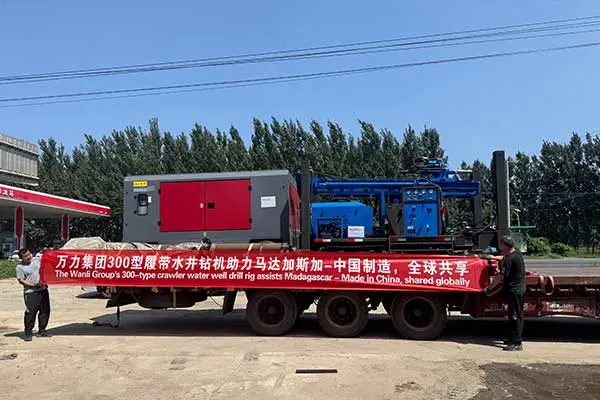
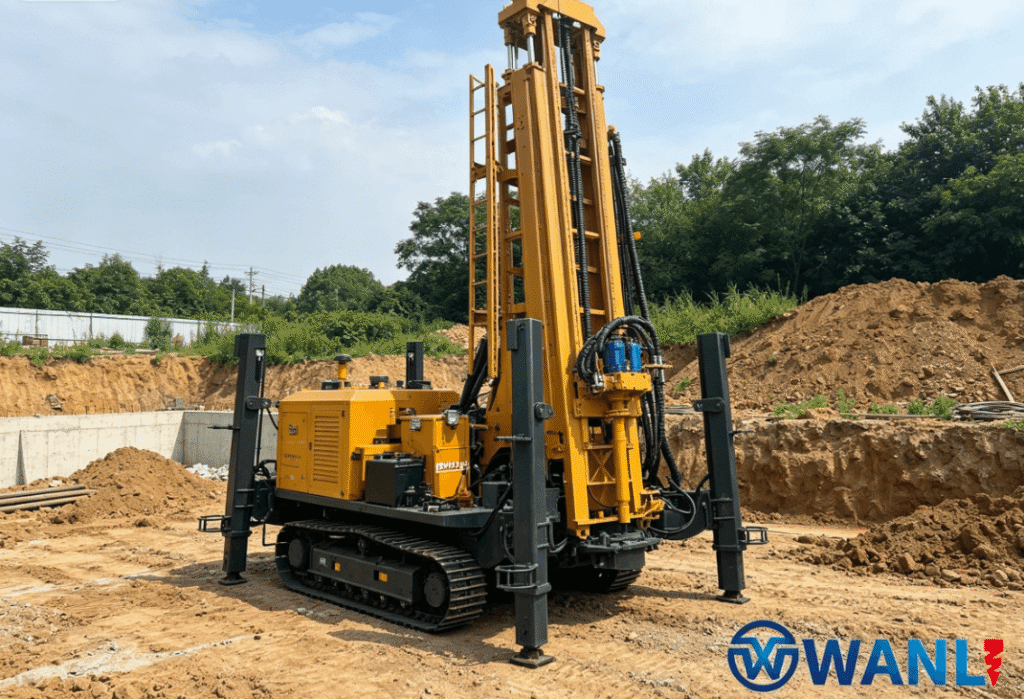
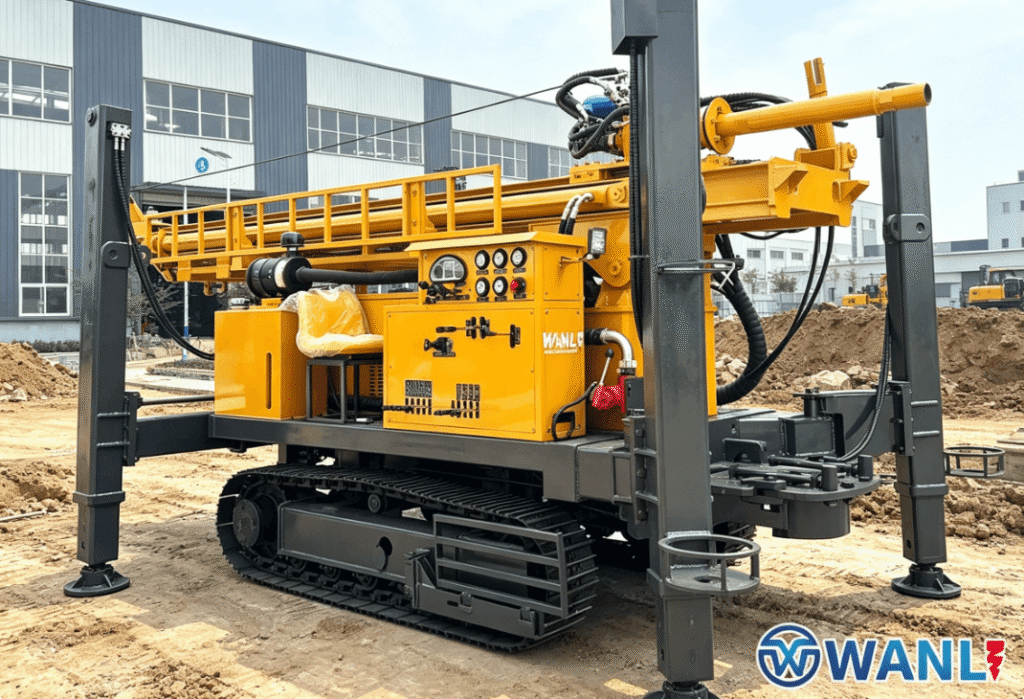
- Crawler-Mounted Rigs: These offer superior “off-road” capability. Steel tracks with rubber pads allow for deployment in muddy or mountainous terrain without the need for extensive site preparation. They provide a low center of gravity, which is essential for high-torque drilling.
- Truck-Mounted Rigs: Ideal for projects spread across large geographic areas. These rigs prioritize rapid transit and are often used in municipal or agricultural emergency relief where speed of arrival is paramount.
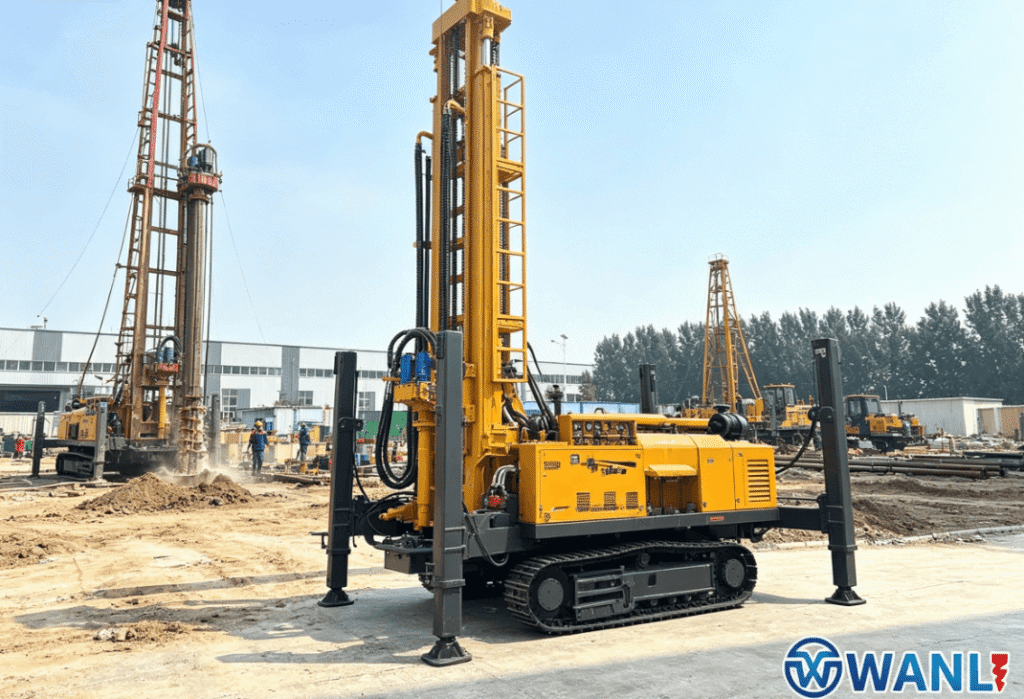
Comparison of Professional Drilling Rig Specifications
To assist in procurement evaluation, the following table summarizes the technical variance across standard industrial models:
| Model Series | Max Depth (m) | Borehole Dia (mm) | Walking Speed (km/h) | Lifting Force (Tons) | Typical Application |
| Light Duty (FY180) | 180 | 140-254 | 2.5 | 12 | Domestic/Farm Wells |
| Medium Duty (FY300) | 300 | 140-305 | 3.0 | 18 | Small Industrial/Irrigation |
| Heavy Duty (FY600) | 600 | 140-325 | 2.2 | 32 | Deep Aquifer/Geothermal |
| Ultra-Deep (FY800) | 800 | 140-350 | 2.0 | 55 | Mine Drainage/Large Scale |
Torque and Rotation Speed (RPM)
Torque is arguably more important than horsepower when drilling through hard rock strata. High torque allows the bit to maintain its “bite” in the formation without stalling.
- Low Speed/High Torque: Essential for large-diameter bits and DTH (Down-The-Hole) hammer drilling in basalt or granite.
- High Speed/Low Torque: Preferred for rotary drilling with mud circulation in loose sand or clay layers.
Most high-spec rigs now feature variable speed motors, allowing operators to adjust the RPM (typically 40-110 RPM) based on real-time feedback from the borehole.
Feed and Lifting Systems
The “Feed” specification refers to the axial pressure applied to the drill bit. In hard rock, weight-on-bit (WOB) is necessary to ensure the DTH hammer functions correctly. Conversely, the “Lifting” specification defines the rig’s ability to pull the drill string out of the hole, especially when facing “stuck pipe” scenarios or high hydrostatic pressure.
Advanced rigs use a telescopic mast and long-stroke oil cylinders to minimize the number of pipe connections, which directly increases the meters-per-hour (MPH) drilling rate.
Commercial Evaluation for B2B Procurement
When sourcing from manufacturers like SDWanli, buyers should look beyond the data sheet. Real-world reliability is found in the quality of the valves, the heat dissipation capacity of the hydraulic oil cooler, and the ease of access for daily maintenance.
For OEM/ODM requirements, verify if the manufacturer can adapt the rig for specific high-altitude engines or reinforced masts for oversized casing operations. Ensuring the rig meets local environmental and safety certifications (such as CE or ISO 9001) is non-negotiable for large-scale construction compliance.
FAQ
Q: How do I match an air compressor to my drilling rig’s specifications?
A: The air compressor must match the rig’s DTH hammer requirements. For a 200m rig using a 6-inch hammer, you typically need a compressor providing at least 250 PSI (17 bar) and 600-750 CFM to ensure effective chip removal.
Q: Why does the lifting force need to be so much higher than the weight of the drill pipes?
A: Friction and “suction” in the borehole can create significant resistance. A rig with a 20-ton lifting force is often required to pull a 5-ton drill string safely to account for hole collapse or sticky formations.
Q: Can a crawler-mounted rig be customized for specialized geotechnical sampling?
A: Yes. Many commercial rigs can be fitted with auxiliary winches, SPT (Standard Penetration Test) hammers, or core barrels by adjusting the hydraulic circuit specifications.
Q: What are the maintenance intervals for high-pressure hydraulic rigs?
A: Generally, hydraulic oil filters should be replaced every 500 hours, and the main pump performance should be tested annually. In high-dust environments, air intake filters require daily inspection.
Reference Sources
- ISO 21467: Earth-moving machinery and mobile road construction machinery — Safety — Drilling and foundation equipment.
- ASTM D1452 / D1452M: Standard Practice for Soil Exploration and Sampling by Auger Borings.
- NGWA (National Ground Water Association): Best Practices for Drill Rig Operation and Maintenance.
- SGS Certification: Industrial machinery safety and performance verification standards.