Borehole drilling is a fundamental engineering process that bridges the gap between surface planning and subsurface reality. Whether the objective is extracting potable water, conducting mineral exploration, or performing geotechnical site investigations, the success of the project rests entirely on the selection of the correct borehole drilling equipment.
In the industrial drilling sector, equipment is not a “one size fits all” solution. The mechanical requirements for penetrating hard igneous rock differ vastly from those needed to stabilize a hole in loose, sandy aquifers. Understanding the mechanical nuances, power transmission systems, and tooling configurations is essential for any project manager or field engineer.
Defining Modern Borehole Drilling Equipment
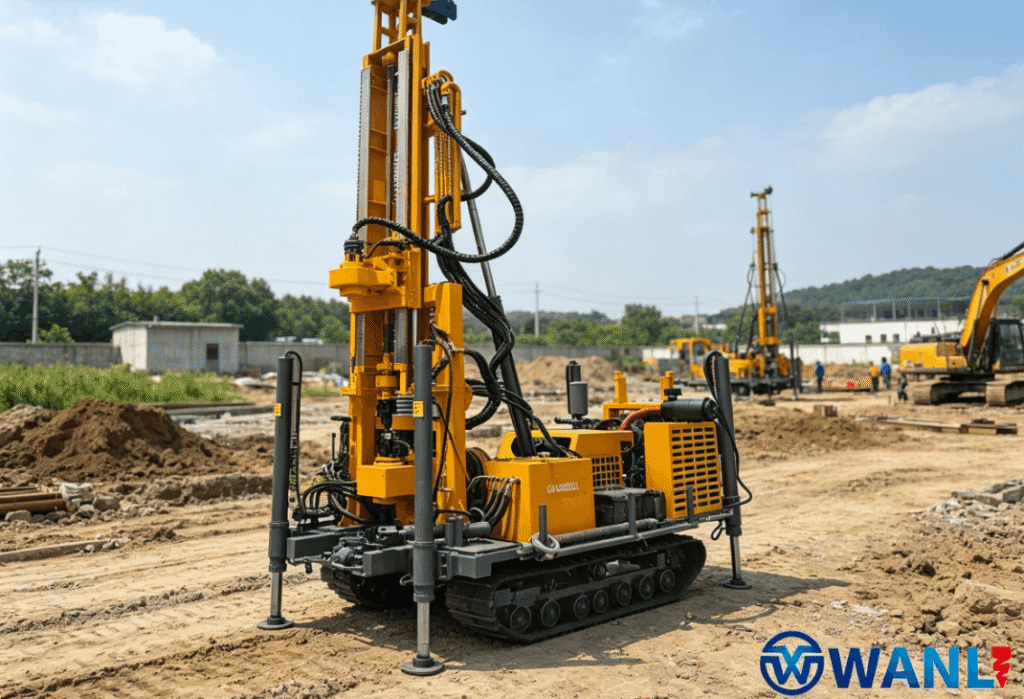
Borehole drilling equipment refers to a specialized assembly of machinery designed to penetrate the earth’s crust to create vertical or angled shafts. Unlike shallow excavation tools, these rigs are engineered to manage significant torque and axial pressure (pull-down/pull-back force) while maintaining hole integrity at depths ranging from 50 to over 2,000 meters.
Modern rigs are typically classified by their power source—usually hydraulic or mechanical—and their mounting method, such as crawler-mounted for rugged terrain or truck-mounted for rapid mobilization across highway networks.
Core Classifications: Coring vs. Water Well Rigs
In the field, equipment is primarily categorized by its end-use application, which dictates the drilling method and the nature of the “sample” or “product” retrieved.
Coring Drilling Rigs
Coring rigs are precision instruments used primarily in geological exploration and mining. Their goal is not just to make a hole, but to extract a continuous, undisturbed cylindrical sample of the strata (a core).
Mechanism: These rigs utilize diamond-impregnated bits and double-tube or triple-tube core barrels.
Technical Focus: High rotation speeds (RPM) and lower torque compared to water well rigs. Precision in “core recovery” is the primary KPI (Key Performance Indicator).
Application: Mineral prospecting, site investigation for dam construction, and environmental soil sampling.
Water Well Drilling Rigs
Water well rigs are built for diameter and depth. Their primary objective is to reach an aquifer and install a casing and screen system to allow for water extraction.
Mechanism: These often employ heavier torque and use either Mud Rotary or Down-The-Hole (DTH) air percussion methods.
Technical Focus: High hoisting capacity (to manage heavy casing strings) and high torque for larger diameter holes.
Application: Agricultural irrigation, municipal water supply, and geothermal heating loops.
Key Technical Components of a Drilling Rig
To evaluate borehole drilling equipment effectively, one must look beyond the exterior and understand the functional modules that drive performance.
| Component | Technical Function | Industrial Consideration |
| Power Head / Top Drive | Provides rotation and pull-down force to the drill string. | Hydraulic top drives offer better variable speed control than mechanical rotary tables. |
| Mast (Derrick) | Supports the weight of the drill string and casing. | Must be rated for the maximum “pull-back” weight to prevent structural failure during deep hauls. |
| Mud Pump / Compressor | Circulates drilling fluid or air to remove “cuttings” from the hole. | Essential for cooling the bit and stabilizing the borehole walls in loose formations. |
| Crawler Chassis | Provides mobility in off-road or mountainous environments. | Steel tracks are standard for durability, while rubber tracks are used to protect existing infrastructure. |
The Mechanics of Subsurface Penetration
The choice of borehole drilling equipment is heavily influenced by the “Drilling Method.” Field engineers must match the method to the lithology (rock type) of the site.
DTH (Down-The-Hole) Pneumatic Drilling
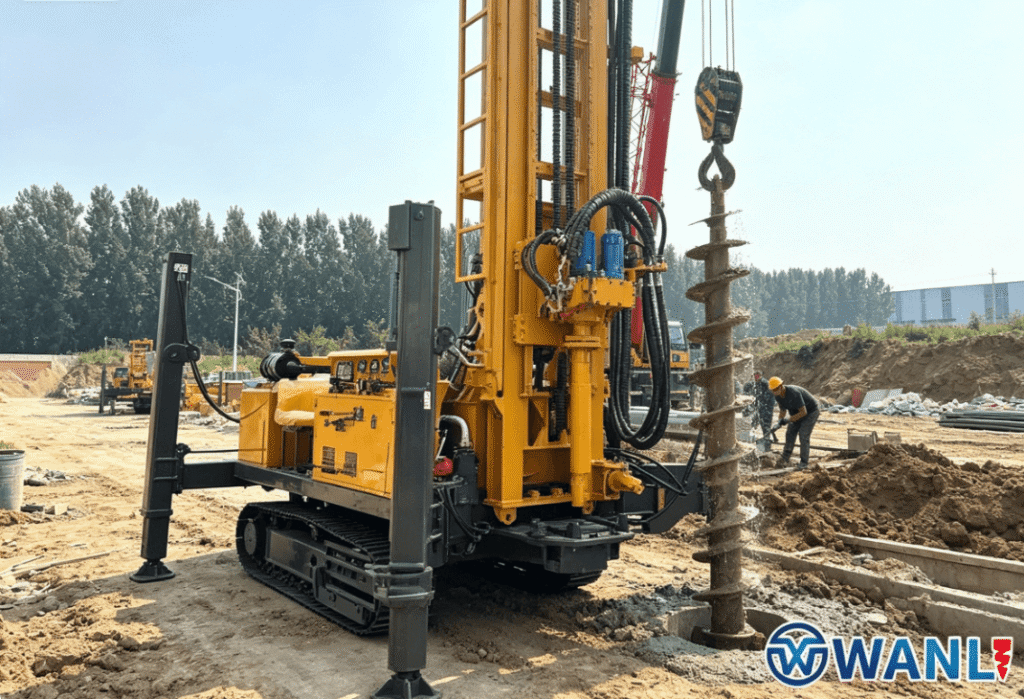
This method uses high-pressure compressed air to drive a pneumatic hammer located directly behind the drill bit. It is the gold standard for hard rock formations (granite, basalt). The impact energy shatters the rock, while the air exhaust carries the chips to the surface.
Mud Rotary Drilling
In softer, unconsolidated formations like clay or silt, mud rotary is preferred. A viscous “drilling mud” (often bentonite-based) is pumped down the drill pipe. This mud serves three purposes: it cools the bit, carries cuttings to the surface, and creates a “filter cake” on the borehole walls to prevent collapse.
Wireline Coring
For deep geological exploration, wireline coring allows the operator to retrieve the core sample without pulling the entire drill string out of the hole. This dramatically increases efficiency at depths exceeding 300 meters.
Strategic Selection: Matching Equipment to Terrain
Selecting borehole drilling equipment requires a balance between technical capability and logistical constraints. An oversized rig for a shallow project increases fuel costs and mobilization complexity, while an underpowered rig risks “getting stuck in the hole” (STUCK pipe), which can lead to total project loss.
Depth and Diameter Requirements: Calculate the total weight of the drill string plus the casing. Ensure the rig’s hoisting capacity has a 20% safety margin.
Geological Profile: If the site consists of “overburden” (mixed soil and boulders), a multi-functional rig capable of both mud rotary and DTH is required.
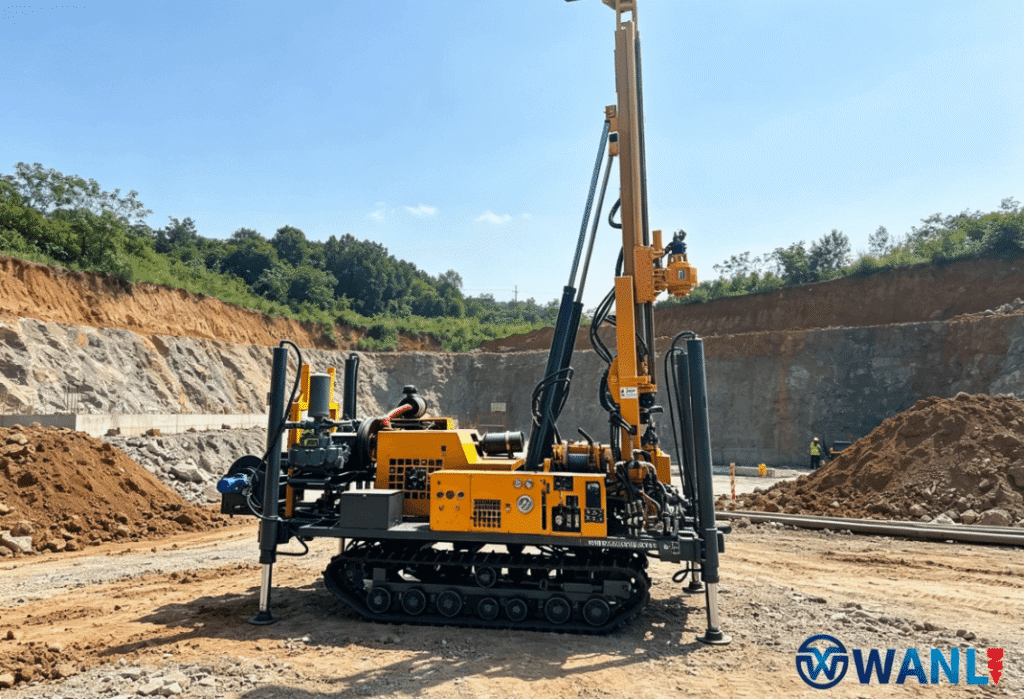
Portability and Footprint: In urban environments or remote mountainous regions, modular or compact crawler rigs are necessary. For example, specialized coring drilling rigs are often designed to be disassembled for transport to remote mining sites via small aircraft or pack animals.
Power Transmission: Modern hydraulic systems are generally preferred over mechanical drives due to their ability to provide “fine-feed” control, which is critical when drilling through delicate or fractured strata.
Maintenance and Operational Longevity
Industrial borehole drilling equipment operates in abrasive, high-vibration environments. A proactive maintenance schedule is the only way to ensure ROI. Key focus areas include:
Hydraulic Filtration: Contaminated oil is the leading cause of pump failure.
Drill Pipe Thread Care: Using proper thread grease (dope) prevents “galling” and ensures the string can be disassembled.
Cooling Systems: Rigs operating in tropical or desert climates require oversized radiators to prevent hydraulic fluid thinning.
Summary of Equipment Evolution
The industry is moving toward automation and increased safety. Modern rigs now feature “hands-free” rod handling systems, which reduce the risk of injury to the drill crew. Furthermore, digital telemetry now allows engineers to monitor drilling parameters like ROP (Rate of Penetration) and “Weight on Bit” in real-time from remote offices.
By understanding the distinct differences between exploration-focused coring rigs and extraction-focused water well rigs, and by matching the drilling method to the specific geology, operators can ensure higher efficiency and lower “cost-per-meter” in their drilling programs.
FAQ
Q1: What is the difference between a borehole and a well?
A: In technical terms, a borehole is the narrow shaft bored into the ground. It becomes a “well” once it is completed with casing, screens, and a pump system for the purpose of extracting water, oil, or gas.
Q2: How deep can standard water well drilling rigs go?
A: While depth depends on the specific model, most industrial-grade truck or crawler-mounted water well rigs are designed for depths between 200 and 600 meters. Specialized deep-well rigs can exceed 1,000 meters.
Q3: Why is air drilling used instead of water?
A: Air drilling (DTH) is significantly faster in hard rock. It also prevents “contamination” of the formation, which is vital when the goal is to identify the exact depth of a water-bearing fracture.
Q4: Can a coring rig be used for water well drilling?
A: While technically possible for small-diameter domestic wells, it is generally inefficient. Coring rigs are optimized for RPM and sample integrity, whereas water well rigs are optimized for torque and large-diameter hole cleaning.
Q5: What determines the “lifespan” of a drill bit?
A: Bit life is determined by the rock’s abrasiveness, the cooling efficiency of the drilling fluid (mud or air), and the “Weight on Bit” (WOB) applied by the operator.
Reference Sources
International Society for Soil Mechanics and Geotechnical Engineering (ISSMGE): Technical standards for site investigation and coring protocols.
American Ground Water Trust (AGWT): Guidelines for water well construction and equipment safety.
ISO 22475-1: Geotechnical investigation and testing — Sampling methods and groundwater measurements.
National Ground Water Association (NGWA): Industry whitepapers on drilling fluid management and rig maintenance.