Selecting the right drilling platform is a pivotal decision that dictates the ROI of a water resource project. While truck-mounted and trailer-mounted units have their place in urban utility work, the crawler water well drilling rig has become the industry standard for contractors facing unpredictable terrain, remote locations, and demanding geological formations.
The transition toward crawler-mounted systems isn’t merely a trend; it is a response to the need for higher torque, better ground stability, and self-propelled mobility that eliminates the logistical burden of auxiliary towing vehicles.
Why Terrain Adaptability Defines Project Success
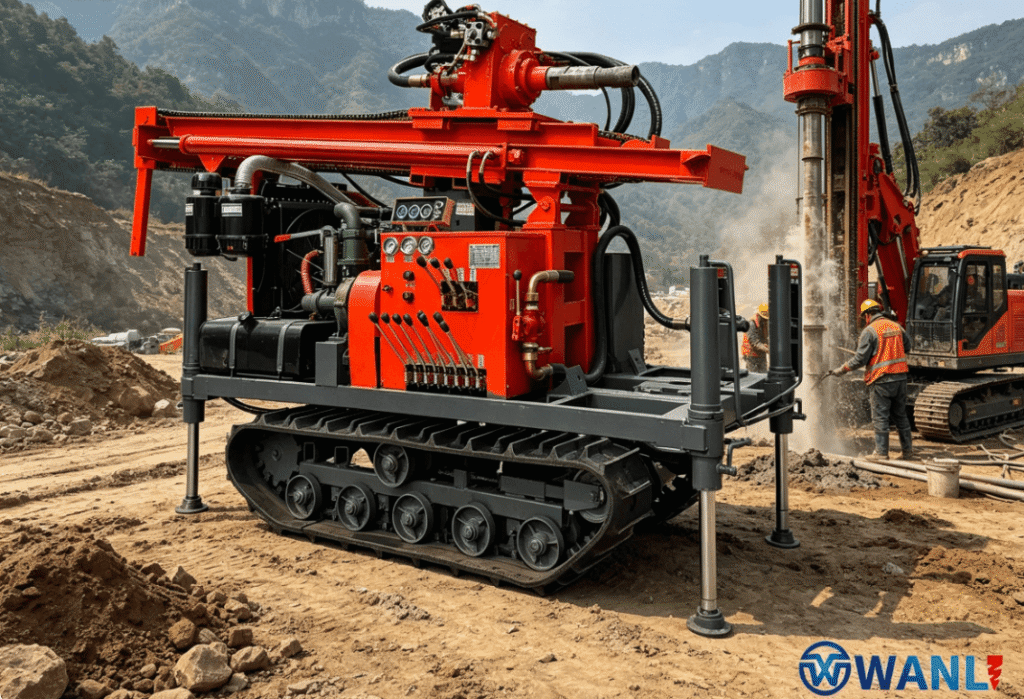
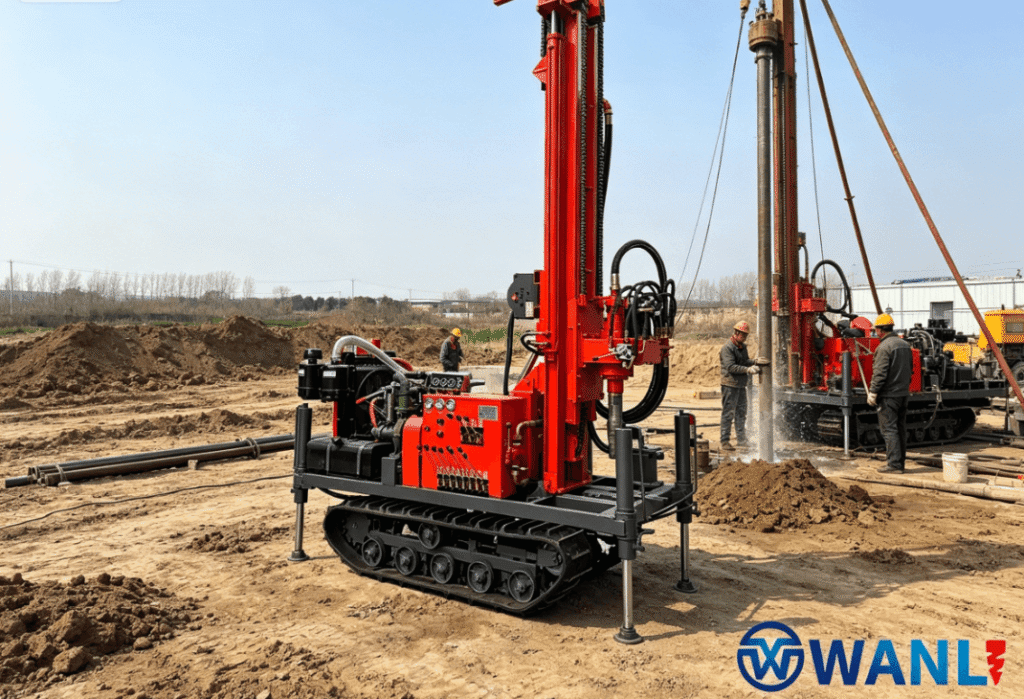
In professional well drilling, the “last mile” to the borehole site is often the most difficult. Rural irrigation projects or mountainous geothermal explorations rarely offer paved access. A crawler water well drilling rig utilizes a heavy-duty track system—available in both steel and rubber—to distribute machine weight over a larger surface area.
From an engineering perspective, this lower ground-bearing pressure (GBP) is critical. It allows the rig to traverse soft soils, mud, or sand where a wheeled vehicle would inevitably sink or lose traction. For operators, this means:
- Reduced Site Preparation: Minimal need for temporary access roads or heavy leveling before the rig arrives.
- High Gradeability: Most professional-grade crawler rigs can handle inclines up to 25–30 degrees, allowing for placement on hillsides or uneven embankments.
- Zero-Turn Maneuverability: The ability of tracks to counter-rotate allows the rig to pivot in its own length, a vital feature when working in confined residential backyards or dense forest clearings.
Technical Superiority: Integration of Hydraulic Systems
Modern crawler rigs, such as those engineered by Shandong Wanli, integrate the power of the diesel engine directly into a sophisticated hydraulic manifold. Unlike older mechanical drive systems, a fully hydraulic crawler water well drilling rig offers infinitely variable speed control and higher “pull-back” force.
Key Component Advantages:
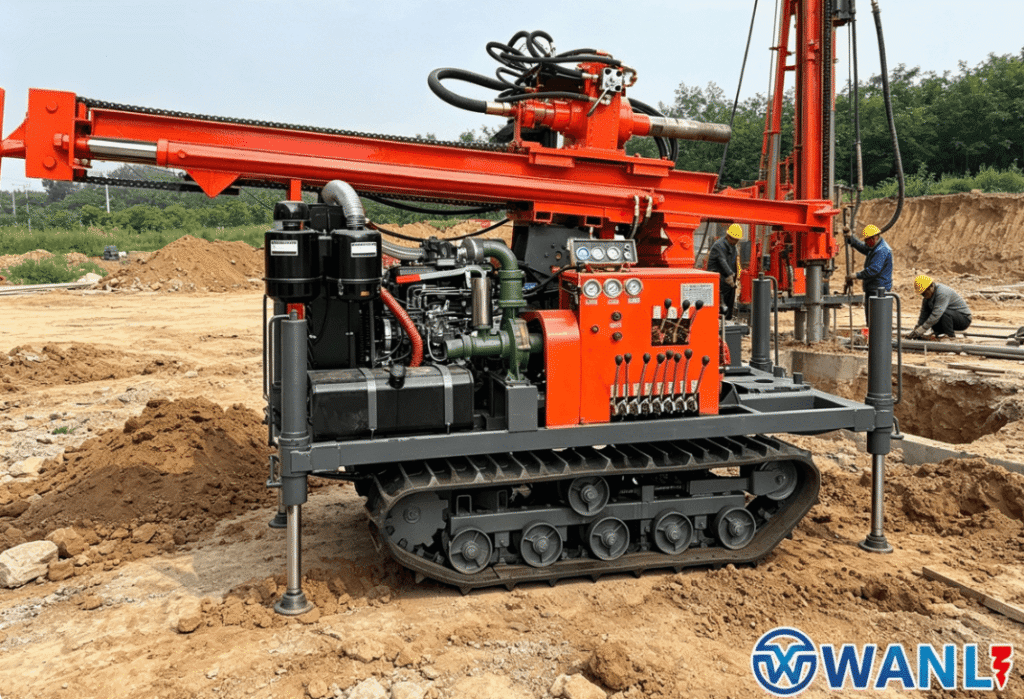
Hydraulic Outriggers: Most crawler units feature four high-strength hydraulic leveling legs. These aren’t just for stability; they allow the rig to be leveled on uneven ground in minutes, ensuring the borehole remains perfectly vertical—a prerequisite for long-term pump performance.
Top-Drive Rotation Heads: By utilizing a top-drive hydraulic head rather than a traditional rotary table, these rigs achieve higher torque. This is essential when switching between mud drilling in soft layers and DTH (Down-the-Hole) hammer drilling in hard rock.
Telescopic Masts: Crawler rigs often feature compact transport profiles. Once on-site, the hydraulic mast elevates and often telescopes, providing the stroke length required for 3-meter or 6-meter drill pipes without the massive footprint of a truck.
Comparative Analysis: Crawler vs. Trailer-Mounted Rigs
For procurement managers and fleet owners, the choice often comes down to the specific logistics of their service area.
| Feature | Crawler Water Well Drilling Rig | Trailer-Mounted Rig |
| Mobility | Self-propelled; independent on-site | Requires towing vehicle |
| Ground Pressure | Low (Spread across tracks) | High (Concentrated on tires) |
| Setup Time | Fast (Hydraulic leveling) | Moderate (Manual/Hydraulic jacks) |
| Off-road Capability | Exceptional (Mud, Rock, Sand) | Limited (Hard-packed soil only) |
| Stability | High (Low center of gravity) | Moderate (Higher CG) |
| Maintenance | Higher (Track tensioning required) | Lower (Standard tire/axle care) |
Operational Efficiency and Labor Costs
A significant commercial advantage of the crawler water well drilling rig is the reduction in support personnel and auxiliary equipment. Because the rig is self-contained, a single operator can often track the machine off a low-boy trailer and navigate it to the borehole location using a remote control or side-mounted control station.
Furthermore, these rigs are designed to be “dual-purpose.” They can easily toggle between air compressor-driven DTH drilling for granite or basalt and mud pump-driven rotary drilling for sedimentary layers. This versatility means a contractor doesn’t need to own two different machines to service a diverse geographic region.
Engineering for Durability: Materials and Maintenance
In the field, downtime is the primary profit-killer. Crawler rigs are built with a “chassis-first” mentality. The undercarriage is typically constructed from high-tensile steel to withstand the torsional stresses of drilling at depths of 200m to 600m.
To maintain peak performance, fleet managers should focus on:
- Track Tensioning: Ensuring the grease-adjusted tensioners are checked weekly to prevent de-tracking.
- Hydraulic Fluid Filtration: Given the high-pressure environment (often exceeding 20Mpa), using high-grade anti-wear hydraulic oil is non-negotiable.
- Engine Maintenance: Most Tier 3 or Tier 4 engines used in these rigs require consistent air filter changes, especially when drilling with air compressors in dusty environments.
Selecting the Right Rig for Your Operation
When evaluating a crawler water well drilling rig for purchase, the decision should be guided by your primary drilling depth and hole diameter requirements. Machines like those in the Wanli Drilling Rig Series offer a spectrum of power—from compact units for domestic wells to heavy-duty rigs capable of reaching 600 meters for industrial or municipal water supply.
Procurement Tip: Always verify the “Pull-up Force” and “Max Torque” specifications. A rig may have the engine power, but without the hydraulic capacity to pull 500 meters of heavy steel pipe out of a wet hole, the engine power is irrelevant.
FAQ
1. Can a crawler water well drilling rig be used on residential driveways?
Yes, but it is recommended to use “rubber track” versions or rubber track pads over steel tracks. Steel tracks can scar asphalt or crack concrete due to the weight and pivot friction of the machine.
2. What is the maximum depth a crawler rig can reach?
This depends on the model. Light crawler rigs typically reach 150m-200m, while heavy-duty industrial crawler rigs can exceed 600m-1000m depending on the drill pipe diameter and geological conditions.
3. Is it difficult to transport a crawler rig between job sites?
While they are self-propelled on-site, they are not street-legal. They must be transported via a flatbed truck or a low-boy trailer. However, their compact footprint often makes them easier to load than bulky truck-mounted units.
4. How does the rig perform in extremely cold climates?
Most professional manufacturers include cold-start heaters for the diesel engine and specialized hydraulic oil heaters. It is crucial to use low-viscosity hydraulic fluid in Arctic or high-altitude conditions to prevent pump cavitation.
5. Which is better: Air drilling or Mud drilling?
A quality crawler rig can do both. Air drilling (with an external compressor) is faster and cleaner for hard rock. Mud drilling is essential for “unconsolidated” formations (like sand or gravel) to prevent the hole from collapsing.
Reference Sources
- International Ground Source Heat Pump Association (IGSHPA): Standards for drilling stability and borehole integrity.
- American Ground Water Trust (AGWT): Technical resources on well construction and rig selection.
- ISO 21467:2004: Earth-moving machinery and drilling equipment safety requirements.
- SGS Technical Reports: Performance testing on hydraulic pressure systems in crawler-mounted machinery.